
Comparison of the Effectiveness of Cognitive-Behavioral Therapy and Mindfulness Therapy on Craving in Methamphetamine-Addicted Patients
DOI:
https://doi.org/10.61838/kman.hn.3.2.7Keywords:
Mindfulness, Cognitive-Behavioral Therapy, Craving, AddictionAbstract
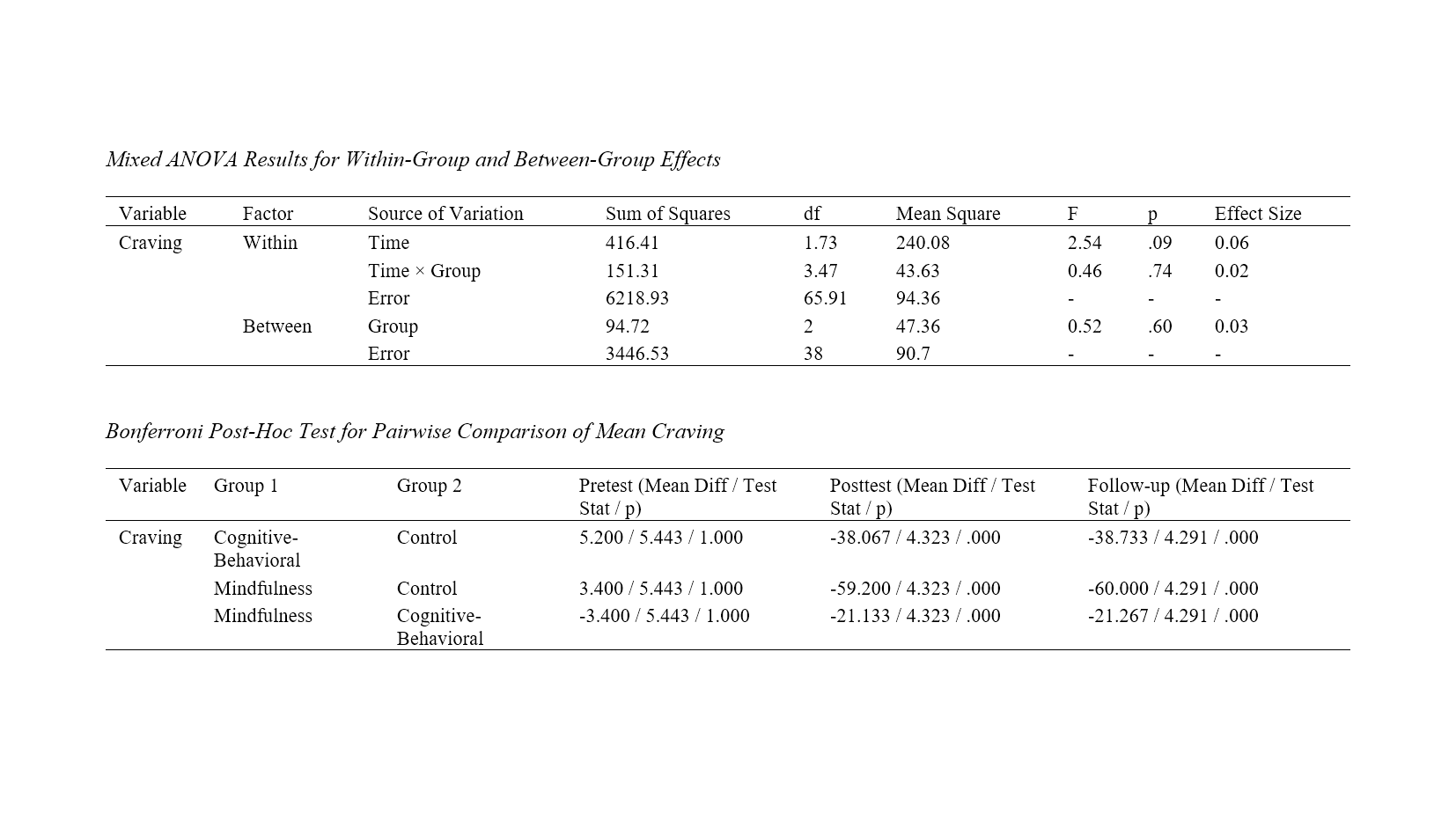
The present study aimed to compare the effectiveness of Cognitive-Behavioral Therapy (CBT) and Mindfulness Therapy on the craving of methamphetamine-addicted patients. The research method was quasi-experimental with a pretest-posttest control group design and a follow-up period (three months). The statistical population included all addicts who referred to addiction treatment clinics in Tehran from August to February 2021. A total of 45 participants were selected through purposive sampling and were randomly assigned to two experimental groups and one control group. The research instrument was the Craving Beliefs Questionnaire by Wright et al. (1993). The interventions, based on Free's CBT protocol (2008) and Kraft and Williams' mindfulness therapy protocol (2012), were administered over eight sessions to the experimental groups, while the control group did not receive any intervention. Data were analyzed using repeated measures ANOVA. The findings indicated a significant difference between the groups in posttest and follow-up regarding the craving of methamphetamine-addicted patients (P<0.05). Both therapies had a significant effect on correctly completed categories, perseverative errors, and total errors (P<0.05). Mindfulness therapy was superior to CBT in reducing perseverative errors in the posttest phase (P<0.05). It can be concluded that mindfulness therapy is more effective in reducing cravings in methamphetamine-addicted patients. Therefore, mindfulness therapy can be more widely used in the treatment of substance-dependent individuals.
Keywords: Mindfulness, Cognitive-Behavioral Therapy, Craving, Addiction.
Downloads
References
1. Sadeghi Pour Meybodi M, Zare Niestank M, Forouzandeh A, Bani Taba SM. Investigating the role of mental disorders in predicting treatment-seeking behavior (treatment-seeking vs. non-treatment-seeking) among individuals with substance use disorders in Meybod. Shahid Sadoughi University of Medical Sciences Journal. 2021;29(8):4034-45. [DOI]
2. Weidenauer A, Bauer M, Sauerzopf U, Bartova L, Nics L, Pfaff S, et al. On the relationship of first-episode psychosis to the amphetamine-sensitized state: a dopamine D2/3 receptor agonist radioligand study. Translational Psychiatry. 2020;10(1):2. [PMID: 32066718] [DOI]
3. Siefried KJ, Acheson LS, Lintzeris N, Ezard N. Pharmacological Treatment of Methamphetamine/Amphetamine Dependence: A Systematic Review. CNS Drugs. 2020;34(4):337-65. [PMCID: PMC7125061] [DOI]
4. Chen T, Su H, Zhong N, Tan H, Li X, Meng Y, et al. Disrupted brain network dynamics and cognitive functions in methamphetamine use disorder: insights from EEG microstates. BMC Psychiatry. 2020;20(1):334. [PMCID: PMC7315471] [DOI]
5. Roberts CA, Jones A, Montgomery C. Meta-analysis of executive functioning in ecstasy/polydrug users. Psychological Medicine. 2016;46(8):1581-96. [PMID: 26966023] [DOI]
6. López G, Orchowski LM, Reddy MK, Nargiso J, Johnson JE. A review of research-supported group treatments for drug use disorders. Substance Abuse Treatment, Prevention, and Policy. 2021;16:51. [DOI]
7. Agbaria Q. Cognitive behavioral intervention in dealing with Internet addiction among Arab teenagers in Israel. International Journal of Mental Health and Addiction. 2023;21:2493-507. [PMCID: PMC8769783] [DOI]
8. Thoma N, Pilecki B, McKay D. Contemporary Cognitive Behavior Therapy: A Review of Theory, History, and Evidence. Psychodynamic Psychiatry. 2015;43(3):423-61. [PMID: 26301761] [DOI]
9. Lancaster T, Stead LF. Individual behavioural counselling for smoking cessation. The Cochrane Database of Systematic Reviews. 2017;3(3):CD001292. [DOI]
10. Rostami Nejad S, Arefi M, Khademi A. The effectiveness of cognitive-behavioral therapy on addiction potential components in high school students. Journal of Disability Studies. 2020;10:1-10.
11. Nateghi M, Sohrabi F. The effectiveness of cognitive-behavioral therapy on impulsivity in adolescents with drug addiction. New Ideas in Psychology. 2021;11(15):1-8.
12. Korecki JR, Schwebel FJ, Votaw VR, Witkiewitz K. Mindfulness-based programs for substance use disorders: a systematic review of manualized treatments. Substance Abuse Treatment, Prevention, and Policy. 2020;15(1):51. [PMID: 32727559] [PMCID: PMC7392831] [DOI]
13. Rosenthal A, Levin ME, Garland EL, Romanczuk-Seiferth N. Mindfulness in Treatment Approaches for Addiction - Underlying Mechanisms and Future Directions. Current Addiction Reports. 2021;8(8):282-97. [DOI]
14. Garland EL, Howard MO. Mindfulness-based treatment of addiction: current state of the field and envisioning the next wave of research. Addiction Science & Clinical Practice. 2018;13(1):14. [PMCID: PMC5907295] [DOI]
15. Hosseini Z, Ahmadi V, Mami S. The effectiveness of mindfulness-based cognitive therapy on cognitive emotion regulation strategies and happiness in men addicted to methamphetamine. Applied Family Therapy. 2021;2(1):177-99.
16. Arefian M, Asgari Mobarakeh K, Fazilat Pour M. The effect of mindfulness integrated cognitive behavioral therapy on pain and life expectancy of women with breast cancer during chemotherapy. Journal of Psychological Science. 2024;23(133):41-58.
17. Bryant RA. Cognitive Behavior Therapy vs Mindfulness in Treatment of Prolonged Grief Disorder. Jama Psychiatry. 2024;81(7):646. [PMID: 38656428] [DOI]
18. Eaton AD, Rourke SB, Craig SL, Fallon BA, Emlet CA, Katz E, et al. Mindfulness and cognitive training interventions that address intersecting cognitive and aging needs of older adults. Journal of Social Work. 2024;24(1):126-45. [DOI]
19. Gargari RY. Comparison of the Effectiveness of Mindfulness-Based Cognitive-Behavioral Therapy and Reality Therapy on Emotional Regulation and Self-Efficacy in Women Seeking Divorce. Psychology of Woman Journal. 2024;5(1):12-22. [DOI]
20. Hosseini SA. Comparison of the Effectiveness of Cognitive Behavioral Therapy and Schema Therapy on Emotional Regulation and Resilience of Mothers with Children with Attention Deficit/Hyperactivity Disorder. Journal of Psychological Dynamics in Mood Disorders (PDMD). 2024;3(1):12-29. [DOI]
21. Shabannezhad A. Comparison of Cognitive Behavioral Therapy and Mindfulness on Anxiety, and Positive and Negative Affect in Female Students. Journal of Adolescent and Youth Psychological Studies (JAYPS). 2024;5(1):133-41. [DOI]
22. Shojeyan S, Khajevand Khoshli A, Azizi LS, Asadi J. Comparison of the Effectiveness of Mindfulness-Based Cognitive-Behavioral Therapy with Emotion-Focused Therapy on Sensation Seeking in Adolescents with Internet Addiction. Journal of Adolescent and Youth Psychological Studies (JAYPS). 2024;5(4):65-74. [DOI]
23. Wright FD, Beck AT, Newman CF, Liese BS. Cognitive therapy of substance abuse: theoretical rationale. NIDA Research Monograph. 1993;137:123-46. [DOI]
24. Chang CW, Huang CW, Wu WH, Wang BE, Liu YL, Shen HC, et al. Psychometric properties of the Chinese craving beliefs questionnaire for heroin abusers in methadone treatment. BMC Psychiatry. 2011;11:39. [PMID: 21388523] [PMCID: PMC3065399] [DOI]
25. Rahmanian M, Mirjafari A, Hasani J. The relationship between drug craving and attentional bias: Comparison of individuals dependent on opioids, relapsed, and abstinent. Iranian Journal of Psychiatry and Clinical Psychology. 2006;12:216-22.
26. Free ML. Cognitive therapy in groups: Guidelines and resources for practice. New Jersey: Wiley; 2008.
27. Vahedi S, Mirnasab M, Fathi Azar A, Damghani Mirmohalla M. The effect of mindfulness-based cognitive therapy on executive brain functions and emotional-social learning in students with oppositional defiant disorder. Child Mental Health. 2018;5(2):47-58.
28. Farhadi T, Asli Azad M, Shakarkhodai N. The effectiveness of mindfulness therapy on executive functions and cognitive fusion in adolescents with obsessive-compulsive disorder. Empowering Exceptional Children. 2018;9(4):81-92.
29. Bahreini Z, Kharazayi F, Nik Manesh Z. The effectiveness of mindfulness-based cognitive therapy on psychological well-being and positive and negative emotions in adolescent girls with body dysmorphic syndrome. Nursing Rehabilitation Research. 2021;8(2):64-79.
30. Barron JM, Storch EA. Editorial: Cognitive Behavior Therapy and Executive Function in Neurodegenerative Disorders, Psychiatric Disorders, and Injury Research. Frontiers in Psychiatry. 2021;12:780748. [PMCID: PMC8593099] [DOI]
31. Roudbari E, Aghayousefi A, Alipour A, Ouraki M. Comparison of the effect of combined cognitive-behavioral therapy and methadone treatment with Narcotics Anonymous on executive functions in addicts volunteering for recovery in Jiroft. Jiroft University of Medical Sciences Journal. 2020;7(2):366-73.
32. Shafiei M, Sadeghi M, Ramezani S. Effectiveness of Cognitive-Behavioral Therapy on Executive Function and Experiential Avoidance in Veterans with Post-Traumatic Stress Disorder. Iran J War Public Health. 2017;9(4):169-75. [DOI]
Downloads
Additional Files
Publication Timeline
- Submitted
- Revised
- Accepted
License
Copyright (c) 2025 Sima Badiee (Author); Taher Tizdast (Corresponding Author); Hasan Ahadi (Author)

This work is licensed under a Creative Commons Attribution-NonCommercial 4.0 International License.