
Understanding Emotional Engagement in Immersive VR Stress Management Programs
DOI:
https://doi.org/10.61838/kman.hn.3.3.16Keywords:
Emotional engagement, virtual reality, stress management, immersive technology, qualitative research, affective computing, presence, psychological safetyAbstract
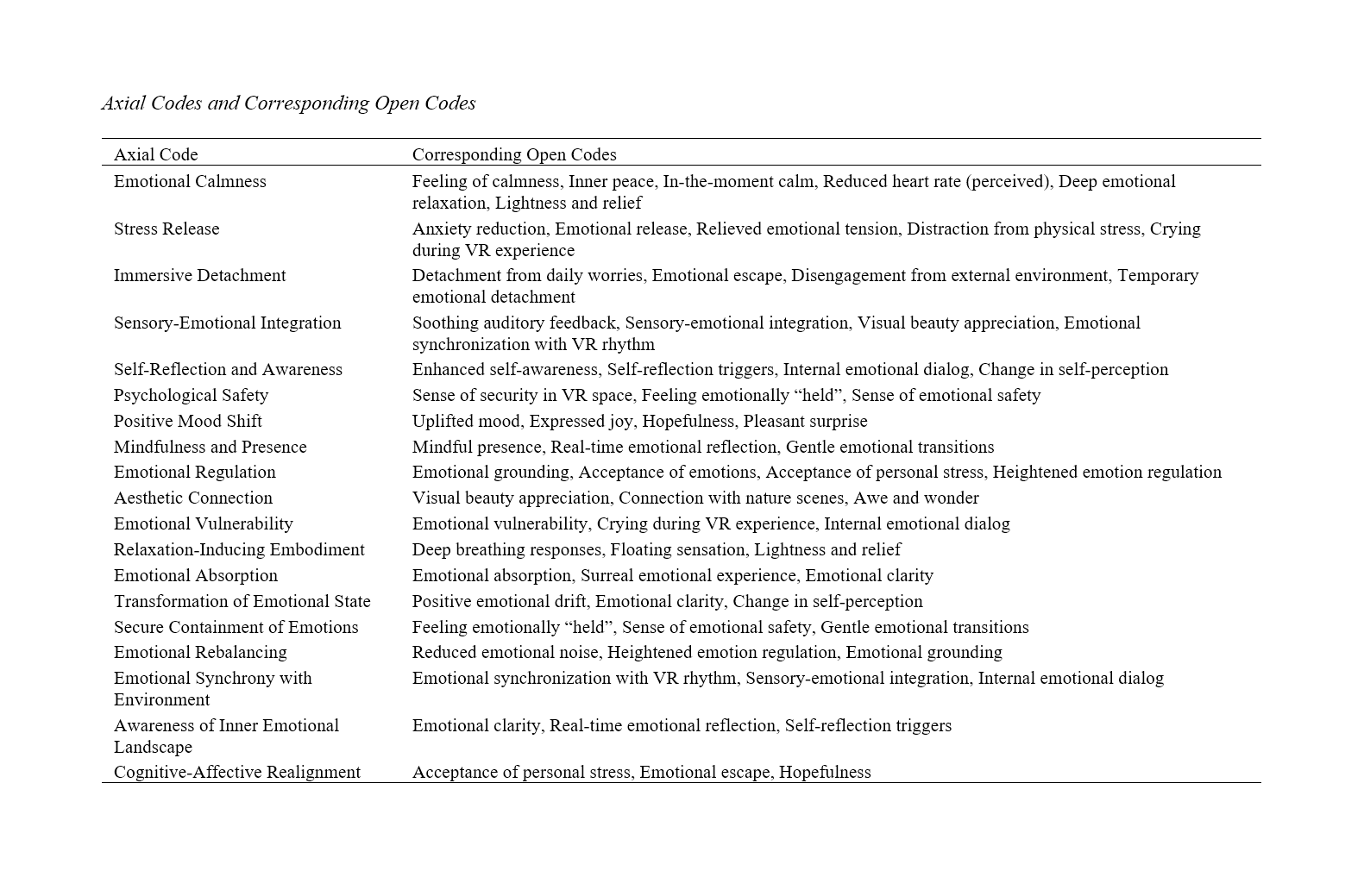
This study aimed to explore the dimensions of emotional engagement experienced by users participating in immersive virtual reality (VR) stress management programs. A qualitative phenomenological approach was employed to investigate how individuals emotionally interact with immersive VR environments designed for stress reduction. Nineteen participants from Turkey, who had completed VR-based stress management sessions within the past six months, were selected using purposive sampling. Data were collected through semi-structured, in-depth interviews and analyzed using a grounded theory approach across three stages: open coding, axial coding, and selective coding. NVivo 14 software was used for data management and coding. Theoretical saturation determined the final sample size. Thematic analysis revealed five core categories of emotional engagement: (1) emotional regulation and relief, characterized by feelings of calm, reduced anxiety, and emotional release; (2) immersive escape and containment, reflecting temporary psychological withdrawal and emotional safety; (3) reflective self-awareness, involving increased emotional insight and self-perception; (4) psychological safety and comfort, supported by sensory design and environmental predictability; and (5) affective transformation, encompassing mood elevation and deeper emotional shifts. Participants described immersive VR not only as a relaxation tool but as an emotionally rich environment capable of triggering introspection, affective balance, and transformation. Immersive VR stress management programs engage users across multiple emotional dimensions—physiological, cognitive, and affective. Emotional engagement is not a passive outcome but a dynamic and layered process shaped by presence, design features, and individual psychological factors. These findings underscore the importance of affect-sensitive design and implementation strategies in therapeutic VR, emphasizing the potential of immersive environments for promoting emotional resilience and mental well-being.
Downloads
References
1. Bayaskar S. Virtual Reality as a Tool for Anxiety and Stress Reduction: User Perspectives. Interantional Journal of Scientific Research in Engineering and Management. 2025;09(06):1-9.
2. Maksatbekova A, Argan M. Virtual Reality’s Dual Edge: Navigating Mental Health Benefits and Addiction Risks Across Timeframes. Current Psychology. 2025;44(7):6469-80.
3. Lee LJ, Son EH, Farmer N, Gerrard C, Tuason RT, Yang L, et al. Nature-Based Virtual Reality Intervention to Manage Stress in Family Caregivers of Allogeneic Hematopoietic Stem Cell Transplant Recipients: A Two-Phase Pilot Study Protocol. Frontiers in Psychiatry. 2024;15.
4. Ahn J, Kim J, Park Y, Kim R, Choi H. Virtual Reality-Based Relaxation Program on Mental Health and Sleep Patterns for Undergraduate Students: A Randomized Controlled Repeated-Measures Design (Preprint). 2024.
5. Weber S, Mast FW, Weibel D. Experiencing Presence in a Gaming Activity Improves Mood After a Negative Mood Induction. 2022:1198-221.
6. Kosa M, Johnson‐Glenberg MC. The Additive Effects of Interactivity, Immersion, and Eudaimonia for Stress Reduction and Mood Management: A Randomized Controlled Study on Games and Virtual Reality. Psychology of Popular Media. 2024;13(4):696-708.
7. Pallavicini F, Orena E, Achille F, Cassa M, Vuolato C, Stefanini S, et al. Psychoeducation on Stress and Anxiety Using Virtual Reality: A Mixed-Methods Study. Applied Sciences. 2022;12(18):9110.
8. Desai S, Athalye‐Jape G, Bottcher SA, Campbell C, Chiffings D, Nathan E, et al. Effect of Using Virtual Reality on Fatigue and Mental Workload as Key Determinants of Perceived Stress in Neonatal Intensive Care Staff: A Randomized Controlled Trial Feasibility Study and Protocol. Nursing in Critical Care. 2025;30(2).
9. Buselli R, Corsi M, Veltri A, Marino R, Caldi F, Guerra PD, et al. Comparison Between Standard Expository Cognitive Behavioral Therapy (CBT-E) and Immersive Virtual Reality CBT (CBT-VR) for Rehabilitation of Patients Affected by Occupational Stress Disorders: Study Protocol. International Journal of Environmental Research and Public Health. 2023;20(9):5735.
10. Birrenbach T, Häni S, Jegerlehner S, Schober S, Exadaktylos AK, Sauter TC. VR for Physician Wellbeing – Feasibility, Subjective Effectiveness and Acceptance of Short Virtual Reality Relaxation Breaks for Immediate Perceived Stress Reduction in Emergency Physicians: A Pilot Study (Preprint). 2025.
11. García L, Birckhead B, Krishnamurthy P, Mackey I, Sackman J, Salmasi V, et al. Durability of the Treatment Effects of an 8-Week Self-Administered Home-Based Virtual Reality Program for Chronic Low Back Pain: Follow-Up Study of a Randomized Clinical Trial (Preprint). 2022.
12. Yıldırım MŞ, Çoğ M, Akbaş BM, Salar S, Keklicek H. Acute Effects of Virtual Reality-Based Relaxation and Exergaming on Primary Dysmenorrhea Symptoms. Turkish Journal of Medical Sciences. 2025;55(2):377-85.
13. Williams G, Riches S. Virtual Reality Relaxation for Staff Wellbeing on a Psychiatric Rehabilitation Ward: A Feasibility and Acceptability Study. Journal of Psychiatric Intensive Care. 2023;19(1):51-8.
14. Nair SB. Virtual Reality Meditation Retreat: A Transformative Approach to Wellness. Interantional Journal of Scientific Research in Engineering and Management. 2025;09(02):1-9.
15. Morganti F, Gattuso M, Solorzano CS, Bonomini C, Rosini S, Ferrari C, et al. Virtual Reality-Based Psychoeducation for Dementia Caregivers: The Link Between Caregivers’ Characteristics and Their Sense of Presence. Brain Sciences. 2024;14(9):852.
16. Doren NV, Ng H, Rawat E, McKenna KR, Blonigen DM. Virtual Reality Mindfulness Training for Veterans in Residential Substance Use Treatment: Pilot Study of Feasibility and Acceptability. 2023.
17. McGarry S, Brown A, Gardner ML, Plowright C, Skou R, Thompson C. Immersive Virtual Reality: An Effective Strategy for Reducing Stress in Young Adults. British Journal of Occupational Therapy. 2023;86(8):560-7.
18. Kim J. A Study on the Characteristics of VR Content to Reduce Cyber Sickness. Journal of Digital Art Engineering and Multimedia. 2022;9(2):149-58.
19. Matamala-Gomez M, Slater M, Sánchez-Vives MV. Impact of Virtual Embodiment and Exercises on Functional Ability and Range of Motion in Orthopedic Rehabilitation. Scientific Reports. 2022;12(1).
20. Wang Y, Zhang X, Gao J, Zhang L, Jiang J. The Effect of Immersive Virtual Reality‐based Attentional Bias Modification on Anxiety Mitigation in Healthy Population. Psych Journal. 2022;11(6):956-67.
21. Mukai T, Tsukiyama Y, Yamada S, Nishikawa A, Hayami S, Noguchi R, et al. Virtual Reality Images of the Home Are Useful for Patients With Hospital-Based Palliative Care: Prospective Observational Study With Analysis by Text Mining. Palliative Medicine Reports. 2023;4(1):214-9.
22. Nagamine T. Challenges in Using Virtual Reality Technology for Pain Relief. World Journal of Clinical Cases. 2025;13(16).
23. Mahmud AA, Zakaria RH, Yusoff MZM, Jaafar NRN, Baharudin A, Tamil AM. Brief Virtual Reality Exposure Therapy and Its Effects on Negative and Positive Emotions Among Healthy Working Adults: A Feasibility Study. Alpha Psychiatry. 2022;23(5):223-9.
24. Barabanschikov VA, Selivanov VV. Mental States and Creativity of the Subject in a Didactic VR Environment of Various Immersiveness. Experimental Psychology (Russia). 2022;15(2):4-19.
25. Thakur P, Talwandi NS, Khare S, Yadav VK. Virtual Reality (VR) in Work Environment for Stress Reduction. Ijaimd. 2025;2(2):37-44.
26. Lai M, Taheri K, Aziz R, Milaire P, Rothman Z, Shi K, et al. Evaluation of a Novel Virtual Reality Immersive Clinical Experience to Enhance Medical Education Curriculum. Canadian Medical Education Journal. 2023.
Downloads
Additional Files
Publication Timeline
- Submitted
- Revised
- Accepted
License
Copyright (c) 2025 Ahmet Kutsal (Corresponding Author); Selva Turan (Author)

This work is licensed under a Creative Commons Attribution-NonCommercial 4.0 International License.