Assessment of Dietary Intake, Nutritional Status, and Cardiovascular Risk in University Students
DOI:
https://doi.org/10.61838/kman.hn.4585Keywords:
dietary intake, cardiovascular risk, university students, overweight, obesityAbstract
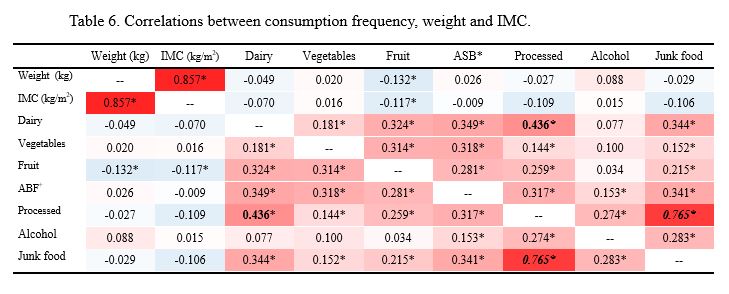
This study assessed the eating habits, nutritional status, and cardiovascular risk in university students. The sample consisted of 295 new students (188 female, 107 male) who attended the induction week at the Autonomous University of Occident and met the inclusion criteria: being adults, enrolled in any undergraduate degree offered by the university, and agreeing to participate through informed consent. The data collection consisted of two parts: an initial survey to collect general characteristics and self-reported height and weight, and the measurement of waist and hip circumferences according to the ISAK protocol. Then, a short version of the FFQ was applied to collect dietary information. Data was captured on MS Excel, and mean, standard deviation, frequencies, and 95 % confidence intervals were reported. Statistical tests were analyzed using SPSS version 26. Results: 38 % of the students are overweight or obese, being higher in men (42 % vs 35.6 % in women). 7.35 % of women and 10.96 % of men presented high WHR, and 33.09 % of women and 35.62 % of men presented high WHRt. Low weekly consumption was found in dairy products (7.13 CI 95 % 6.71 - 7.56), vegetables (5.83 CI 95 % 5.33 - 6.34), and fruits (6.92 CI 95 % 6.43 – 7.42). Processed foods and junk food are highly consumed (8.77 CI 95 % 8.10 - 9.45, and 14.20 CI 95 % 13.20 – 15.20, respectively). Significant correlations were found on weekly consumption of processed foods and junk food (R = 0.765, p < 0.001), processed foods and dairy products (R = 0.436, p<0.001). The findings indicate a high rate of malnutrition among university students, poor intake of healthy foods, and a high consumption of processed and junk food. These inadequate lifestyle habits could be a risk factor for the development of both cardiovascular diseases and NCDs in the long term. Therefore, it is important to emphasize the need for university-level nutritional interventions.
Downloads
References
1. World Health Organization. Noncommunicable diseases. 2025. Who.int. https://www.who.int
2. Villanueva SJR, Esponda PJG, Tamborell RA. Chronic noncommunicable diseases as a risk factor for mortality in intensive care. Acta Médica GA. 2024;22(1):22-26. https://doi.org/10.35366/114589
3. Escamilla-Núñez MC, Castro-Porras L, Romero-Martínez M, Zárate-Rojas E, Rojas-Martínez R. Screening, previous diagnosis, and treatment of chronic non-communicable diseases in Mexican adults. Ensanut 2022. Salud Pública de México. 2023;65(Suppl 1):S153-S162. https://doi.org/10.21149/14726
4. Pavlovic R, Mihajlovic I, Idrizovic K, Vrcic M, Stankovic D, Joksimovic M. Differences in anthropometric traits and trend of changes in high school students. International Journal of Sport Studies for Health. 2018;1(1):1-5. https://doi.org/10.61838/kman.intjssh.1.1.8
5. World Health Organization. WHO package of essential noncommunicable (PEN) disease interventions for primary health care. 2020. Who.int. https://www.who.int
6. Villaquiran AF, Cuero P, Ceron GM, Ordonez A, Jácome S. Anthropometric characteristics, nutritional habits, physical activity, and alcohol consumption in college students. Salud UIS. 2020;52(2):111-120. http://dx.doi.org/10.18273/revsal.v52n2-2020005
7. Yaguachi-Alarcón RA, Espinoza-Burgos AD, Altamirano-Morán NA, Peralta-Machado JD, Peralta-Zúñiga GA, Manosalvas-Lemus KN, et al. Lifestyles and cardiovascular risk based on anthropometric indicators in university students. Retos. 2024;61:1314-1320.
8. Rodríguez IT, Ballart JF, Pastor GC, Jordà EB, Val VA. Validation of a short questionnaire on frequency of dietary intake: reproducibility and validity. Nutrición Hospitalaria. 2008;23(3):242-252.
9. World Health Organization. Obesity and Overweight. 2025. Who.int. https://www.who.int
10. Guzmán-Muñoz E, González-Cerpa C, Olivares-Neira C, Salazar-Orellana C, Corredor-Serrano LF, Alarcón-Rivera M. Relationship between perceived physical fitness and self-reported anthropometric measures in university students. Revista Ciencias de la Actividad Física UCM. 2024;25(1):1-14. https://doi.org/10.29035/rcaf.25.1.2
11. Zurita VAR, Pianda MAH, Lezcano AAV, Saltos KG, Méndez KM, Sáncez VZ. Waist-to-hip ratio and waist-to-height ratio in the evaluation of abdominal gauze distribution in university students. Health Leadership and Quality of Life. 2024;3:1-7. https://doi.org/10.56294/hl2024.333
12. World Medical Association. Declaration of Helsinki on the ethical principles for medical research involving human subjects. European Journal of Emergency Medicine. 2001;8:221-223. https://www.wma.net/policies-post/wma-declaration-of-helsinki/
13. Moral Moreno L, Flores Ferro E, Maureira Cid F. Physical activity level in university students: a Spain-Chile comparative study. Retos. 2024;56:188-199. https://doi.org/10.47197/retos.v56.102969
14. Gamarra Camacho ML, Miranda Flores MA, Saintila J, Javier-Aliaga DJ. Correlation between physical activity, body fat and BMI in university students: a cross-sectional study. Nutrición Clínica y Dietética Hospitalaria. 2021;41(4):112-118. https://doi.org/10.12873/414aliaga
15. Gaona-Pineda EB, Rodríguez-Ramírez S, Medina-Zacarías MC, Valenzuela-Bravo DG, Martínez-Tapia B, Arango-Angarita A. Food groups consumption in the Mexican population. Ensanut 2020-2022. Salud Pública de México. 2023;65(supl 1):S248-S258. https://doi.org/10.21149/14785
16. Cortez-Belmares W, Araujo-Sáenz A, Velasco-Silveyra J, Urquidez-Romero R. Eating habits and their relationship with physiological risk factors in university students. Biotecnia. 2025;27:1-6. Doi:10.18633/biotecnia.v27.2542
17. Martínez-Hernández VR, Sandoval-Copado JR, Aranzana Juarros M. Access to food and eating habits of young university, State of Mexico. Revista Salud Pública y Nutrición. 2021;20(3):36-45. https://doi.org/10.29105/respyn20.3-5
18. Saucedo-Soto JM, De la Peña de León AS, Amezcua-Núñez JB. Healthy eating habits in college students. Revista de Investigaciones Universidad del Quindio. 2021;33(S1):199-211. https://doi.org/10.33975/riuq.vol33nS1.492
19. Hernández-Gallardo D, Arencibia-Moreno R, Linares-Girela D, Murillo-Plúa DC, Bosques-Cotelo J, Linares-Manrique M. Nutritional condition and eating habits in university students from Manabi, Ecuador. Revista Española de Nutrición Comunitaria. 2020;27(1):15-22. https://doi.org/10.14642/RENC.2021.27.1.5349
20. Maza-Ávila FJ, Caneda-Bermejo MC, Vivas-Castillo AC. Dietary habits and health effects among university students. A systematic review. Psicogente. 2022;25(47):1-31. https://doi.org/10.17081/psico.25.47.4861.
21. Hernández-Arteaga LG, Sánchez Limón ML. Academic Stress and Performance in University Students. RIDE. 2025;15(29):1-26. https://doi.org/10.23913/ride.v15i29.2200
22. Unar Munguía M. Taxes on sugary drinks to protect health. 2025. INSP.
23. Salgado JC, Pedraza LS, Contreras-Manzano A, Aburto TC, Tolentino-Mayo L, Barquera S. Product reformulation in non-alcoholic beverages and foods after the implementation of front-of-pack warning labels in Mexico. PLOS Medicine. 2025;22(3):e1004533. https://doi.org/10.1371/journal.pmed.1004533
24. WHO. (2023). WHO acceleration plan to stop obesity. World Health Organization. https://www.who.int/publications/i/item/9789240075634.
25. OECD. (2023). Step Up! Tackling the Burden of Insufficient Physical Activity in Europe. OECD. https://www.oecd.org/en/publications/step-up-tackling-the-burden-of-insufficient-physical-activity-in-europe_500a9601-en/full-report/component-8.html#section-d1e5214-fbe5f9b707
26. Palomares Estrada L. Healthy lifestyles and their relationship with nutritional status in health professionals [Thesis]. 2014. Universidad Peruana de Ciencias Aplicadas.
27. O’Leary M, Mooney E, McCloat A. The relationship between nutrition knowledge and dietary intake of university students: a scoping review. Dietetics. 2025;4(2):1-26. https://doi.org/10.3390/dietetics4020016
Downloads
Publication Timeline
- Submitted
- Revised
- Accepted