Effects of Aerobic Exercise at Different Circadian Phases on p53 Expression and β-Cell Survival in the Pancreas of Type 2 Diabetic NMRI Mice
DOI:
https://doi.org/10.61838/kman.hn.4828Keywords:
Circadian Rhythm, Aerobic Exercise, Type 2 Diabetes, p53 Gene Expression, Pancreatic β-Cells, NMRI MiceAbstract
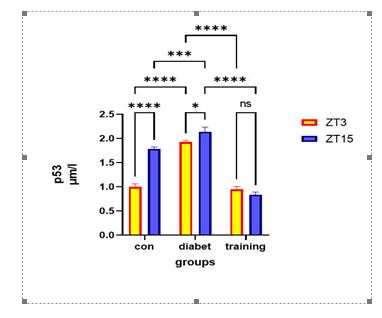
Circadian rhythms regulate glucose homeostasis, insulin secretion, mitochondrial function, and apoptosis in pancreatic β-cells. The tumor suppressor gene p53 is a key molecular regulator of apoptosis and may contribute to β-cell loss in type 2 diabetes (T2DM). This study investigates the effects of aerobic exercise performed during different circadian phases on blood glucose, β-cell survival, insulin presence, and p53 gene expression in type 2 diabetic NMRI mice. Thirty male NMRI mice were assigned to six groups: healthy controls (CH-ZT3, CH-ZT15), diabetic controls (CD-ZT3, CD-ZT15), and diabetic exercise groups trained in light (TD-ZT3) or dark phase (TD-ZT15). T2DM was induced via high-fat diet plus low-dose streptozotocin. Aerobic training (50–60% Vmax) was performed for 8 weeks. Pancreatic tissues were analyzed for β-cell survival, insulin immunostaining, and p53 expression via qRT-PCR. Data were evaluated using two-way ANOVA. Exercise significantly reduced glucose levels (p < 0.05), increased β-cell survival (p < 0.0001), and decreased p53 expression (p < 0.0001). Light-phase training (ZT3) produced greater improvements than dark-phase training. A significant interaction between training × circadian phase was found for β-cell percentage and p53 expression (p < 0.01). Aerobic exercise improves β-cell viability and reduces apoptotic signaling in diabetic mice, with circadian phase strongly modulating the benefits. Exercise during the light phase showed superior outcomes, suggesting that timing of physical activity may be an important factor in diabetes management.
Downloads
Downloads
Publication Timeline
- Submitted
- Revised
- Accepted