A Causal Model of Job Satisfaction Based on Perceived Social Support : The Mediating Role of Cognitive Adaptability among Physical Education Teachers
DOI:
https://doi.org/10.61838/kman.hn.4966Keywords:
Job Satisfaction; Perceived Social Support; Cognitive Adaptability; Physical Education TeachersAbstract
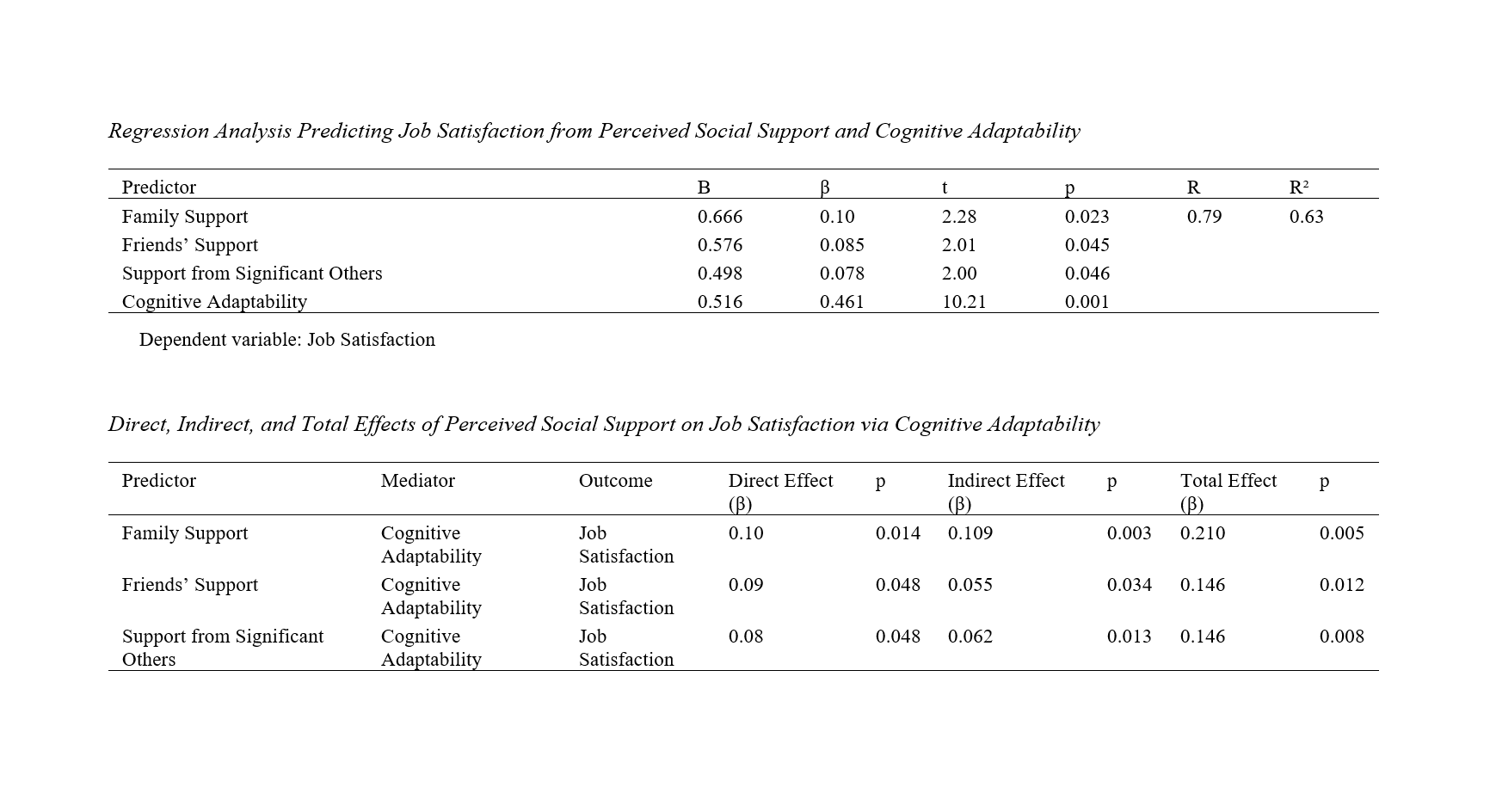
The present study aimed to develop and test a causal model of job satisfaction based on perceived social support, with cognitive adaptability serving as a mediating variable among physical education teachers in non-governmental schools. This study employed a descriptive–correlational design using structural equation modeling (SEM). The statistical population consisted of all physical education teachers in Tehran during the 2024–2025 academic year. Using multistage cluster sampling, 336 physical education teachers (134 females and 202 males) were selected from different educational districts of Tehran. Data were collected using the Perceived Social Support Questionnaire, the Cognitive Adaptability Questionnaire, and the Short Job Satisfaction Scale. Data analysis was conducted using SPSS and AMOS software. The findings indicated that perceived social support (from family, friends, and significant others) had a direct and positive effect on teachers’ job satisfaction. Perceived social support also positively influenced cognitive adaptability, which in turn had a direct effect on job satisfaction. Cognitive adaptability played a partial mediating role in the relationship between perceived social support and job satisfaction. The proposed model demonstrated an acceptable level of fit. Perceived social support enhances job satisfaction among physical education teachers by strengthening their cognitive adaptability. These findings highlight the importance of social and cognitive resources in promoting occupational well-being among teachers in non-governmental educational settings.
Downloads
References
1. Ali BJ, Anwar G. An empirical study of employees’ motivation and its influence job satisfaction. International Journal of Engineering, Business and Management. 2021;5(2):21-30. [DOI]
2. Spector PE. Industrial and organizational psychology: Research and practice: John Wiley & Sons; 2021.
3. Katebi A, HajiZadeh MH, Bordbar A, Salehi AM. The relationship between job satisfaction and job performance: A meta-analysis. Global Journal of Flexible Systems Management. 2022;23(1):21-42. [DOI]
4. da Cruz Carvalho A, Riana IG, Soares ADC. Motivation on job satisfaction and employee performance. International Research Journal of Management, IT and Social Sciences. 2020;7(5):13-23.
5. Baruani TH, Li X, Binghai S. Teachers’ resilience against stress: A review on ways and its impacts towards teaching profession. Asian Journal of Education and Social Studies. 2021;20(4):28-41. [DOI]
6. Saleh R, Atan T. The involvement of sustainable talent management practices on employee’s job satisfaction. Sustainability. 2021;13(23):13320. [DOI]
7. Keshavarz M, Eidi H. Evaluating the viewpoints of physical education teachers, health staff, and parents regarding the effectiveness of the COACH program during the COVID-19 pandemic. Research in Physiology and Management in Sport. 2024;16(1):79-97.
8. Olan F, Arakpogun EO, Suklan J, Nakpodia F, Damij N, Jayawickrama U. Artificial intelligence and knowledge sharing: Contributing factors to organizational performance. Journal of Business Research. 2022;145:605-15. [DOI]
9. Hayat A, Afshari L. CSR and employee well-being in hospitality industry: A mediation model of job satisfaction and affective commitment. Journal of Hospitality and Tourism Management. 2022;51:387-96. [DOI]
10. Demerouti E, Bakker AB. Job demands-resources theory in times of crises: New propositions. Organizational Psychology Review. 2023;13(3):209-36. [DOI]
11. Bulińska-Stangrecka H, Bagieńska A. The role of employee relations in shaping job satisfaction as an element promoting positive mental health at work in the era of COVID-19. International Journal of Environmental Research and Public Health. 2021;18(4):1903. [PMID: 33669365] [PMCID: PMC7920272] [DOI]
12. Jolly PM, Kong DT, Kim KY. Social support at work: An integrative review. Journal of Organizational Behavior. 2021;42(2):229-51. [DOI]
13. Zeng X, Zhang X, Chen M, Liu J, Wu C. The influence of perceived organizational support on police job burnout. Frontiers in Psychology. 2020;11:948. [PMID: 32528368] [PMCID: PMC7265159] [DOI]
14. Savari K, Naseri M, Savari Y. Evaluating the role of perceived stress, social support, and resilience in predicting the quality of life among parents of disabled children. International Journal of Disability, Development and Education. 2023;70(5):644-58. [DOI]
15. Taylor SE. Health psychology: McGraw-Hill; 2003.
16. Cohen S, McKay G. Social support, stress and the buffering hypothesis: A theoretical analysis. Handbook of Psychology and Health. 4: Routledge; 2020. p. 253-67. [DOI]
17. McDonald A, Thompson AJ, Perzow SE, Joos C, Wadsworth ME. The protective roles of ethnic identity, social support, and coping on depression in low-income parents. Journal of Consulting and Clinical Psychology. 2020;88(6):504. [PMID: 32406724] [DOI]
18. Lazarus RS, Folkman S. Stress, appraisal, and coping: Springer Publishing Company; 1984.
19. Rahgoi A. The Relationship Between Perceived Social Support, Psychological Capital, Job Burnout, and Work Engagement in Nurses Working on the Front Line of the Fight Against the Coronavirus. 2024. [DOI]
20. Fernández Lasarte O, Ramos Díaz E, Goñi Palacios E, Rodríguez Fernández A. The role of social support in school adjustment during secondary education. Psicothema. 2020. [PMID: 31954422] [DOI]
21. Kwok SY, Cheng L, Wong DF. Family emotional support, positive psychological capital and job satisfaction among Chinese white-collar workers. Journal of Happiness Studies. 2015;16:561-82. [DOI]
22. Nunes C, Martins C, Ayala-Nunes L, Matos F, Costa E, Gonçalves A. Parents’ perceived social support and children’s psychological adjustment. Journal of Social Work. 2021;21(3):497-512. [DOI]
23. García-Salirrosas EE, Rondon-Eusebio RF, Geraldo-Campos LA, Acevedo-Duque Á. Job satisfaction in remote work: The role of positive spillover from work to family and work–life balance. Behavioral Sciences. 2023;13(11):916. [PMID: 37998663] [PMCID: PMC10669200] [DOI]
24. Bowlby J. Attachment and loss: Vol. 1. Attachment: Basic Books; 1969.
25. Bronfenbrenner U. The ecology of human development: Experiments by nature and design: Harvard University Press; 1979. [DOI]
26. Li Y. A Network Analysis of the Relationship Between Perceived Social Support, Emotion Regulation, and Job Burnout Among Elementary and Middle School Teachers. Frontiers in Psychology. 2025;16. [PMID: 41245328] [PMCID: PMC12615160] [DOI]
27. Sachs-Ericsson N, Carr D, Sheffler J, Preston TJ, Kiosses D, Hajcak G. Cognitive reappraisal and the association between depressive symptoms and perceived social support among older adults. Aging & Mental Health. 2021;25(3):453-61. [PMID: 31876170] [DOI]
28. Vaghela R, Santoro C, Braham L. The psychological adjustment needs of individuals following an acquired brain injury. Applied Neuropsychology: Adult. 2023;30(5):469-82. [PMID: 34340606] [DOI]
29. Abkhiz S, Mikaeli Manie F. Investigating the Structural Relationships of Cognitive Self-Regulation and Occupational Well-being with the Mediation of Job Burnout and Job Satisfaction among Second-Grade High School Teachers in Urmia during the 2017-2018 Academic Year. Career and Organizational Counseling. 2020;12(44):71-86.
30. Chen H, Sun L, Du Z, Zhao L, Wang L. A cross-sectional study of mental health status and self-psychological adjustment in nurses who supported Wuhan for fighting against the COVID-19. Journal of Clinical Nursing. 2020;29(21-22):4161-70. [PMID: 32757428] [PMCID: PMC7436217] [DOI]
31. Zhou A, Liu J, Xu C, Jobe MC. Effect of social support on career decision-making difficulties: The chain mediating roles of psychological capital and career decision-making self-efficacy. Behavioral Sciences. 2024;14(4):318. [PMID: 38667114] [PMCID: PMC11047401] [DOI]
32. Qamari L, Sadeghi N, Azarbarzin M. The relationship between perceived support from friends and psychosocial adjustment to illness among adolescents with cancer. Journal of Nursing and Midwifery. 2021;19(1):77-86.
33. Parsaiezadeh M, Shahbazimoghadam M, Derakhshande M, Namjoo M. Exploring the Predictive Relationship between Mental Toughness and Subjective Well-Being: A Quantitative Analysis. Journal of Personality and Psychosomatic Research (JPPR). 2024;2(1):29-35. [DOI]
34. Kesselmayer RF, Mainella AMK, Smedema SM, Villanueva PC. The Mediating Effects of Disability Impact, Job Satisfaction, and Social Support in the Relationship Between Core Self-Evaluations and Life Satisfaction in Employed People With Disabilities. Journal of Applied Rehabilitation Counseling. 2025;56(1):42-56. [DOI]
35. Parsaei M, Shayan Mehr EK. Predicting Job Burnout Based on Occupational Well-being, Career Anchors, and Perceived Social Support. Journal of Psychology and Educational Sciences (Negareh Higher Education Institute). 2024;7(69):169-82.
Downloads
Additional Files
Publication Timeline
- Submitted
- Revised
- Accepted