Effects of Structured Play Interventions on Self-Esteem, Physical Competence, and Psychological Well-Being in Children
DOI:
https://doi.org/10.61838/kman.hn.5114Keywords:
Child, Play Therapy, Self Concept, Physical Fitness, Mental HealthAbstract
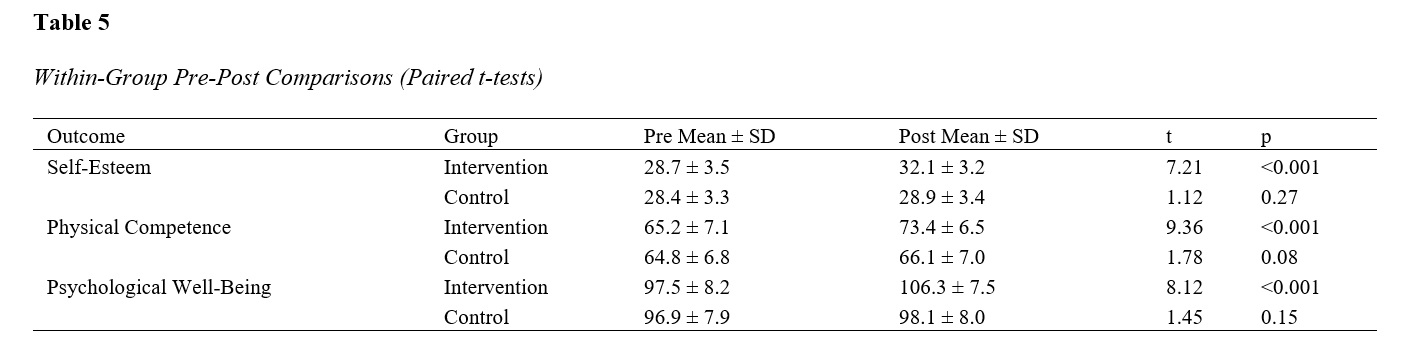
Structured play has been proposed as an effective approach to enhance both physical and psychological health in children. However, empirical evidence on its impact on self-esteem, physical competence, and psychological well-being remains limited. This study examined the effects of an eight-week structured play intervention on self-esteem, physical competence, and psychological well-being in children aged 8–11 years. A total of 68 children were recruited from primary schools and assigned to either a structured play intervention group (n = 34) or a control group (n = 34). The intervention consisted of twice-weekly 45-minute sessions incorporating skill-based activities, cooperative games, and reflection periods. Outcomes were assessed using the Rosenberg Self-Esteem Scale (child-adapted), Physical Self-Perception Profile for Children, and KIDSCREEN-27 for psychological well-being. Pre- and post-intervention data were analyzed using ANCOVA, controlling for baseline scores, with effect sizes reported as partial eta squared (η²p). ANCOVA revealed significant intervention effects on all outcomes. Self-esteem improved significantly in the intervention group compared to controls (F(1, 65) = 18.42, p < 0.001, η²p = 0.22). Similarly, perceived physical competence (F(1, 65) = 32.15, p < 0.001, η²p = 0.33) and psychological well-being (F(1, 65) = 24.87, p < 0.001, η²p = 0.28) increased significantly. Paired-sample t-tests confirmed pre- to post-intervention improvements in the intervention group (all p < 0.001), whereas changes in the control group were non-significant. Structured play interventions are effective in enhancing self-esteem, physical competence, and psychological well-being in children, highlighting their potential for promoting holistic development in school and community settings.
Downloads
References
1. Mastorci F, Lazzeri MFL, Vassalle C, Pingitore A. The Transition from Childhood to Adolescence: Between Health and Vulnerability. Children (Basel). 2024;11(8):989. [PMID: 39201923] [PMCID: PMC11352511] [DOI]
2. Sick K, Pila E, Gilchrist JD, Gohari MR, Patte KA, Leatherdale S. Prospective Relations Between Self-Concept and Adolescent Physical Education Participation: A Sex Stratified Analysis. J Adolesc. 2025;97(4):1034-46. [PMID: 39945216] [PMCID: PMC12128908] [DOI]
3. Fu Q, Li L, Li Q, Wang J. The effects of physical activity on the mental health of typically developing children and adolescents: a systematic review and meta-analysis. BMC Public Health. 2025;25(1):1514. [PMID: 40269876] [PMCID: PMC12016293] [DOI]
4. Rothstein JD, Buckland AJ, Gagnier K, Ochoa M, Allen-Valley A, Jivapong B, et al. Assessing the play and learning environments of children under two years in peri-urban Lima, Peru: a formative research study. BMC Public Health. 2021;21(1):108. [PMID: 33422022] [PMCID: PMC7796591] [DOI]
5. Priftis N, Panagiotakos D. Screen Time and Its Health Consequences in Children and Adolescents. Children (Basel). 2023;10(10):1665. [PMID: 37892328] [PMCID: PMC10605067] [DOI]
6. Tortella P, Haga M, Lorås H, Fumagalli GF, Sigmundsson H. Effects of Free Play and Partly Structured Playground Activity on Motor Competence in Preschool Children: A Pragmatic Comparison Trial. Int J Environ Res Public Health. 2022;19(13):7652. [PMID: 35805311] [PMCID: PMC9265359] [DOI]
7. Muris P, Otgaar H. Self-Esteem and Self-Compassion: A Narrative Review and Meta-Analysis on Their Links to Psychological Problems and Well-Being. Psychol Res Behav Manag. 2023;16:2961-75. [PMID: 37554304] [PMCID: PMC10406111] [DOI]
8. Malm C, Jakobsson J, Isaksson A. Physical Activity and Sports-Real Health Benefits: A Review with Insight into the Public Health of Sweden. Sports (Basel). 2019;7(5):127. [PMID: 31126126] [PMCID: PMC6572041] [DOI]
9. Dana A, Ranjbari S, Chaharbaghi Z, Ghorbani S. Association between Physical Activity and Motor Proficiency among Primary School Children. Int J School Health. 2023;10(3):128-35. [DOI]
10. Šerbetar I, Loftesnes JM, Mamen A. Linking Motor Competence to Children's Self-Perceptions: The Mediating Role of Physical Fitness. Children (Basel). 2025;12(10):1412. [PMID: 41153594] [PMCID: PMC12564408] [DOI]
11. Gautam S, Jain A, Chaudhary J, Gautam M, Gaur M, Grover S. Concept of mental health and mental well-being, it's determinants and coping strategies. Indian J Psychiatry. 2024;66(2):231-44. [PMID: 38445271] [PMCID: PMC10911315] [DOI]
12. Wan J, Wee LH, Siau CS, Wong YH. Psychological well-being and its associated factors among university students in Sichuan, China. Front Psychol. 2025;16:1473871. [PMID: 41583784] [PMCID: PMC12827107] [DOI]
13. Francis G, Deniz E, Torgerson C, Toseeb U. Play-based interventions for mental health: A systematic review and meta-analysis focused on children and adolescents with autism spectrum disorder and developmental language disorder. Autism Dev Lang Impair. 2022;7:23969415211073118. [PMID: 36438159] [PMCID: PMC9685160] [DOI]
14. Smith TE, Thompson AM, Maynard BR. Self-management interventions for reducing challenging behaviors among school-age students: A systematic review. Campbell Syst Rev. 2022;18(1):e1223. [PMID: 36913185] [PMCID: PMC8902300] [DOI]
15. Nery M, Sequeira I, Neto C, Rosado A. Movement, Play, and Games-An Essay about Youth Sports and Its Benefits for Human Development. Healthcare (Basel). 2023;11(4):493. [PMID: 36833027] [PMCID: PMC9956671] [DOI]
16. Yang PF, Qian SW. The relationship between self-determined motivation, emotional involvement, cognitive involvement and leisure-time physical activity among college students. Heliyon. 2024;10(11):e31817. [PMID: 40535294] [PMCID: PMC12134689] [DOI]
17. Teixeira PJ, Carraça EV, Markland D, Silva MN, Ryan RM. Exercise, physical activity, and self-determination theory: a systematic review. Int J Behav Nutr Phys Act. 2012;9:78. [PMID: 22726453] [PMCID: PMC3441783] [DOI]
18. Khajeaflaton Mofrad S. Impact of a Novelty-based Intervention in Physical Education on Motivation and Physical Activity of Children with ADHD. Phys Act Child. 2024;1(1):6-13. [DOI]
19. Li B, Ng K, Tong X, Zhou X, Ye J, Yu JJ. Physical activity and mental health in children and youth during COVID-19: a systematic review and meta-analysis. Child Adolesc Psychiatry Ment Health. 2023;17(1):92. [PMID: 37468975] [PMCID: PMC10357657] [DOI]
20. Tomporowski PD, Lambourne K, Okumura MS. Physical activity interventions and children's mental function: an introduction and overview. Prev Med. 2011;52(1):3-9. [PMID: 21420981] [PMCID: PMC3160636] [DOI]
21. Pan W, Zhang H, Xu L. Association between physical activity and academic achievement in adolescents mediated by self-concept and physical and mental health. Sci Rep. 2025;15(1):33561. [PMID: 41023155] [PMCID: PMC12480576] [DOI]
22. Wood C, Griffin M, Barton J, Sandercock G. Modification of the Rosenberg Scale to Assess Self-Esteem in Children. Front Public Health. 2021;9:655892. [PMID: 34222169] [PMCID: PMC8247758] [DOI]
23. Crocker PR, Eklund RC, Kowalski KC. Children's physical activity and physical self-perceptions. J Sports Sci. 2000;18(6):383-94. [PMID: 10902673] [DOI]
24. Ravens-Sieberer U, Auquier P, Erhart M, Gosch A, Rajmil L, Bruil J, et al. The KIDSCREEN-27 quality of life measure for children and adolescents: psychometric results from a cross-cultural survey in 13 European countries. Qual Life Res. 2007;16(8):1347-56. [PMID: 17668292] [DOI]
25. Gibson JL, Pritchard E, de Lemos C. Play-based interventions to support social and communication development in autistic children aged 2-8 years: A scoping review. Autism Dev Lang Impair. 2021;6:23969415211015840. [PMID: 36381525] [PMCID: PMC9620698] [DOI]
26. Hedges JH, Adolph KE, Amso D, Bavelier D, Fiez JA, Krubitzer L, et al. Play, attention, and learning: how do play and timing shape the development of attention and influence classroom learning? Ann N Y Acad Sci. 2013;1292(1):1-20. [PMID: 23763338] [PMCID: PMC3842829] [DOI]
27. Falci CD. Self-Esteem and Mastery Trajectories in High School by Social Class and Gender. Soc Sci Res. 2011;40(2):586-601. [PMID: 21423844] [PMCID: PMC3057090] [DOI]
28. Crone EA, van Drunen L. Development of Self-Concept in Childhood and Adolescence: How Neuroscience Can Inform Theory and Vice Versa. Hum Dev. 2024;68(5-6):255-71. [PMID: 39816529] [PMCID: PMC11734892] [DOI]
29. Mohammad Gholinejad P, Hojjati H, Ghorbani S. The Effect of Aerobic Exercise on Body Composition and Muscle Strength of Female Students at Elementary Schools of Ali Abad Katoul in 2018. Int J School Health. 2019;6(4):27-33. [DOI]
30. Lee RLT, Lane SJ, Tang ACY, Leung C, Louie LHT, Browne G, et al. Effects of an Unstructured Free Play and Mindfulness Intervention on Wellbeing in Kindergarten Students. Int J Environ Res Public Health. 2020;17(15):5382. [PMID: 33808942] [PMCID: PMC8003194] [DOI]
31. Marsigliante S, Gómez-López M, Muscella A. Effects on Children's Physical and Mental Well-Being of a Physical-Activity-Based School Intervention Program: A Randomized Study. Int J Environ Res Public Health. 2023;20(3):1927. [PMID: 36767292] [PMCID: PMC9915543] [DOI]
32. Ryan RM, Deci EL. Self-determination theory and the facilitation of intrinsic motivation, social development, and well-being. Am Psychol. 2000;55(1):68-78. [PMID: 11392867] [DOI]
33. Yermakhanov B. Impact of an Autonomy-Based Program on Perceived Autonomy Support, Intrinsic Motivation and Leisure-Time Physical Activity of High-School Student: An Accelerometer-Based Study. Phys Act Child. 2025;2(1):43-8. [DOI]
Downloads
Additional Files
Publication Timeline
- Submitted
- Revised
- Accepted