Predicting Somatic Complaints from Personality Traits and Smartphone-Derived Behavioral Data Using Machine Learning
DOI:
https://doi.org/10.61838/kman.jppr.5103Keywords:
somatic complaints, personality traits, smartphone sensing, digital phenotyping, machine learningAbstract
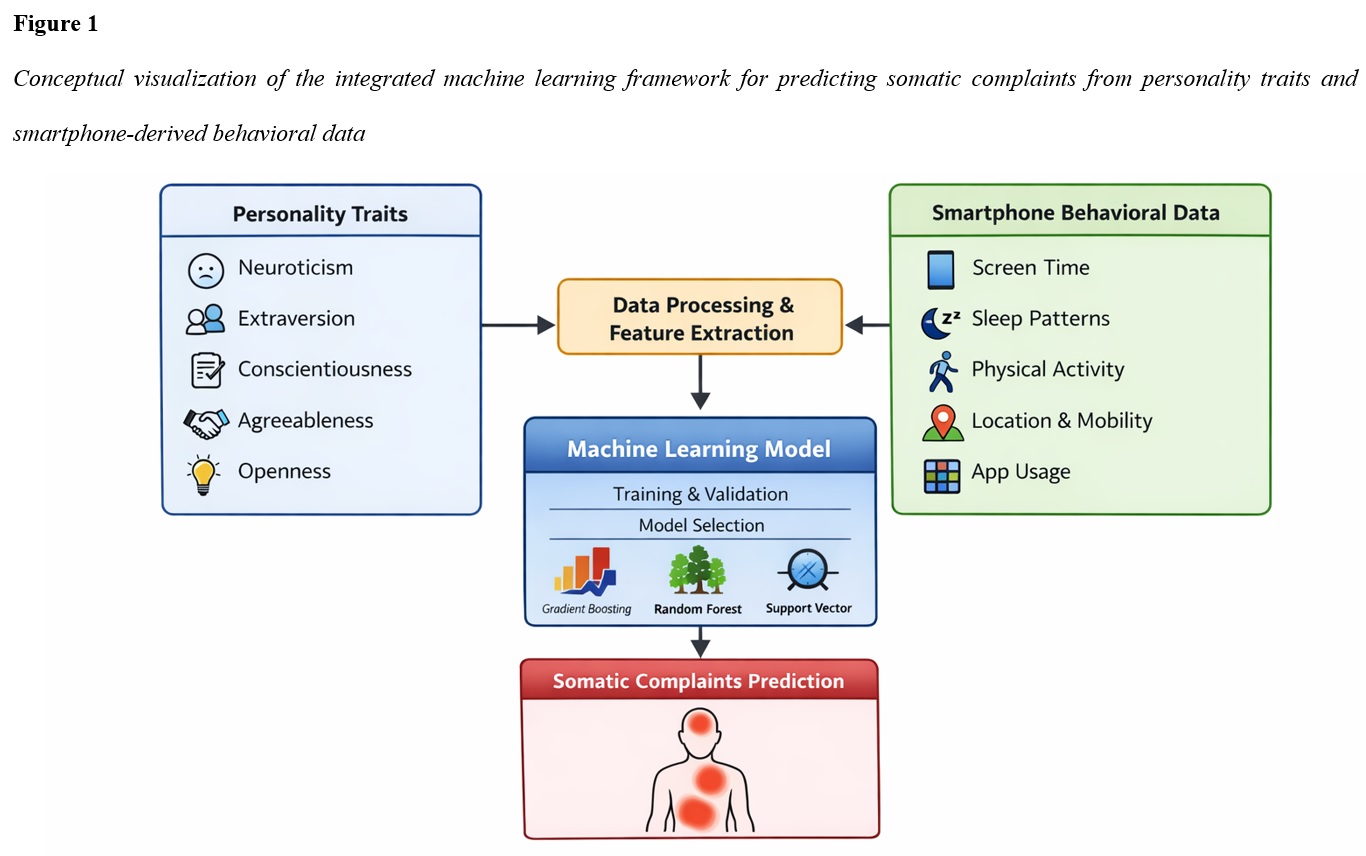
This study aimed to predict somatic complaints by integrating Big Five personality traits and passive smartphone-derived behavioral indicators within a machine learning framework. A cross-sectional observational design was employed with an adult community sample recruited in Armenia. Participants completed standardized self-report measures assessing somatic complaints and Big Five personality traits. In parallel, passive smartphone sensing data were collected continuously over a four-week period using a custom Android application that captured behavioral indicators such as screen time, sleep regularity proxies, physical inactivity duration, nighttime phone activity, and app usage patterns, without recording personal content. Data preprocessing included cleaning, aggregation of behavioral features at the participant level, and standardization of predictors. Supervised machine learning models were trained to predict somatic complaint scores, including regularized linear models, support vector regression, random forest, and gradient boosting. Model evaluation used train–test splits with cross-validation, and performance was assessed using error-based indices and explained variance metrics. Nonlinear ensemble models significantly outperformed linear approaches in predicting somatic complaints, with gradient boosting explaining the largest proportion of variance. Models combining personality traits and smartphone-derived behavioral data demonstrated significantly higher predictive accuracy than models using either data source alone. Neuroticism showed the strongest positive contribution to somatic complaints, while conscientiousness and extraversion contributed negatively. Among behavioral indicators, sleep regularity, daily screen time, nighttime phone activity, and physical inactivity emerged as significant predictors. Model performance remained stable across gender and age subgroups, indicating robustness of the predictive relationships. Integrating personality traits with passive smartphone-derived behavioral data using machine learning provides a powerful and ecologically valid approach for predicting somatic complaints, supporting biopsychosocial models of psychosomatic health and highlighting the potential of digital phenotyping for personalized health assessment.
Downloads
References
Aksnes, E. R., Birkeland, M. S., Ebrahimi, O. V., Bekkhus, M., Ferschmann, L., Beck, D., Fixdal, T., Havdahl, A., Speyer, L. G., Westlye, L. T., Bos, M. G., & Tamnes, C. K. (2024). Development of Symptoms of Emotional Problems From Childhood to Adolescence: A Longitudinal Network Analysis. https://doi.org/10.31219/osf.io/m5gr7_v1
Asare, K. O., Visuri, A., Vega, J., & Ferreira, D. (2022). Me In the Wild: An Exploratory Study Using Smartphones To Detect The Onset Of Depression. 121-145. https://doi.org/10.1007/978-3-031-06368-8_9
Bhayangkara, N. I., Lerik, M. D. C., & Benu, J. M. Y. (2024). Smartphone Addiction Reviewed From Big Five Personality in College Students. Journal of Health and Behavioral Sciences, 6(4), 426-437. https://doi.org/10.35508/jhbs.v6i4.15601
Chung, K., & Park, J. Y. (2025). Identifying Subgroups at Risk for Major Depression and Suicidal Ideation via Mobile App–Based Ecological Momentary Assessment: A Cluster Analysis (Preprint). https://doi.org/10.2196/preprints.80332
Damian, A., Mihăilescu, A., Anghele, C., Ciobanu, C. A., Petrescu, C., Riga, S., Dionisie, V., & Ciobanu, A. M. (2023). Quality of Life Predictors in a Group of Informal Caregivers During the COVID-19 Pandemic. Medicina, 59(8), 1486. https://doi.org/10.3390/medicina59081486
Eren, N., & Yiğitoğlu, G. T. (2023). Delirium Awareness and Management of Intensive Care Nurses in Terms of Their Personality Traits. Ordu Üniversitesi Hemşirelik Çalışmaları Dergisi, 6(2), 393-403. https://doi.org/10.38108/ouhcd.1128273
Ferguson, G., Pasquini, G., Sliwinski, M. J., & Scott, S. (2022). Measuring Personality in Daily Life: Evidence From an Age-Heterogeneous Adult Sample. Innovation in Aging, 6(Supplement_1), 641-641. https://doi.org/10.1093/geroni/igac059.2374
Fuller, C., Marin-Dragu, S., Iyer, R. S., & Meier, S. (2025). A Mobile App–Based Gratitude Intervention’s Effect on Mental Well-Being in University Students: Randomized Controlled Trial. Jmir Mhealth and Uhealth, 13, e53850-e53850. https://doi.org/10.2196/53850
Gashi, D., Gallopeni, F., Imeri, G., Shahini, M., & Bahtiri, S. (2022). The Relationship Between Big Five Personality Traits, Coping Strategies, and Emotional Problems Through the COVID-19 Pandemic. Current Psychology, 42(33), 29179-29188. https://doi.org/10.1007/s12144-022-03944-9
Gong, F., Jia, Y., Sun, X., Min, H., Jia, X., Wang, F., Huang, X., Lin, X., Li, Z., & Wu, Y. (2023). The Influence of Media Use Degree on Public Depressive Symptoms: Mediating Role of Big Five Personality. BMC psychiatry, 23(1). https://doi.org/10.1186/s12888-023-05097-w
Grover, S. (2022). Loneliness Among the Elderly: A Mini Review. Consortium Psychiatricum, 3(1), 30-36. https://doi.org/10.17816/cp143
Hoshino, Y., Kataoka, S., & Ansai, T. (2023). Association of Personality Traits With Dental Visit Procrastination by Japanese University Students. BioPsychoSocial Medicine, 17(1). https://doi.org/10.1186/s13030-023-00288-z
Ibrar, K., Fayyaz, A. M., Khan, M. A., Alhaisoni, M., Tariq, U., Jeon, S., & Nam, Y. (2023). Human Personality Assessment Based on Gait Pattern Recognition Using Smartphone Sensors. Computer Systems Science and Engineering, 46(2), 2351-2368. https://doi.org/10.32604/csse.2023.036185
Jacobs, P., Wagner, M. F., Paloski, L. H., Irani Iracema de Lima, A., & Oliveira, C. R. d. (2022). Personality Traits and Psychopathological Symptoms in Adults With Substance Use Disorders. Behavioral Psychology/Psicología Conductual, 30(2), 347-357. https://doi.org/10.51668/bp.8322201n
Kakuta, M., Gondo, Y., Nakagawa, T., Masui, Y., Kamide, K., Ikebe, K., Ishizaki, T., & Arai, Y. (2024). Relationship Between Personality Traits and Preference for Coping Styles in Older Adults. Innovation in Aging, 8(Supplement_1), 770-770. https://doi.org/10.1093/geroni/igae098.2503
Marengo, D., Elhai, J. D., & Montag, C. (2023). Predicting Big Five Personality Traits From Smartphone Data: A Meta‐analysis on the Potential of Digital Phenotyping. Journal of personality, 91(6), 1410-1424. https://doi.org/10.1111/jopy.12817
Müller-Bardorff, M., Schulz, A., Paersch, C., Recher, D., Schlup, B., Seifritz, E., Kolassa, I. T., Kowatsch, T., Fisher, A. J., Galatzer‐Levy, I. R., & Kleim, B. (2024). Optimizing Outcomes in Psychotherapy for Anxiety Disorders Using Smartphone-Based and Passive Sensing Features: Protocol for a Randomized Controlled Trial. Jmir Research Protocols, 13, e42547. https://doi.org/10.2196/42547
Okutucu, F. T., & Ceyhun, H. A. (2025). The Impact of Anxiety and Depression Levels on the Big Five Personality Traits. PLoS One, 20(7), e0321373. https://doi.org/10.1371/journal.pone.0321373
Parpoula, C. (2024). An Analytical Approach for Identifying Trend‐seasonal Components and Detecting Unexpected Behaviour in Psychological Time‐series. International journal of psychology, 59(6), 1307-1316. https://doi.org/10.1002/ijop.13244
Perlini, C. (2025). Psycho-Social Profile of Patients With Chronic Neuropathic Pain and Spinal Cord Stimulation Outcome: Preliminary Finding From an Italian Sample Recruited at the University Hospital of Verona (Italy). European Psychiatry, 68(S1), S936-S936. https://doi.org/10.1192/j.eurpsy.2025.1897
Rodríguez, B. C., Rodríguez‐Sedano, F. J., & Porras‐García, E. (2025). Assessing Vulnerability to Harmful Internet, Social Media, and Digital Environment Use Through the Big Five Model: A Neuropsychosocial Perspective. https://doi.org/10.20944/preprints202510.1542.v1
Song, H. (2025). Integrating Ecological Momentary Assessment and Intervention With Wearable-Based Digital Phenotypes for Anxiety in Young Adults: A Mixed-Method Experimental Study (Preprint). https://doi.org/10.2196/preprints.88919
Srivastava, S., Verma, N., Kumar, D., Singh, N., & Kumar, K. (2025). Nomophobia as an Emerging Psychopathology Psychophysiological Mechanisms and Clinical Implications. Annals of Neurosciences. https://doi.org/10.1177/09727531251351082
Su, S., Cousijn, J., Molenaar, D., Freichel, R., Larsen, H., & Wiers, R. W. (2024). From Everyday Life to Measurable Problematic Smartphone Use: The Development and Validation of the Smartphone Use Problems Identification Questionnaire (SUPIQ). Journal of Behavioral Addictions, 13(2), 506-524. https://doi.org/10.1556/2006.2024.00010
Turan, Z., & Yılmaz, R. M. (2024). Do Personality Traits Influence Nomophobia? An Investigation of the Big Five Personality Traits and Nomophobia Levels in University Students. Psycho-Educational Research Reviews, 13(1). https://doi.org/10.52963/perr_biruni_v13.n1.03
Venkateswaran, P. S., Rekha, N., & Sriramkumar, M. (2025). A Study on the Relationship Between Personality Traits and Levels of Smartphone Addiction to Gain Insights Into Sales Executive Behavioral Patterns. 303-336. https://doi.org/10.4018/979-8-3693-8804-4.ch011
Vroegindeweij, A., Swart, J. F., Houtveen, J., Eijkelkamp, N., Elise, M. v. d. P., Wulffraat, N., & Nijhof, S. L. (2022). Identifying Disrupted Biological Factors and Patient-Tailored Interventions for Chronic Fatigue in Adolescents and Young Adults With Q-Fever Fatigue Syndrome, Chronic Fatigue Syndrome and Juvenile Idiopathic Arthritis (QFS-study): Study Protocol for a Randomized Controlled Trial With Single-Subject Experimental Case Series Design. Trials, 23(1). https://doi.org/10.1186/s13063-022-06620-2
Vroegindeweij, A., Wulffraat, N., Elise, M. V. D. P., Hanne, B. T. d. J., Lucassen, D. A., Swart, J. F., & Nijhof, S. L. (2023). Targeting Persistent Fatigue With Tailored Versus Generic Self‐management Strategies in Adolescents and Young Adults With a Fatigue Syndrome or Rheumatic Condition: A Randomized Crossover Trial. British Journal of Health Psychology, 29(3), 516-532. https://doi.org/10.1111/bjhp.12711
Zdanowicz, P., Pasieka, Z., Wujcik, R., Kamola, P. J., Białas, A. J., & Pietras, T. (2025). Structure of Patients’ Temperament Traits as a Risk Factor for Anxiety and Depression in Patients With Asthma and Chronic Obstructive Pulmonary Disease (COPD). Journal of clinical medicine, 14(10), 3414. https://doi.org/10.3390/jcm14103414
Zhao, L., Gooi, L.-M., & Wang, L. (2024). The Relationship Between Personality Traits and Turnover Intention of Private University Teachers: The Mediating Role of Sense of Belonging. Academic Journal of Management and Social Sciences, 8(2), 137-148. https://doi.org/10.54097/r7hgps38
Downloads
Additional Files
Publication Timeline
- Submitted
- Revised
- Accepted