Alexithymia, Interoceptive Awareness, and Autonomic Indices: A Machine-Learning Approach to Psychosomatic Vulnerability
Keywords:
Alexithymia, Interoceptive Awareness, Autonomic Nervous System, Psychosomatic VulnerabilityAbstract
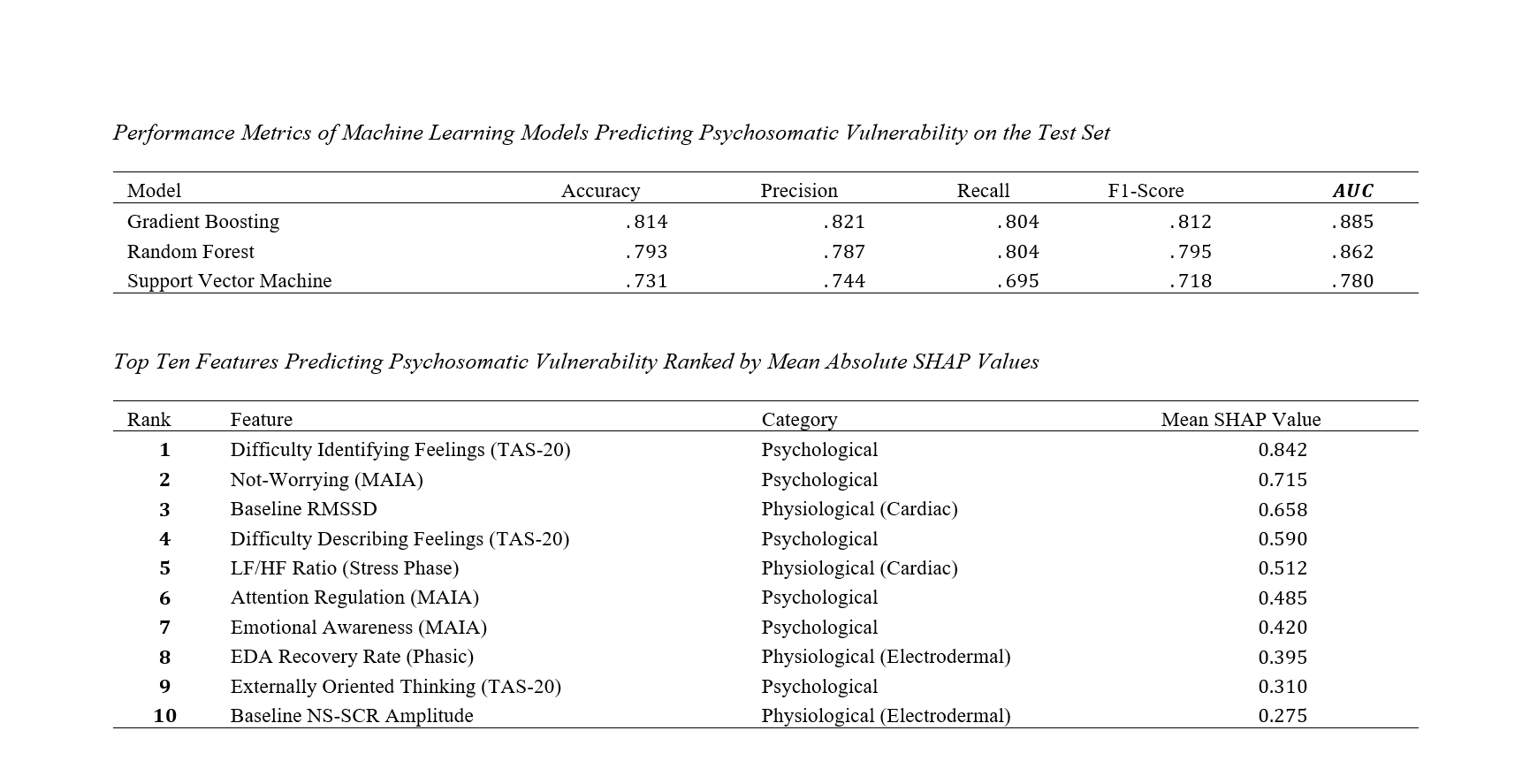
This study aims to predict psychosomatic vulnerability by integrating self-reported measures of alexithymia and interoceptive awareness with objective autonomic indices using a machine-learning approach. This cross-sectional observational study included healthy adult participants (aged to years) recruited from urban centers in Colombia. Self-reported psychological and somatic data were collected using the Toronto Alexithymia Scale (TAS- ), Multidimensional Assessment of Interoceptive Awareness (MAIA), and Somatic Symptom Scale (SSS). Continuous objective physiological data, specifically electrocardiogram and electrodermal activity, were acquired at a sampling rate of Hz during resting, stress induction, and recovery phases. Machine learning models, including Random Forest, Support Vector Machines, and Gradient Boosting, were developed using an / train/test data split and ten-fold cross-validation, with SHapley Additive exPlanations (SHAP) utilized to determine feature importance. The Gradient Boosting model yielded the highest predictive performance, achieving an accuracy of and an Area Under the Curve (AUC) of on the test dataset. SHAP value analysis identified that the top predictors of psychosomatic vulnerability were the “difficulty identifying feelings” facet of the TAS- , the “not-worrying” dimension of the MAIA, baseline root mean square of successive differences (RMSSD), and the low-frequency to high-frequency (LF/HF) power ratio during stress. Psychosomatic vulnerability can be highly accurately predicted by synergistically integrating subjective psychological traits and objective physiological markers through advanced machine learning algorithms.
Downloads
References
Adamowicz, J. L., Sirotiak, Z., & Thomas, E. B. (2024). Childhood Maltreatment and Somatic Symptoms: Examining the Role of Specific Types of Childhood Maltreatment and Alexithymia. Psychological Trauma Theory Research Practice and Policy, 16(Suppl 1), S2-S9. https://doi.org/10.1037/tra0001315
Bijsterbosch, J. M., Hasenack, B., Rooijen, B. v., Sternheim, L., Boelen, P. A., Dijkerman, H. C., & Keizer, A. (2023). Intolerable Feelings of Uncertainty Within the Body: Associations Between Interoceptive Awareness, Intolerance of Uncertainty, and Body Dissatisfaction. Journal of adolescence, 95(8), 1678-1688. https://doi.org/10.1002/jad.12237
Blaettler, L. T., Stewart, J. A., & Holtforth, M. G. (2019). Alexithymia moderates effects of psychotherapeutic treatment expectations on depression outcome in interdisciplinary chronic pain treatment. Journal of psychosomatic research, 122, 69-72. https://doi.org/10.1016/j.jpsychores.2019.04.010
Brown, T. A., Vanzhula, I. A., Reilly, E. E., Levinson, C. A., Berner, L. A., Krueger, A., Lavender, J. M., Kaye, W. H., & Wierenga, C. E. (2020). Body Mistrust Bridges Interoceptive Awareness and Eating Disorder Symptoms. Journal of abnormal psychology, 129(5), 445-456. https://doi.org/10.1037/abn0000516
Bullock, A. J., & Goldbacher, E. M. (2023). Interoceptive awareness and emotional eating in college women: the role of appetite and emotional awareness. Journal of American College Health, 71(8), 2445-2450. https://doi.org/10.1080/07448481.2021.1970566
Gatta, M., Angelico, C., Rigoni, F., Raffagnato, A., & Miscioscia, M. (2022). Alexithymia and Psychopathological Manifestations Centered on the Body: Somatization and Self-Harm. Journal of clinical medicine, 11(8), 2220. https://doi.org/10.3390/jcm11082220
Ghavanati, J. F., Ehteshami, Z., & Parvin. (2025). Effectiveness of Emotion-Based Group Family Therapy on Self-Differentiation and Alexithymia in Adolescent Girls with Psychosomatic Disorders. Scientific Journal of Ruyesh Psychology, 13(9), 121-130. https://frooyesh.ir/article-1-5385-fa.html
Hooshmandi, R., Aljaberi, M. A., Hammadi, F., & Ma, J. (2024). The Impact of Interoceptive Awareness on Pain Catastrophizing and Illness Perception. Journal of Personality and Psychosomatic Research (JPPR), 2(2), 4-10. https://doi.org/10.61838/kman.jppr.2.2.2
Jones, A., Silas, J., Todd, J., Stewart, A. L., Acree, M., Coulson, M., & Mehling, W. (2020). Exploring the Multidimensional Assessment of Interoceptive Awareness in Youth Aged 7–17 Years. Journal of Clinical Psychology, 77(3), 661-682. https://doi.org/10.1002/jclp.23067
Liné, C., Lachal, J., & Andrieu, B. (2022). Obesity and Interoceptive Awareness: A Preliminary Qualitative Study of Hospitalized Adolescent Girls With Obesity. L Évolution Psychiatrique, 87(1), e1-e18. https://doi.org/10.1016/j.evopsy.2021.12.001
Lundberg, K. (2023). The effect of mindfulness-based cognitive therapy on alexithymia in fibromyalgia: A randomized controlled trial. Journal of psychosomatic research, 165, 111156.
Martino, G., Caputo, A., Schwarz, P., Bellone, F., Fries, W., Quattropani, M. C., & Vicario, C. M. (2020). Alexithymia and Inflammatory Bowel Disease: A Systematic Review [Systematic Review]. Frontiers in psychology, 11. https://doi.org/10.3389/fpsyg.2020.01763
Mohammadi Begi, M. (2023). A structural model predicting somatic symptoms based on childhood trauma, emotional alexithymia, and perceived social support with the mediating role of depression/anxiety/stress in patients with epilepsy
Mohammadi, M., & Jafari, R. (2020). The Mediating Role of Alexithymia in the Relationship Between Perceived Social Support and Somatic Complaints in Depressed Women. Woman & Society Quarterly, 11(44), 199-216. https://www.sid.ir/paper/999629/en
Myles, L. A. M., Merlo, Emanuele Maria. (2021). Alexithymia and physical outcomes in psychosomatic subjects: a cross-sectional study. Journal of Mind and Medical Sciences, 8(1), 86-93. https://doi.org/10.22543/7674.81.P8693
Nakao, M., & Takeuchi, T. (2018). Alexithymia and somatosensory amplification link perceived psychosocial stress and somatic symptoms in outpatients with psychosomatic illness. Journal of clinical medicine, 7(5), 112. https://doi.org/10.3390/jcm7050112
O’Malley, P. (2023). Alexithymia in Children/ Adolescents and Psychosomatic Families. In J. M. Maldonado-Duran, A. Jimenez-Gomez, & K. Saxena (Eds.), Handbook of Mind/Body Integration in Child and Adolescent Development (pp. 157-166). Springer International Publishing. https://doi.org/10.1007/978-3-031-18377-5_11
pardh, A. M., Karami, J., & Moradi, A. (2022). Role of Experiential Avoidance and Alexithymia in the Prediction of Psychosomatic Disorder Among the Employees at National Iranian South Oil Company. Journal of Ilam University of Medical Sciences, 30(2), 63-70. https://doi.org/10.52547/sjimu.30.2.63
Porcelli, P., De Carne, M., & Leandro, G. (2020). Distinct associations of DSM-5 Somatic Symptom Disorder, the Diagnostic Criteria for Psychosomatic Research-Revised (DCPR-R) and symptom severity in patients with irritable bowel syndrome. General Hospital Psychiatry, 64, 56-62. https://doi.org/10.1016/j.genhosppsych.2020.03.004
Renzi, A., Conte, G., & Tambelli, R. (2022). Somatic, Emotional and Behavioral Symptomatology in Children During COVID-19 Pandemic: The Role of Children’s and Parents’ Alexithymia. Healthcare, 10(11), 2171. https://doi.org/10.3390/healthcare10112171
Riboli, G. (2022). Multidimensional Interoceptive Awareness, Psychosomatic Symptoms, and Risk for Eating Disorders in a Female at Birth Adolescent Sample. Curr Res Psychol Behav Sc, 3(2), 1-4. https://doi.org/10.54026/crpbs/1040
Saffarian Toosi, M. R., & Khadivi Rofugar, G. R. (2020). Alexithymia and Psychological Well-Being in Adolescent Girl Students with Psychosomatic Problems: Mediation of Loneliness. Contemporary Psychology, Biannual Journal of the Iranian Psychological Association, 15(1), 53-67.
Smith, R., Persich, M. R., Chuning, A. E., Cloonan, S., Woods-Lubert, R., Skalamera, J., & Killgore, W. D. (2024). Improvements in mindfulness, interoceptive and emotional awareness, emotion regulation, and interpersonal emotion management following completion of an online emotional skills training program. Emotion, 24(2), 431. https://doi.org/10.1037/emo0001237
Taylor, G. J., & Bagby, R. M. (2020). Examining Proposed Changes to the Conceptualization of the Alexithymia Construct: The Way Forward Tilts to the Past. Psychotherapy and psychosomatics, 90(3), 145-155. https://doi.org/10.1159/000511988
Todd, J., Aspell, J. E., Barron, D., & Swami, V. (2019). Multiple dimensions of interoceptive awareness are associated with facets of body image in British adults. Body Image, 29, 6-16. https://doi.org/10.1016/j.bodyim.2019.02.003
Westwood, H., Kerr-Gaffney, J., Ståhl, D., & Tchanturia, K. (2017). Alexithymia in Eating Disorders: Systematic Review and Meta-Analyses of Studies Using the Toronto Alexithymia Scale. Journal of psychosomatic research, 99, 66-81. https://doi.org/10.1016/j.jpsychores.2017.06.007
Willem, C., Gandolphe, M.-C., Roussel, M., Verkindt, H., Pattou, F., & Nandrino, J.-L. (2019). Difficulties in emotion regulation and deficits in interoceptive awareness in moderate and severe obesity. Eating and Weight Disorders - Studies on Anorexia, Bulimia and Obesity, 24(4), 633-644. https://doi.org/10.1007/s40519-019-00738-0
Xu, L., & Shi, Y. (2024). Addressing psychosomatic symptom distress with mindfulness-based cognitive therapy in somatic symptom disorder: Mediating effects of self-compassion and alexithymia. Frontiers in Psychiatry, 15. https://doi.org/10.3389/fpsyt.2024.1289872
Zimоglyad, O. E., Ivanova, Y. S., Смирнова, А. П., & Volkova, E. (2023). Alexithymia and Related Mental and Psychosomatic Disorders. Clinical Medicine (Russian Journal), 101(4-5), 223-228. https://doi.org/10.30629/0023-2149-2023-101-4-5-223-228
Zulkifli, N., Abalorio, B., & Muñoz, N. G. (2025). Cognitive Avoidance and Somatic Complaints in Adolescents: The Mediating Role of Interoceptive Awareness. Jayps, 6(1), 156-165. https://doi.org/10.61838/kman.jayps.6.1.17
Downloads
Additional Files
Publication Timeline
- Submitted
- Revised
- Accepted