Predictive Modeling of Health Anxiety From Personality Dimensions and Physiological Stress Parameters
Keywords:
Health Anxiety, Personality Dimensions, Neuroticism, Heart Rate VariabilityAbstract
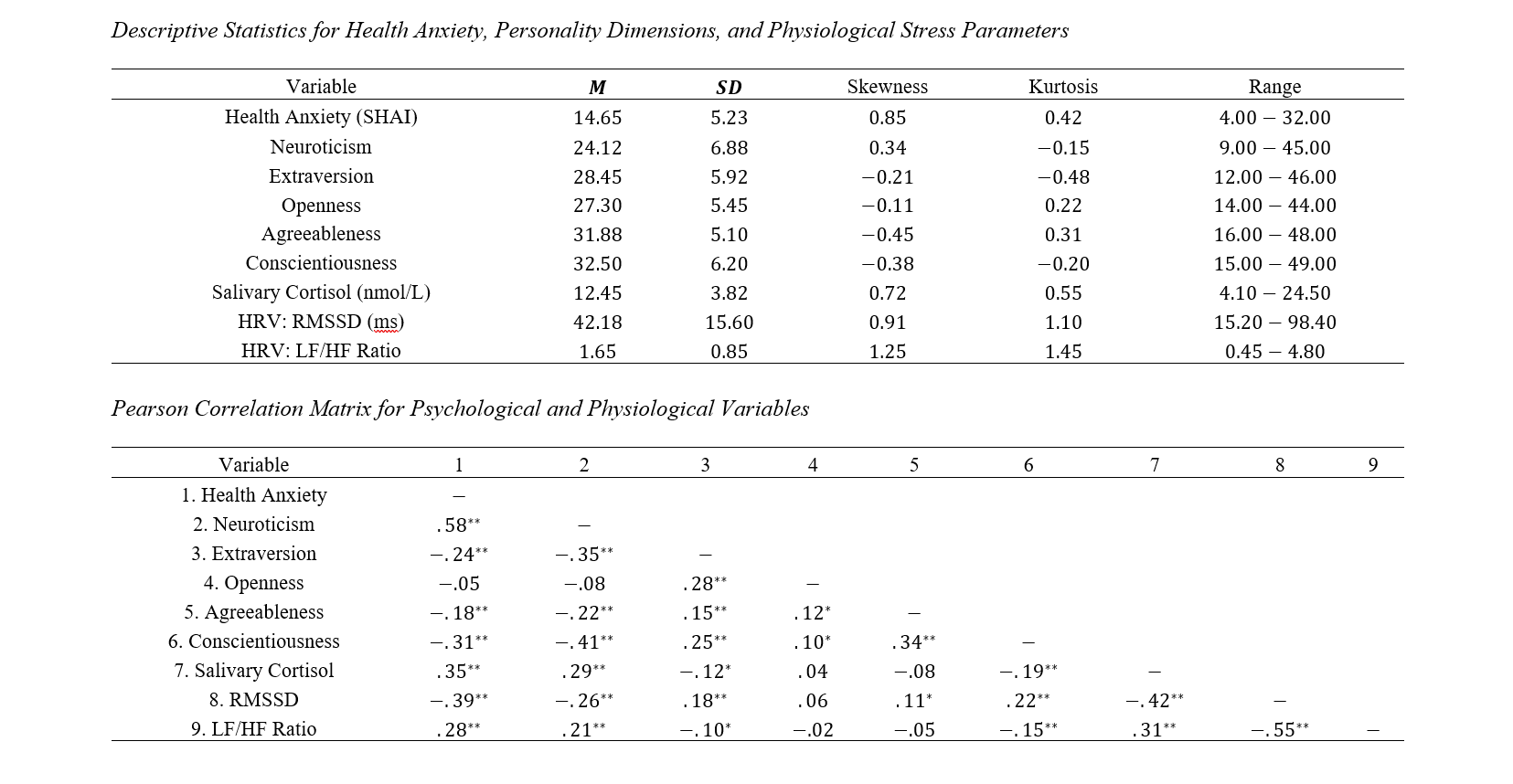
The primary objective of this study was to develop a comprehensive predictive model of health anxiety by integrating foundational personality dimensions with objective physiological stress parameters. This cross-sectional study evaluated a sample of healthy adults in Taiwan. Psychological constructs were measured utilizing the Short Health Anxiety Inventory and the NEO Five-Factor Inventory. Objective physiological stress was quantified through baseline salivary cortisol assays and continuous heart rate variability monitoring to measure the root mean square of successive differences (RMSSD). Statistical evaluation was conducted using hierarchical multiple regression modeling to determine the incremental predictive validity of the physiological variables. The sample consisted of females with a mean age of . The final hierarchical regression model was highly significant and accounted for of the total variance in health anxiety. Trait neuroticism was the strongest psychological predictor ( ). Crucially, objective biological markers provided significant incremental predictive validity, with elevated baseline salivary cortisol ( ) and reduced parasympathetic vagal tone as measured by RMSSD ( ) serving as significant independent predictors of heightened health anxiety. Health anxiety is a profoundly psychophysiological condition driven by a synergistic interaction between inherent characterological vulnerabilities, such as neuroticism, and systemic autonomic and neuroendocrine dysregulation.
Downloads
References
Aghajani, S., Parzor, P., & Ahmadi, S. (2022). The role of risk perception and social isolation in predicting COVID-19 anxiety through the mediation of health anxiety in students. Journal of Health and Care, 23(1), 7-19. https://doi.org/10.52547/jhc.23.1.7
Andrei, A.-M., Webb, R., & Enea, V. (2023). Health anxiety, death anxiety and coronaphobia: Predictors of postpartum depression symptomatology during the COVID-19 pandemic. Midwifery, 124, 103747. https://doi.org/10.1016/j.midw.2023.103747
Benke, C., Wallenfels, L.-M., Bleichhardt, G., & Melzig, C. A. (2024). Health Anxiety Amplifies Fearful Responses to Illness-Related Imagery. Scientific reports, 14(1). https://doi.org/10.1038/s41598-024-54985-y
Bükrük, T., & Aldemir, İ. D. (2024). The Role of Looming Cognitive Style in Health Anxiety Through the Mediation of Anxiety Sensitivity and Intolerance of Uncertainty. Klinik Psikoloji Dergisi. https://doi.org/10.57127/kpd.26024438.1533544
Bulut, S., Saadati, N., Al-Dossary, S. A., Coelho, O., Rostami, M., Parsakia, K., Zadhasn, Z., Seyed Ali Tabar, S. H., & Mehdi Abadi, P. (2025). Introspective Awareness and Its Predictive Power on Health Anxiety: A Cross-sectional Study. Journal of Research and Health, 15(1), 71-80. https://jrh.gmu.ac.ir/article-1-2529-fa.html
Chan, C., Lau, B. H. P., Chan, T. H. Y., Leung, H. T., So, G. Y. K., & Chan, C. (2020). Examining the Moderating Role of Patient Enablement on the Relationship Between Health Anxiety and Psychosomatic Distress: A Cross-Sectional Study at a Traditional Chinese Medicine Outpatient Clinic in Hong Kong. Frontiers in psychology, 11. https://doi.org/10.3389/fpsyg.2020.01081
Dehghanizadeh, Z., Allame, Z., & Eydi-Baygi, M. (2021). Prediction of Health Anxiety Based on Spiritual Well-Being and Cognitive Emotion Regulation Strategies During COVID-19 in Iranian Individuals. Annals of Military and Health Sciences Research, 19(2). https://doi.org/10.5812/amh.113454
Enayatian, A., Fakouri Haji Yaar, H., & Akbari Amrghan, H. (2024). Developing a Causal Model of the Relationship Between Sleep Quality, Health Anxiety, Emotion Regulation, and Emotional Exhaustion Mediated by Cognitive Styles in Nurses with Chronic Fatigue Syndrome. Nursing Education, 13(2), 75-88. https://jne.ir/article-1-1598-fa.html
Keen, E., Kangas, M., & Gilchrist, P. T. (2022). A systematic review evaluating metacognitive beliefs in health anxiety and somatic distress. British Journal of Health Psychology, 27(4), 1398-1422. https://doi.org/10.1111/bjhp.12609
Mohamadi Nia, N., & Nasehi, A. (2023). Prediction of health anxiety based on non-tolerance of uncertainty: mediating role of cognitive flexibility and cyberchondria in women with breast cancer. Quarterly of Breast Illness, 16(3). https://doi.org/10.30699/ijbd.16.3.65
Mohsenabadi, H., Pirmoradi, M. R., Tajrishi, K. Z., & Gharraee, B. (2025). A Transdiagnostic Approach to Investigate of the Relationships Between Anxiety Sensitivity and Health Anxiety: The Mediated Roles of Distress Tolerance and Emotion Regulation. Frontiers in Psychiatry, 16. https://doi.org/10.3389/fpsyt.2025.1478442
Nikčević, A. V., Marino, C., Kolubinski, D. C., Leach, D. M., & Spada, M. M. (2021). Modelling the Contribution of the Big Five Personality Traits, Health Anxiety, and COVID-19 Psychological Distress to Generalised Anxiety and Depressive Symptoms During the COVID-19 Pandemic. Journal of affective disorders, 10(1), 39-53. https://doi.org/10.1016/j.jad.2020.10.053
Nkyi, A. K., & Baaba, B. (2024). Coping, health anxiety, and stress among health professionals during Covid-19, Cape Coast, Ghana. PLoS One, 19(1), e0296720. https://doi.org/10.1371/journal.pone.0296720
Polat, K. (2025). Relationships Between Health Anxiety, Intolerance of Uncertainty, Rumination and Self-Compassion: A Structural Equation and Latent Profile Analysis. International Journal of Eurasia Social Sciences, 16(59), 290-313. https://doi.org/10.70736/ijoess.552
Sauer, K. S., Witthöft, M., & Rief, W. (2023). Somatic Symptom Disorder and Health Anxiety: Assessment and Management. Neurologic Clinics, 41(4), 745-758. https://doi.org/10.1016/j.ncl.2023.02.009
Shahamatinejad, S. (2021). The Relationship between Health Anxiety and Emotion Regulation with Rumors on Social Networks during the COVID-19 Pandemic. Journal of Assessment and Research in Applied Counseling (JARAC), 3(1), 38-48. https://journals.kmanpub.com/index.php/jarac/article/view/48
Sharmi Alamdari, F., Mirzapour Alamdari, M., Khanekeshi, A., Hasanzadeh, M., & Yazdani, F. (2023). Correlation of personality traits and cognitive emotion regulation strategies with health anxiety during the COVID-19 pandemic. Shenakht Journal of Psychology and Psychiatry, 10(2), 95-106. https://doi.org/10.32598/shenakht.10.2.95
Shi, C., Du, X., Chen, W., & Ren, Z. (2024). Predictive Roles of Cognitive Biases in Health Anxiety: A Machine Learning Approach. Stress and Health, 40(5). https://doi.org/10.1002/smi.3463
Shivak, S., Caissie, D. M., Power, H. A., Asmundson, A. J. N., & Wright, K. D. (2023). The Relationship Between Maladaptive Health Beliefs, Pandemic-Related Stress, and Health Anxiety During the COVID-19 Pandemic. Health Psychology Report. https://doi.org/10.5114/hpr/169169
Skjernov, M., Bach, B., Fink, P., Fallon, B., Soegaard, U., & Simonsen, E. (2020). DSM-5 personality disorders and traits in patients with severe health anxiety. The Journal of Nervous and Mental Disease, 208(2), 108-117. https://doi.org/10.1097/NMD.0000000000001108
Yousefi Salekdeh, B., Soltani Shal, R., & Shakerinia, A. (2023). The role of irrational health beliefs, health locus of control, and health anxiety in predicting COVID-19 anxiety. Rooyesh-e-Ravanshenasi (Psychological Growth), 12(11), 33-42. http://frooyesh.ir/article-1-4671-fa.html
Downloads
Additional Files
Publication Timeline
- Submitted
- Revised
- Accepted