
Sensory Processing Sensitivity and Migraine-Related Disability: A Longitudinal Mediation Model Through Body Vigilance and Sleep Disturbance
Keywords:
sensory processing sensitivity, migraine, migraine-related disability, body vigilance, sleep disturbance, longitudinal mediationAbstract
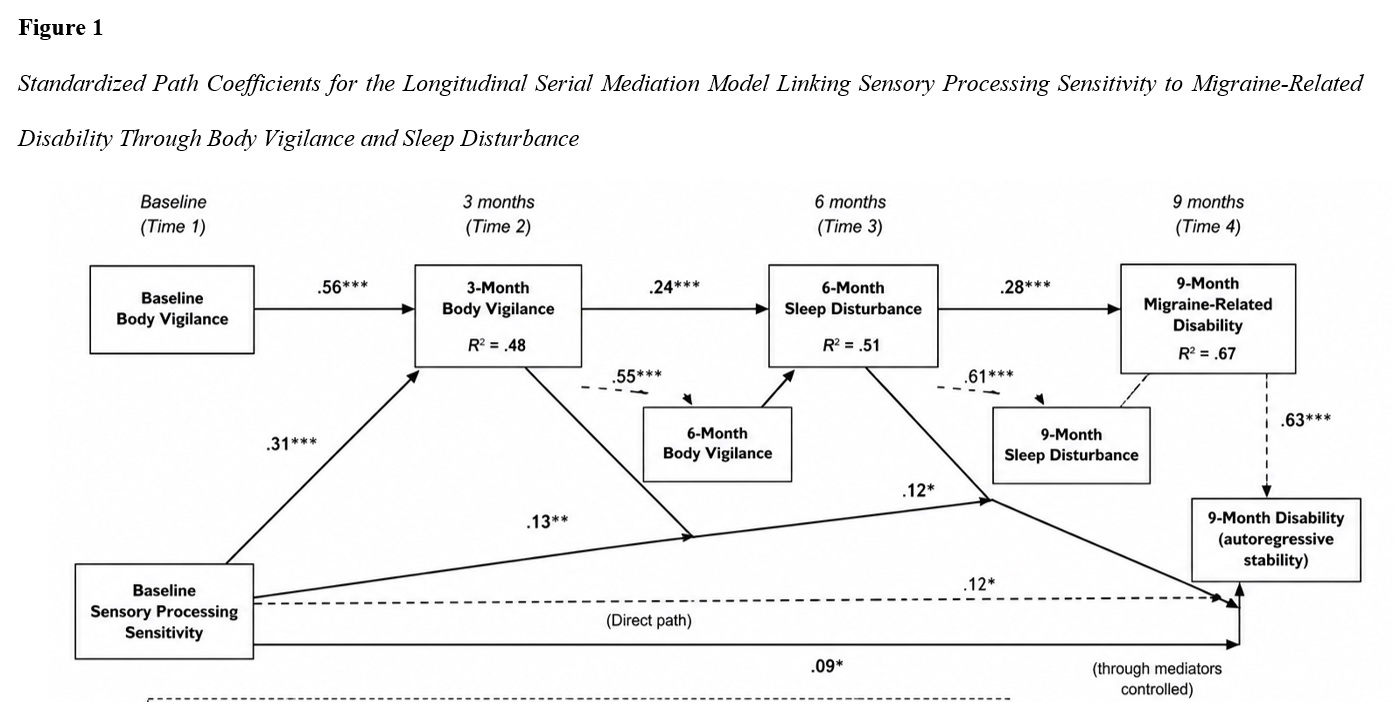
This study aimed to examine the longitudinal association between sensory processing sensitivity and migraine-related disability and to determine whether body vigilance and sleep disturbance sequentially mediated this relationship among Canadian adults with migraine. A prospective four-wave longitudinal study was conducted with 352 Canadian adults diagnosed with migraine. Data were collected at baseline and at three-, six-, and nine-month follow-ups. Sensory processing sensitivity was assessed using the Highly Sensitive Person Scale, body vigilance was measured with the Body Vigilance Scale, sleep disturbance was evaluated using the PROMIS Sleep Disturbance Short Form, and migraine-related disability was assessed with the Migraine Disability Assessment questionnaire. The hypothesized serial mediation model specified baseline sensory processing sensitivity as the predictor, three-month body vigilance as the first mediator, six-month sleep disturbance as the second mediator, and nine-month migraine-related disability as the outcome. Longitudinal structural equation modeling with robust maximum likelihood estimation and full-information maximum likelihood was used. Earlier levels of the mediators and outcome, age, gender, migraine duration, monthly migraine days, migraine chronicity, and preventive medication use were controlled. The hypothesized serial mediation model demonstrated good fit, χ²(44) = 68.21, p = .011, CFI = .976, TLI = .958, RMSEA = .040, and SRMR = .035. Sensory processing sensitivity significantly predicted three-month body vigilance, β = .310, p < .001; body vigilance predicted six-month sleep disturbance, β = .240, p < .001; and sleep disturbance predicted nine-month migraine-related disability, β = .280, p < .001. The serial indirect effect was significant, β = .021, 95% CI [.010, .038], p = .002. The total indirect effect was also significant, β = .094, 95% CI [.049, .151], p < .001, while the remaining direct effect indicated partial mediation. Greater sensory processing sensitivity may contribute to subsequent migraine-related disability partly through increased monitoring of bodily sensations and later sleep disturbance, highlighting body vigilance and sleep as potentially modifiable intervention targets.
Downloads
Downloads
Additional Files
Publication Timeline
- Submitted
- Revised
- Accepted