Modeling the Influence of Fear‑Avoidance Beliefs and Cognitive Biases on Psychosomatic Symptom Maintenance Using Machine Learning
Keywords:
psychosomatic symptoms, fear‑avoidance beliefs, cognitive bias, machine learning, health anxiety, chronic painAbstract
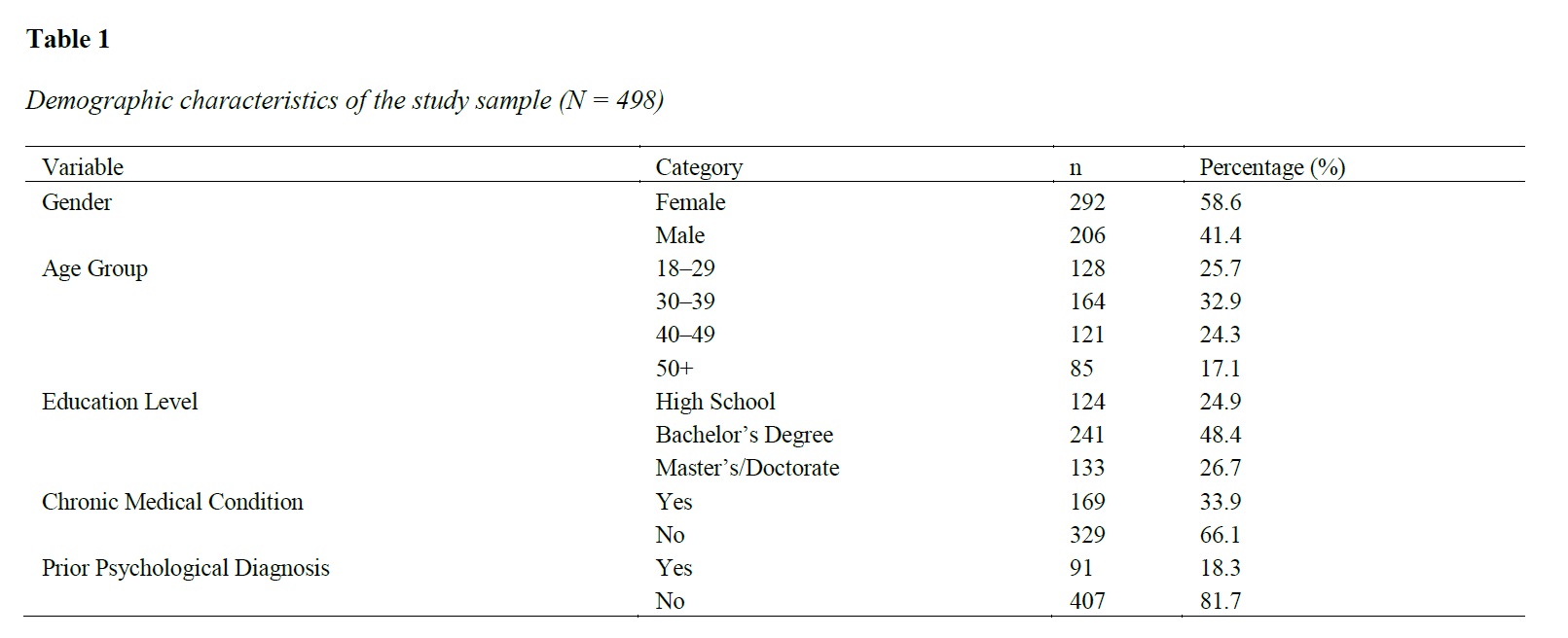
This study aimed to model the influence of fear‑avoidance beliefs and cognitive biases on psychosomatic symptom maintenance using machine learning techniques. A cross‑sectional study was conducted among 512 adults recruited from the general population in Romania. Psychosomatic symptom severity was assessed using the Patient Health Questionnaire‑15 (PHQ‑15), fear‑avoidance beliefs were measured with the Fear‑Avoidance Beliefs Questionnaire (FABQ), and health anxiety and cognitive bias related to bodily sensations were assessed using the Health Anxiety Inventory and a cognitive bias measure. Data were analyzed using several machine learning algorithms, including Random Forest, Gradient Boosting, Support Vector Regression, and Linear Regression. Model performance was evaluated using mean squared error (MSE), root mean squared error (RMSE), and the coefficient of determination (R²), and feature importance analysis was conducted to identify the most influential predictors of psychosomatic symptom severity. After data screening, the final sample consisted of 498 participants (mean age = 36.8 ± 11.4 years). The mean psychosomatic symptom score measured by the PHQ‑15 was 10.9 ± 5.7. Significant positive correlations were observed between psychosomatic symptoms and health anxiety (r = 0.61), cognitive bias (r = 0.57), and fear‑avoidance beliefs (r = 0.52). Among the machine learning models, the Random Forest algorithm demonstrated the best predictive performance, explaining 68% of the variance in psychosomatic symptom severity (R² = 0.68). Feature importance analysis indicated that health anxiety, cognitive bias, and fear‑avoidance beliefs were the most influential predictors of psychosomatic symptoms. Fear‑avoidance beliefs and cognitive biases play a significant role in the maintenance of psychosomatic symptoms.
Downloads
References
Boersma, K., Södermark, M., Hesser, H., Flink, I. K., Gerdle, B., & Linton, S. J. (2019). Efficacy of a transdiagnostic emotion–focused exposure treatment for chronic pain patients with comorbid anxiety and depression: a randomized controlled trial. Pain, 160(8). https://journals.lww.com/pain/fulltext/2019/08000/efficacy_of_a_transdiagnostic_emotion_focused.6.aspx
De Baets, L., Meulders, A., Van Damme, S., Caneiro, J. P., & Matheve, T. (2023). Understanding Discrepancies in a Person's Fear of Movement and Avoidance Behavior: A Guide for Musculoskeletal Rehabilitation Clinicians Who Support People With Chronic Musculoskeletal Pain. Journal of Orthopaedic & Sports Physical Therapy, 53(5), 307-316. https://doi.org/10.2519/jospt.2023.11420
Doménech, J., Angulo, A. E., Peñalver-Barrios, L., Rio-González, E. D., Herrero, R., García‐Palacios, A., Díaz, M. M., Garreta-Catalá, I., Díez-Ulloa, M.-A., & Baños-Rivera, R. M. (2025). Catastrophizing and Fear Avoidance Beliefs in Chronic Low Back Pain: A Cross-Sectional Study. European Journal of Physical and Rehabilitation Medicine, 61(2). https://doi.org/10.23736/s1973-9087.25.08419-9
Linton, S. J., & Shaw, W. S. (2018). Impact of fear-avoidance beliefs on pain persistence: Implications for rehabilitation interventions. Pain Management, 8(6), 405-415. https://doi.org/10.2217/pmt-2018-0032
Marshall, A., Joyce, C. T., Tseng, B., Gerlovin, H., Yeh, G. Y., Sherman, K. J., Saper, R. B., & Roseen, E. J. (2022). Changes in Pain Self-Efficacy, Coping Skills, and Fear-Avoidance Beliefs in a Randomized Controlled Trial of Yoga, Physical Therapy, and Education for Chronic Low Back Pain. Pain Medicine, 23(4), 834-843. https://doi.org/10.1093/pm/pnab318
McCracken, L. M., & Keogh, E. (2009). Acceptance, mindfulness, and values-based action may counteract fear and avoidance of emotions in chronic pain: an analysis of anxiety sensitivity. The Journal of Pain, 10(4), 408-415. https://doi.org/10.1016/j.jpain.2008.09.015
Payne, R. T., Holloway, D., & Mercer, L. (2021). Cognitive-emotional mechanisms in chronic pelvic pain: The mediating role of fear, avoidance, and attentional bias. Journal of psychosomatic research, 145, 110473. https://doi.org/10.1016/j.jpsychores.2021.110473
Pedler, A., Kamper, S. J., Maujean, A., & Sterling, M. (2018). Investigating the fear avoidance model in people with whiplash: the association between fear of movement and in vivo activity. The Clinical Journal of Pain, 34(2), 130-137. https://doi.org/10.1097/AJP.0000000000000524
Pilar Martínez Narváez-Cabeza de, V., Sánchez, A. I., Miró, E., Medina, A., & Lami, M. J. (2011). The Relationship Between the Fear-Avoidance Model of Pain and Personality Traits in Fibromyalgia Patients. Journal of Clinical Psychology in Medical Settings, 18(4), 380-391. https://doi.org/10.1007/s10880-011-9263-2
Rajaeinia, A. (2022). Effectiveness of Cognitive Behavior Group Therapy on decreasing perfectionism, increasing positive affect and mental performance in Female Clergies. International Journal of Education and Cognitive Sciences, 2(4), 45-53. https://doi.org/10.22034/injoeas.2022.160688
Rogers, D. G., Protti, T. A., & Smitherman, T. A. (2020). Fear, Avoidance, and Disability in Headache Disorders. Current Pain and Headache Reports, 24, 1-8. https://doi.org/10.1007/s11916-020-00865-9
Tawil, S., Kassis, V., Bassil, T., Farhat, K., Hourani, E., Massoud, L., & Najem, C. (2025). Intermediary role of mental toughness beliefs on the relationship between pain self-efficacy and fear avoidance in Elite injured athletes. BMC Sports Science, Medicine and Rehabilitation, 17(1), 124. https://doi.org/10.1186/s13102-025-01171-w
Vlaeyen, J. W., & Linton, S. J. (2000). Fear-avoidance and its consequences in chronic musculoskeletal pain: A state of the art. Pain, 85(3), 317-332. https://doi.org/10.1016/S0304-3959(99)00242-0
Vlaeyen, J. W. S., & Linton, S. J. (2012). Fear-avoidance model of chronic musculoskeletal pain: 12 years on. Pain, 153(6), 1144-1147. https://doi.org/10.1016/j.pain.2011.12.009
Yang, J., Lo, W. L. A., Zheng, F., Cheng, X., Yu, Q., & Wang, C. (2022). Evaluation of Cognitive Behavioral Therapy on Improving Pain, Fear Avoidance, and Self‐Efficacy in Patients with Chronic Low Back Pain: A Systematic Review and Meta‐Analysis. Pain Research and Management, 2022(1), 4276175. https://doi.org/10.1155/2022/4276175
Downloads
Additional Files
Publication Timeline
- Submitted
- Revised
- Accepted