Personality‑Based Digital Phenotyping of Psychosomatic Health Using Machine Learning
DOI:
https://doi.org/10.61838/kman.jppr.5163Keywords:
digital phenotyping, personality traits, psychosomatic health, machine learning, smartphone behavior, neuroticismAbstract
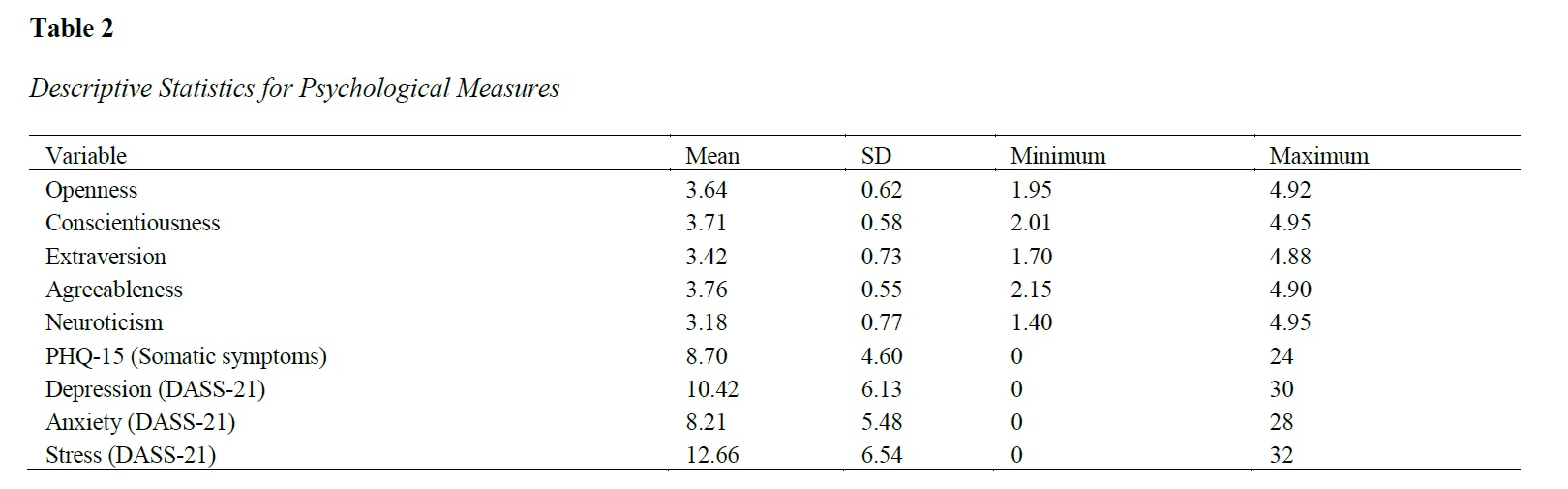
This study aimed to investigate whether integrating personality traits with smartphone‑derived digital phenotyping indicators can predict psychosomatic health using machine learning models. A cross‑sectional study was conducted with 524 adult participants recruited from Germany. Personality traits were assessed using the Big Five Inventory (BFI‑44), psychosomatic symptoms were measured using the Patient Health Questionnaire (PHQ‑15), and psychological distress was evaluated using the Depression Anxiety Stress Scales (DASS‑21). Participants also installed a custom smartphone application that passively collected behavioral data for four weeks, including daily phone usage duration, nighttime phone inactivity, communication frequency, response latency, and mobility variability. Data analysis involved descriptive statistics, correlation analyses, and machine learning modeling using Random Forest, Support Vector Machine, Logistic Regression, and Gradient Boosting algorithms implemented in Python with scikit‑learn. Model performance was evaluated using accuracy, precision, recall, F1‑score, and AUC‑ROC metrics. The sample consisted of 524 participants (mean age = 29.4 ± 7.8 years), including 56% females and 44% males. Moderate to severe psychosomatic symptoms were identified in 31.5% of participants based on PHQ‑15 scores. Neuroticism showed significant positive correlations with psychosomatic symptoms (r = 0.46), depression (r = 0.49), anxiety (r = 0.52), and stress (r = 0.47), while conscientiousness and agreeableness showed negative correlations with psychosomatic symptoms (r = −0.28 and r = −0.21, respectively). Participants with higher psychosomatic symptom scores demonstrated longer daily smartphone usage (mean = 5.2 hours vs. 3.7 hours), reduced nighttime inactivity periods (mean = 5.8 hours vs. 7.1 hours), and lower mobility variability. Among the predictive models, Gradient Boosting achieved the best performance with an accuracy of 0.82, F1‑score of 0.80, and AUC‑ROC of 0.87, outperforming Random Forest (accuracy = 0.79), Support Vector Machine (accuracy = 0.76), and Logistic Regression (accuracy = 0.73). The findings suggest that combining personality assessments with smartphone‑based digital phenotyping can effectively predict psychosomatic health and may support early identification of psychosomatic risk through machine learning approaches.
Downloads
References
Ahmadabadi, M. S. (2025). Identifying the Psychological and Somatic Dimensions of Neuroticism: A Qualitative Approach. Journal of Personality and Psychosomatic Research, 3(1), 40-47. https://doi.org/10.61838/kman.jppr.3.1.6
Asanova, A., & Mukharovska, I. (2023). Study of Psychological Phenomena in the Structure of Chronic Pain: Depression, Anxiety, Catastrophizing. Literature Review. Psychosomatic Medicine and General Practice, 8(4). https://doi.org/10.26766/pmgp.v8i4.505
Bulut, S., Bukhori, B., & Bhat, R. H. (2024). The Experience of Psychosomatic Disorders among Adolescents: Challenges and Coping Strategies. Journal of Personality and Psychosomatic Research (JPPR), 2(2), 19-25. https://doi.org/10.61838/kman.jppr.2.2.4
Doreste, A., Pujol, J., Penelo, E., Pérez, V., Blanco‐Hinojo, L., Martínez‐Vilavella, G., Ojeda, F., Monfort, J., & Deus, J. (2025). Personality Assessment Inventory in Fibromyalgia: Links to Functional, Physical–Somatic, and Emotional Impact. European Journal of Investigation in Health Psychology and Education, 15(8), 149. https://doi.org/10.3390/ejihpe15080149
Giampà, A. (2024). Embodied online therapy”: The efficacy of somatic and psychological treatment delivered digitally. Advances in Medicine, Psychology, and Public Health, 1(3), 164–169. https://doi.org/10.5281/zenodo.10901015
Gianesini, G., & Brighi, A. (2015). Cyberbullying in the Era of Digital Relationships: The Unique Role of Resilience and Emotion Regulation on Adolescents’ Adjustment. In Technology and Youth: Growing Up in a Digital World (Vol. 19, pp. 1-46). Emerald Group Publishing Limited. https://doi.org/10.1108/S1537-466120150000019001
Juul, S., Jakobsen, J. C., Hestbæk, E., Kamp, C. B., Olsen, M. H., Rishede, M., Frandsen, F. W., Bo, S., Poulsen, S., Sørensen, P. S., Bateman, A., & Simonsen, S. (2025). Short-Term Versus Long-Term Mentalization-Based Therapy for Borderline Personality Disorder: 24 Months Follow-Up of a Randomized Clinical Trial. Psychotherapy and psychosomatics, 94(4), 263-272. https://doi.org/10.1159/000544934
Kailanko, S., Wiebe, S. A., Tasca, G. A., Laitila, A. A., & Allan, R. (2022). Somatic experience of emotion in emotionally focused couple therapy: Experienced trainer therapists' views and experiences. Journal of marital and family therapy, 48(3), 677-692. https://onlinelibrary.wiley.com/doi/abs/10.1111/jmft.12543
Kampling, H., Riedl, D., Lampe, A., Nolte, T., Brähler, E., Ernst, M., & Kruse, J. (2025). Somatic symptom disorder and the role of epistemic trust, personality functioning and child abuse: Results from a population-based representative German sample. Journal of affective disorders, 373, 429-437. https://doi.org/10.1016/j.jad.2024.12.096
Kearney, B. E., & Lanius, R. A. (2022). The brain-body disconnect: A somatic sensory basis for trauma-related disorders [Review]. Frontiers in Neuroscience, 16. https://doi.org/10.3389/fnins.2022.1015749
Krause, R., & Forgon, T. (2025). Neuropsychological Aspects of the Patient’s Personality in the Context of Psychosomatic Experience. Frontiers in Psychiatry, 16. https://doi.org/10.3389/fpsyt.2025.1596321
Rostami, M., Bulut, S., Coelho, O., & Riyono, B. (2024). Living with Fibromyalgia: A Phenomenological Study of Pain, Fatigue, and Coping. Journal of Personality and Psychosomatic Research (JPPR), 2(1), 16-23. https://doi.org/10.61838/kman.jppr.2.1.4
Saadati, N., Kiliçaslan, F., & Salami, M. O. (2024). The Psychosomatic Effects of Childhood Trauma: Insights from Adult Survivors. Journal of Personality and Psychosomatic Research (JPPR), 2(2), 34-40. https://doi.org/10.61838/kman.jppr.2.2.6
Schrottenberg, V. v., Kerber, A., Sterner, P., Teusen, C., Beigel, P., Linde, K., Henningsen, P., Herpertz, S. C., Gensichen, J., & Schneider, A. (2024). Exploring Associations of Somatic Symptom Disorder With Personality Dysfunction and Specific Maladaptive Traits. Psychopathology, 1-12. https://doi.org/10.1159/000540161
Sefotho, M. M., Serjanaj, B., Karthik, S., & Saadati, S. A. (2024). The Psychosomatic Interface of Stress and Skin Disorders: Patient Experiences and Perceptions. Journal of Personality and Psychosomatic Research (JPPR), 2(2), 26-33. https://doi.org/10.61838/kman.jppr.2.2.5
Seiffge‐Krenke, I., & Sattel, H. (2024). How Personality Factors, Coping With Identity-Stress, and Parental Rearing Styles Contribute to the Expression of Somatic Complaints in Emerging Adults in Seven Countries. Frontiers in Psychiatry, 15. https://doi.org/10.3389/fpsyt.2024.1257403
Shcherbakova, T., & Bespalova, E. I. (2021). Digital Environment and Socialisation of Adolescents With Reduced Somatic Health Status. E3s Web of Conferences, 258, 07088. https://doi.org/10.1051/e3sconf/202125807088
Šnele, M. S., Todorović, J., & Nikolić, M. (2024). Personality Traits and Tendency Towards Psychosomatics. https://doi.org/10.36315/2024inpact107
Downloads
Additional Files
Publication Timeline
- Submitted
- Revised
- Accepted