Predicting Somatic Symptom Disorder Using Facets of Neuroticism, Somatosensory Amplification, and Interoceptive Sensitivity: An Explainable Machine Learning Analysis
DOI:
https://doi.org/10.61838/kman.jppr.5172Keywords:
Somatic Symptom Disorder, Explainable Machine Learning, SHAP, Somatosensory Amplification, Interoceptive Sensitivity, NeuroticismAbstract
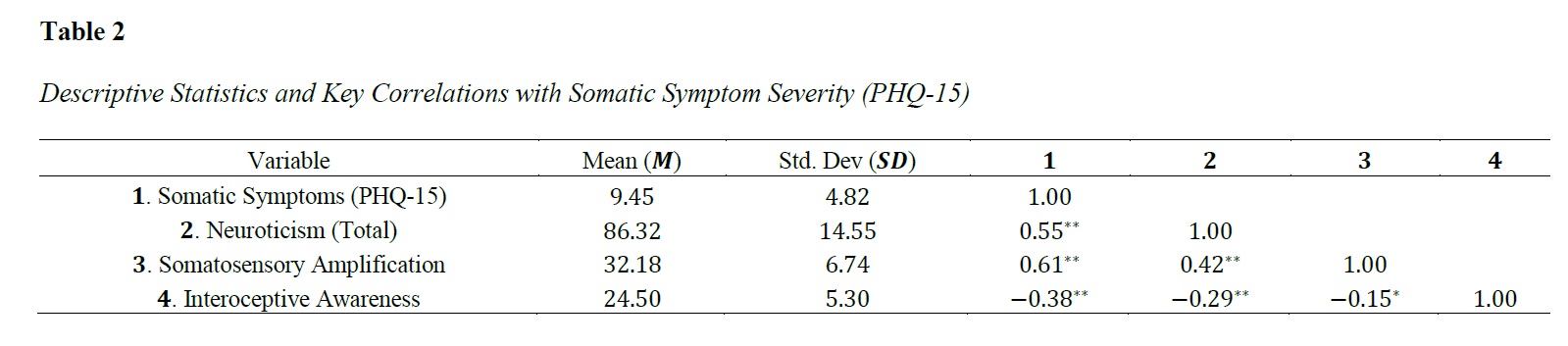
The objective of this study was to utilize an explainable machine learning approach to predict Somatic Symptom Disorder by delineating the complex, non-linear contributions of specific neuroticism facets, somatosensory amplification, and multidimensional interoceptive sensitivity. A quantitative, cross-sectional design was employed with a sample of Malaysian adults. Data were collected using the Patient Health Questionnaire-15 (PHQ-15), the Neuroticism domain of the NEO-PI-R, the Somatosensory Amplification Scale (SSAS), and the Multidimensional Assessment of Interoceptive Awareness (MAIA). Predictive modeling was conducted using advanced ensemble tree-based algorithms (Random Forest, Gradient Boosting, and XGBoost), and model interpretability was achieved using SHapley Additive exPlanations (SHAP) to evaluate the marginal contribution of each psychological feature. The XGBoost algorithm demonstrated superior predictive performance, achieving an overall accuracy of and an Area Under the Curve (AUC) of . SHAP explainability metrics revealed that Somatosensory Amplification was the most profound positive predictor of somatic distress, followed by the specific Anxiety and Vulnerability facets of neuroticism. Conversely, adaptive interoceptive capacities, specifically the “Not-Worrying” and “Body Trusting” dimensions, emerged as the strongest negative (protective) predictors against Somatic Symptom Disorder classification. Explainable machine learning demonstrates that specific sensory appraisal mechanisms and interoceptive deficits are more critical than broad personality domains in driving somatic distress, providing highly specific targets for precision psychological interventions.
Downloads
References
Abdullah, K., Swandari, A., Anggarani, A. P. M., & Aisyah, S. (2022). Somatosensory Stimulation of the Foot Versus Tai Chi to Improve Dynamic Balance in the Elderly. Gaceta Médica De Caracas, 130(Supl. 1). https://doi.org/10.47307/gmc.2022.130.s1.20
Ahmadabadi, M. S. (2025). Identifying the Psychological and Somatic Dimensions of Neuroticism: A Qualitative Approach. Journal of Personality and Psychosomatic Research, 3(1), 40-47. https://doi.org/10.61838/kman.jppr.3.1.6
Bailey, R., & Wells, A. (2013). Does metacognition make a unique contribution to health anxiety when controlling for neuroticism, illness cognition, and somatosensory amplification? Journal of Cognitive Psychotherapy, 27(4), 327-337. https://doi.org/10.1891/0889-8391.27.4.327
Braet, J., & Braet, C. (2024). I Can Feel My Heartbeat: The Relationship Between Interoceptive Abilities and Emotional States During Stress and Recovery in Healthy Adolescents. Psychophysiology, 61(12). https://doi.org/10.1111/psyp.14679
Bullock, A. J., & Goldbacher, E. M. (2023). Interoceptive awareness and emotional eating in college women: the role of appetite and emotional awareness. Journal of American College Health, 71(8), 2445-2450. https://doi.org/10.1080/07448481.2021.1970566
Büyüktaşkın, D., İşeri, E., Güney, E., Günendi, Z., & Çengiz, B. (2021). Somatosensory Temporal Discrimination in Autism Spectrum Disorder. Autism Research, 14(4), 656-667. https://doi.org/10.1002/aur.2479
Datta, N., & Lock, J. (2023). Exploration of Interoceptive Capabilities in Avoidant/Restrictive Food Intake Disorder and Anorexia Nervosa. Journal of eating disorders, 11(1). https://doi.org/10.1186/s40337-023-00914-9
Denovan, A., Dagnall, N., & Lofthouse, G. (2018). Neuroticism and Somatic Complaints: Concomitant Effects of Rumination and Worry. Behavioural and Cognitive Psychotherapy, 47(4), 431-445. https://doi.org/10.1017/s1352465818000619
Farris, S. G., Derby, L., & Kibbey, M. M. (2025). Getting Comfortable with Physical Discomfort: A Scoping Review of Interoceptive Exposure in Physical and Mental Health Conditions. Psychological bulletin, 151(2), 131. https://doi.org/10.1037/bul0000464
Hooshmandi, R., Aljaberi, M. A., Hammadi, F., & Ma, J. (2023). The Impact of Interoceptive Awareness on Pain Catastrophizing and Illness Perception. JPPR, 2(2), 4-10. https://doi.org/10.61838/kman.jppr.2.2.2
Hooshmandi, R., Aljaberi, M. A., Hammadi, F., & Ma, J. (2024). The Impact of Interoceptive Awareness on Pain Catastrophizing and Illness Perception. Journal of Personality and Psychosomatic Research (JPPR), 2(2), 4-10. https://doi.org/10.61838/kman.jppr.2.2.2
Kealy, D., Rice, S. M., Chartier, G. B., & Cox, B. J. (2021). Investigating Attachment Insecurity and Somatosensory Amplification, and the Mediating Role of Interpersonal Problems. European Journal of Health Psychology, 28(3), 120-130. https://doi.org/10.1027/2512-8442/a000078
Kim, D., Triolo, R. J., & Charkhkar, H. (2023). Plantar Somatosensory Restoration Enhances Gait, Speed Perception, and Motor Adaptation. Science Robotics, 8(83). https://doi.org/10.1126/scirobotics.adf8997
Köteles, F., & Witthöft, M. (2017). Somatosensory amplification–An old construct from a new perspective. Journal of psychosomatic research, 101, 1-9.
Lee, D., Kim, S. J., Cheon, J., Jung, Y. C., & Kang, J. I. (2024). Changes in Interoceptive Accuracy Related to Emotional Interference in Somatic Symptom Disorder. BMC psychology, 12(1). https://doi.org/10.1186/s40359-024-01778-7
Lin, L., Qing, W., Zheng, Z., Poon, W. S., Guo, S., Zhang, S., & Hu, X. (2024). Somatosensory Integration in Robot-Assisted Motor Restoration Post-Stroke. Frontiers in Aging Neuroscience, 16. https://doi.org/10.3389/fnagi.2024.1491678
Nakao, M., & Takeuchi, T. (2018). Alexithymia and somatosensory amplification link perceived psychosocial stress and somatic symptoms in outpatients with psychosomatic illness. Journal of clinical medicine, 7(5), 112. https://doi.org/10.3390/jcm7050112
Naraindas, A. M., & Cooney, S. (2023). Body Image Disturbance, Interoceptive Sensibility and the Body Schema Across Female Adulthood: A Pre-Registered Study. Frontiers in psychology, 14. https://doi.org/10.3389/fpsyg.2023.1285216
Naraindas, A. M., McInerney, A., Deschênes, S. S., & Cooney, S. (2025). Differences in the Relationships Between Interoceptive Sensibility and Self-Objectification in Women With High and Low Body Dissatisfaction: A Network Analysis. PLoS One, 20(5), e0323524. https://doi.org/10.1371/journal.pone.0323524
Naraindas, A. M., Moreno, M. C., & Cooney, S. (2023). Beyond Gender: Interoceptive Sensibility as a Key Predictor of Body Image Disturbances. Behavioral Sciences, 14(1), 25. https://doi.org/10.3390/bs14010025
Riquelme, I., Hatem, S. M., Sabater-Gárriz, Á., & Montoya, P. (2023). A Multidimensional Investigation of the Relationship Between Skin-Mediated Somatosensory Signals, Emotion Regulation and Behavior Problems in Autistic Children. Frontiers in Neuroscience, 17. https://doi.org/10.3389/fnins.2023.1227173
Sakaj, E. (2025). Wim Hof’s Breathing Method: Influence on the Autonomic Nervous System and Somatosensory Perception. https://doi.org/10.31234/osf.io/n2d34
Sayed Alitabar, S. H., & Goli, F. (2023). The Interplay of Neuroticism and Self-Efficacy in Pain Catastrophizing: A Quantitative Analysis. Journal of Personality and Psychosomatic Research (JPPR), 1(2), 19-24. https://doi.org/10.61838/kman.jppr.1.2.4
Schaefer, M., Kühnel, A., & Gärtner, M. (2022). Sensory Processing Sensitivity and Somatosensory Brain Activation When Feeling Touch. Scientific reports, 12(1). https://doi.org/10.1038/s41598-022-15497-9
Tymofiyeva, O., Sipes, B. S., Luks, T., Hamlat, E. J., Samson, T. E., Hoffmann, T. J., Glidden, D. V., Jakary, A., Li, Y., Ngan, T., Henje, E., & Yang, T. (2024). Interoceptive Brain Network Mechanisms of Mindfulness-Based Training in Healthy Adolescents. Frontiers in psychology, 15. https://doi.org/10.3389/fpsyg.2024.1410319
Downloads
Additional Files
Publication Timeline
- Submitted
- Revised
- Accepted