Multimodal Machine-Learning Prediction of Eating-Related Psychosomatic Risk Based on Impulsivity, Interoceptive Deficits, Emotional Eating, and Body Mass Index
Keywords:
emotional eating, interoception, impulsivity, body mass index, psychosomatic risk, machine learning, eating behaviorAbstract
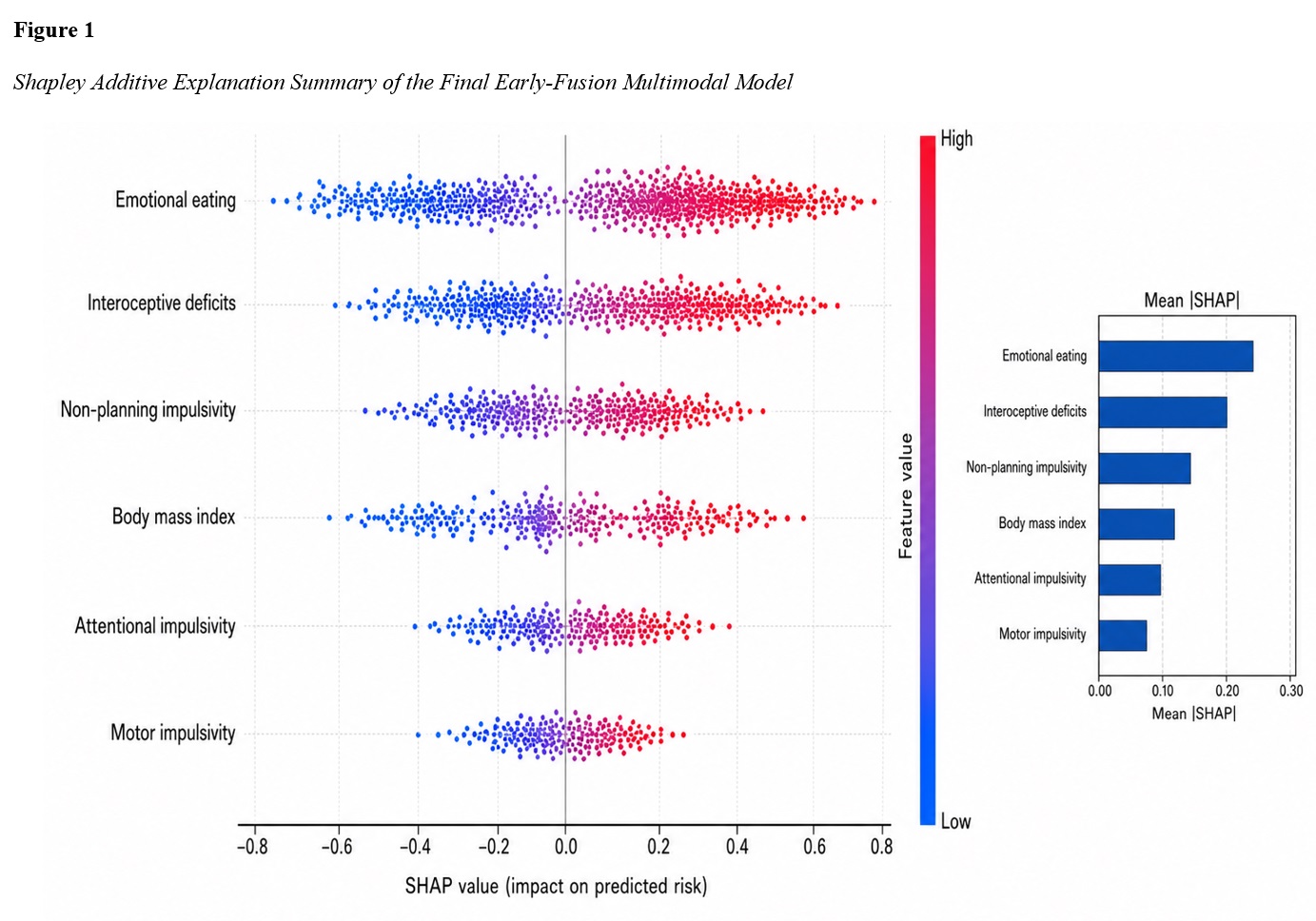
This study aimed to develop, compare, and interpret multimodal machine-learning models for predicting elevated eating-related psychosomatic risk among Mexican adults based on impulsivity, interoceptive deficits, emotional eating, and body mass index. A cross-sectional predictive study was conducted with 812 adults recruited from five metropolitan areas in Mexico. Impulsivity was assessed using the Barratt Impulsiveness Scale–11, interoceptive deficits using the corresponding subscale of the Eating Disorder Inventory–3, emotional eating using the Dutch Eating Behavior Questionnaire, and body mass index through standardized height and weight measurements. Elevated eating-related psychosomatic risk was defined as the simultaneous presence of clinically relevant disordered eating attitudes and moderate or greater somatic symptom burden. The sample was stratified into a development set of 650 participants and an independent test set of 162 participants. Logistic regression, elastic-net regression, support vector machine, random forest, extreme gradient boosting, and early- and late-fusion multimodal neural networks were evaluated using nested cross-validation. Emotional eating, interoceptive deficits, impulsivity, and body mass index were significantly and positively associated with the continuous psychosomatic-risk index. The early-fusion multimodal neural network produced the strongest test-set performance, with an ROC–AUC of .905, precision–recall AUC of .742, sensitivity of .882, specificity of .875, balanced accuracy of .879, and Brier score of .098. It significantly outperformed conventional logistic regression. Ablation analyses showed that excluding emotional eating produced the largest reduction in predictive accuracy, followed by removing interoceptive deficits and impulsivity. Body mass index alone showed limited discrimination, whereas its addition modestly improved the psychometric model. Eating-related psychosomatic risk was predicted most accurately through integration of emotional, interoceptive, behavioral, and anthropometric information, with emotional eating and interoceptive deficits representing the most influential predictors.
Downloads
References
Amianto, F., Arletti, L., Vesco, S., Davico, C., & Vitiello, B. (2022). Therapeutic Outcome and Long-Term Naturalistic Follow-Up of Female Adolescent Outpatients With AN: Clinical, Personality and Psychopathology Evolution, Process Indicators and Outcome Predictors. https://doi.org/10.21203/rs.3.rs-2191328/v1
Aouad, P., Barakat, S., Boakes, R. A., Brennan, L., Bryant, E., Byrne, S. M., Caldwell, B., Calvert, S., Carroll, B., Castle, D., Caterson, I. D., Chelius, B., Chiem, L., Clarke, S., Conti, J., Crouch, L., Dammery, G., Dzajkovski, N., Fardouly, J., . . . Maguire, S. (2023). Risk Factors for Eating Disorders: Findings From a Rapid Review. Journal of eating disorders, 11(1). https://doi.org/10.1186/s40337-022-00717-4
Atwood, M. E. (2024). Emotion Dysregulation and Obesity: A Conceptual Review of the Literature. Clinical Obesity, 14(6). https://doi.org/10.1111/cob.12699
Bastoni, I., Usubini, A. G., Gobetti, M., Sanna, M., Pagnoncelli, G., Uboldi, L., Villa, V., Castelnuovo, G., Sartório, A., & Mendolicchio, L. (2023). Let the Body Talk: Preliminary Data of an Open Trial of Dance Movement Therapy for Eating Disorders. Journal of clinical medicine, 13(1), 5. https://doi.org/10.3390/jcm13010005
Bevione, F., Martini, M., Toppino, F., Longo, P., Abbate‐Daga, G., Brustolin, A., & Panero, M. (2024). Cognitive Impulsivity in Anorexia Nervosa in Correlation With Eating and Obsessive Symptoms: A Comparison With Healthy Controls. Nutrients, 16(8), 1156. https://doi.org/10.3390/nu16081156
Carmassi, C., Gravina, D., Barbuti, M., Bordacchini, A., Rimoldi, B., Andreoli, D., Coccoglioniti, A., & Simoncini, M. (2026). Correlation Patterns Between Lifetime Mood Spectrum, Impulsivity, and Disordered Eating Behaviors in Candidates to Bariatric Surgery. CNS Spectrums, 31(1). https://doi.org/10.1017/s1092852926101060
Colle, L., Hilviu, D., Boggio, M., Toso, A., Longo, P., Abbate‐Daga, G., Garbarini, F., & Fossataro, C. (2023). Abnormal Sense of Agency in Eating Disorders. Scientific reports, 13(1). https://doi.org/10.1038/s41598-023-41345-5
Dakin, C., Finlayson, G. D., & Stubbs, R. J. (2025). Exploring the Underlying Psychological Constructs of Self-Report Eating Behavior Measurements: Toward a Comprehensive Framework. Psychological review, 132(5), 1241-1265. https://doi.org/10.1037/rev0000496
Duffy, R. G., & Attuquayefio, T. (2025). The Impact of Mindfulness Interventions Upon Visual Attention and Attentional Bias Towards Food Cues: A Systematic Review. Nutrients, 17(24), 3885. https://doi.org/10.3390/nu17243885
EmİRoĞLu, E., & IŞIk, M. (2022). Impulsivity as a Determinant of Food Intake: A Cross-Sectional Study of Its Role in Eating Attitudes and Behaviors. Turkiye Klinikleri Journal of Health Sciences, 7(3), 635-641. https://doi.org/10.5336/healthsci.2021-86816
Frederiksen, C., Byrne, D. V., & Andersen, B. V. (2024). Sensing the Snacking Experience: Bodily Sensations Linked to the Consumption of Healthy and Unhealthy Snack Foods—A Comparison Between Body Mass Index Levels. Foods, 13(3), 438. https://doi.org/10.3390/foods13030438
Giddens, E., Noy, B., Steward, T., & Verdejo‐García, A. (2023). The Influence of Stress on the Neural Underpinnings of Disinhibited Eating: A Systematic Review and Future Directions for Research. Reviews in Endocrine and Metabolic Disorders, 24(4), 713-734. https://doi.org/10.1007/s11154-023-09814-4
Ha, O. R., & Lim, S.-L. (2023). The Role of Emotion in Eating Behavior and Decisions. Frontiers in psychology, 14. https://doi.org/10.3389/fpsyg.2023.1265074
Huang, W., Yuan, H., & Gao, X. (2025). Brief Mindfulness Reduces Emotional Eating via the Alleviation of Negative Emotions. https://doi.org/10.21203/rs.3.rs-7345155/v1
Idini, E., Paredes-Carreño, P., Navarro‐Gil, M., Barceló‐Soler, A., Valera-Ceamanos, D., & García‐Campayo, J. (2024). “Age of Traumatic Experience as a Predictor of Distorted Body Image in Patients With Eating Disorders”. Clinical Child Psychology and Psychiatry, 29(3), 1043-1057. https://doi.org/10.1177/13591045241251902
Iida, N., Ono, J., Mizuhara, Y., & Narumoto, J. (2023). The Subjective Assessment of Work and Social Adjustment Impairments and Associated Psychopathologies in Japanese Adult Female Patients With Anorexia Nervosa. Psychiatry and Clinical Neurosciences Reports, 2(4). https://doi.org/10.1002/pcn5.151
Joshi, V., Graziani, P., & Del‐Monte, J. (2024). Bodily Sensations and Bariatric Surgery: Links Between Interoceptive Sensibility, Intuitive and Disordered Eating Behaviour in Obesity and Obesity Surgery. European Eating Disorders Review, 32(3), 514-523. https://doi.org/10.1002/erv.3066
Kipping, M., Schulz, A., & Pollatos, O. (2026). Stress Modulates Gastric Interoception Depending on Eating Traits and Emotion Regulation: Evidence From the Magic Table. Scientific reports, 16(1). https://doi.org/10.1038/s41598-026-48641-w
Lyvers, M., Kelahroodi, M., Udodzik, E., Stapleton, P., & Thorberg, F. A. (2022). Alexithymia and Binge Eating: Maladaptive Emotion Regulation Strategy or Deficient Interoception? Appetite, 175, 106073. https://doi.org/10.1016/j.appet.2022.106073
Lyvers, M., Truncali, J., Stapleton, P., & Thorberg, F. A. (2022). Alexithymia, Reward Sensitivity and Excessive Exercise in Non-Binge-Eaters Versus Severe Binge Eaters: Implications for Primary and Secondary Exercise Dependence. Current Psychology, 42(28), 24599-24612. https://doi.org/10.1007/s12144-022-03511-2
Marano, G., Lanzettà, M., Scialpi, C., Sottile, A., Giacomi, O. D., Brisi, C., Traversi, G., Mazza, O., Capristo, E., Sani, G., Gaetani, E., & Mazza, M. (2026). Disordered Minds, Disordered Meals: When Emotions Masquerade as Hunger in Eating Disorders—A Systematic Review. Nutrients, 18(9), 1350. https://doi.org/10.3390/nu18091350
Meneguzzo, P., Mancini, C., Ormitti, A., Bonello, E., & Todisco, P. (2022). Time Evaluation And its Accuracy in Eating Disorders: Differences in Relation to Interoceptive Awareness. Eating and Weight Disorders - Studies on Anorexia Bulimia and Obesity, 27(7), 2551-2560. https://doi.org/10.1007/s40519-022-01394-7
Palazzo, C. C., Leghi, B. E., & Garcia, R. W. D. (2022). Food Consciousness Intervention Improves Interoceptive Sensitivity and Expression of Exteroception in Women. Nutrients, 14(3), 450. https://doi.org/10.3390/nu14030450
Palazzo, C. C., Leghi, B. E., Pereira-Júnior, A., & Garcia, R. W. D. (2021). Educational Intervention for Food Consciousness: A Randomized Study Protocol. Nutrition and Health, 28(1), 123-129. https://doi.org/10.1177/02601060211011801
Riva, A., Panarella, C., Arienti, G., Guardo, S. D., Brasola, E., Nacinovich, R., & Cavanna, A. E. (2025). Interoception, Self‐Injury and Suicidal Ideation in Female Adolescents With Restrictive Eating Disorders and Co‐Morbid Borderline Personality Disorder. Clinical Psychology & Psychotherapy, 32(4). https://doi.org/10.1002/cpp.70134
Serier, K. N., Pacheco, C. R., & Smith, J. E. (2026). Eating Styles and Psychological Well-Being: A Latent Profile Analysis of College Women. Journal of Health Psychology, 31(8), 3359-3378. https://doi.org/10.1177/13591053251394348
Voderholzer, U., Favreau, M., & Schlegl, S. (2021). Impact of Comorbid Borderline Personality Disorder on the Outcome of Inpatient Treatment for Anorexia Nervosa: A Retrospective Chart Review. Borderline personality disorder and emotion dysregulation, 8(1). https://doi.org/10.1186/s40479-021-00149-7
Warren, A., & Frame, L. A. (2025). Restoring a Healthy Relationship With Food by Decoupling Stress and Eating: A Translational Review of Nutrition and Mental Health. Nutrients, 17(15), 2466. https://doi.org/10.3390/nu17152466
Young, H. A., & Brennan, A. (2023). The Role of Interoception in Age-Related Obesity: A Structural Equation Modelling Study. https://doi.org/10.31219/osf.io/ge8fa
Downloads
Additional Files
Publication Timeline
- Submitted
- Revised
- Accepted