
Machine Learning-Based Modeling of Family Decision Processes Using Shared Mental Models, Power Dynamics, and Negotiation Styles
DOI:
https://doi.org/10.61838/kman.jprfc.5336Keywords:
Family decision-making, Shared mental models, Power dynamics, Negotiation styles, Machine learning, Predictive modelingAbstract
Objective: The present study aimed to model and predict family decision-making effectiveness using machine learning techniques by examining the roles of shared mental models, power dynamics, and negotiation styles.
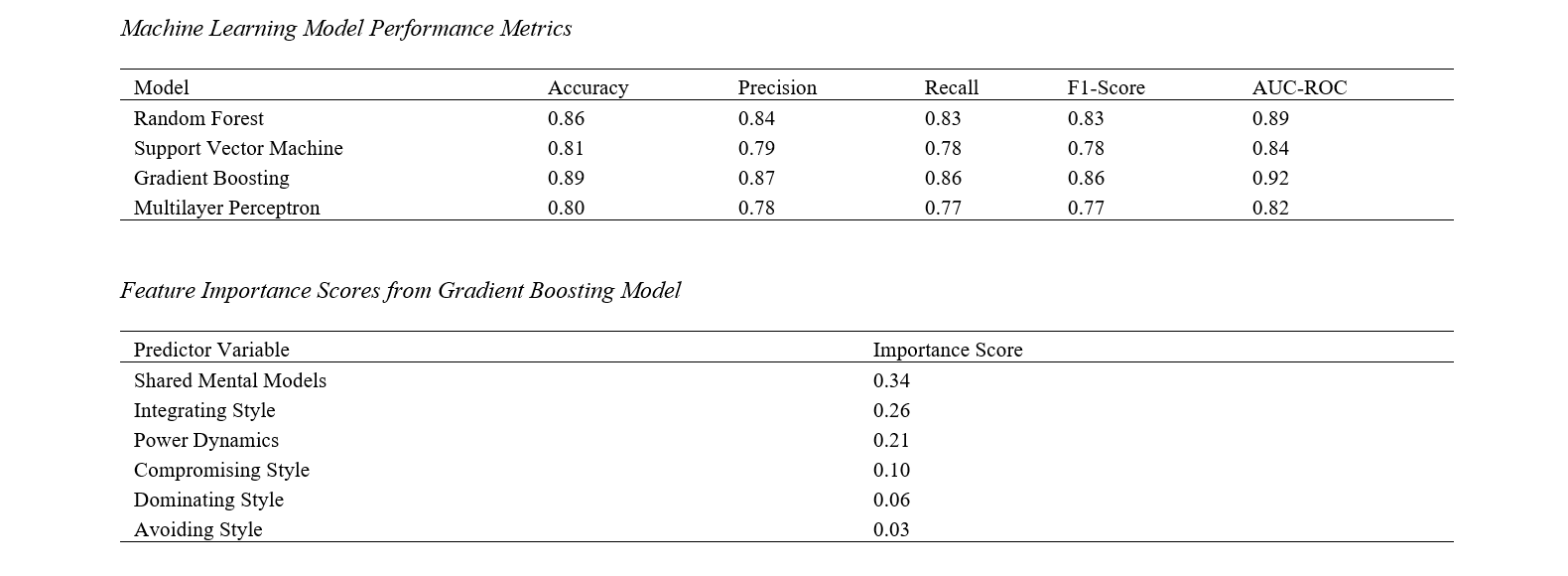
Methods and Materials: This descriptive–correlational study with a predictive modeling approach was conducted on 412 married adults in Thailand selected through multistage cluster sampling. Data were collected using standardized instruments assessing shared mental models, family power dynamics, and negotiation styles, all of which demonstrated acceptable validity and reliability. Data analysis was performed using a hybrid approach combining statistical analysis in IBM SPSS Statistics (version 27) and machine learning modeling in Python with scikit-learn and TensorFlow. Predictive models including Random Forest, Support Vector Machine, Gradient Boosting, and Multilayer Perceptron were trained and evaluated using cross-validation, with performance assessed through accuracy, precision, recall, F1-score, and AUC-ROC metrics.
Findings: The results indicated that shared mental models had a significant positive effect on family decision-making effectiveness, while power dynamics showed a significant negative effect. Integrative negotiation style significantly and positively predicted decision-making effectiveness, whereas dominating style had a significant negative association. Machine learning analysis revealed that the Gradient Boosting model achieved the highest predictive performance (accuracy = 0.89, AUC = 0.92), outperforming other models. Feature importance analysis demonstrated that shared mental models were the strongest predictor, followed by integrative negotiation style and power dynamics, confirming the relative contribution of cognitive, behavioral, and structural variables in predicting decision outcomes.
Conclusion: The findings highlight the central role of cognitive alignment and collaborative negotiation in enhancing family decision-making effectiveness, while unequal power structures undermine optimal outcomes. The integration of machine learning approaches provides a robust and nuanced framework for modeling complex family processes, offering both theoretical advancement and practical implications for improving relational functioning.
Downloads
References
Ahlborg, H. (2024). Technological Power, Complex Systems, and Boundary Objects in Global Energy Transitions. Frontiers in Human Dynamics, 6. https://doi.org/10.3389/fhumd.2024.1151614
Al-Sheyab, N., Nsour, M. A., Khader, Y., Yousif, H., Alyahya, M. S., Taha, H., Bardus, M., Kattan, M. A., & Amiri, M. (2021). Midwives and Women's Perspectives on Family Planning in Jordan: Human Rights, Gender Equity, Decision-Making and Power Dynamics. Heliyon, 7(8), e07810. https://doi.org/10.1016/j.heliyon.2021.e07810
Alcaide, X. M., & Monasterio, G. Z. (2025). Psychosocial Dynamics of Strike Action and Union Renewal: The Case of ELA in the Basque Country. Journal of Community & Applied Social Psychology, 35(4). https://doi.org/10.1002/casp.70145
Allegretta, R. A., Rovelli, K., & Balconi, M. (2025). Converging Minds: EEG Synchrony During Communication About Moral Decision-Making in Dyadic Interactions. Sensors, 25(13), 4239. https://doi.org/10.3390/s25134239
Castillo‐López, Á. G. d., Berenguer-Soler, M., Pineda, D., & José, A. G. d. C. (2024). Emotional Flooding in Couple Relationships: Psychosocial Aspects and Regulatory Strategies. https://doi.org/10.5772/intechopen.1006183
Dhondt, B., Sompel, D. V. d., & Hudders, L. (2025). Becoming Competent Consumers: Exploring the Dynamics of the Consumer Socialization Process Between Parents and Their Adolescents. Journal of Consumer Affairs, 59(2). https://doi.org/10.1111/joca.70012
Duby, Z., Bergh, K., Jonas, K., Reddy, T., Bunce, B., Fowler, C., & Mathews, C. (2022). “Men Rule… This Is the Normal Thing. We Normalise It and It’s Wrong”: Gendered Power in Decision-Making Around Sex and Condom Use in Heterosexual Relationships Amongst Adolescents and Young People in South Africa. AIDS and Behavior, 27(6), 2015-2029. https://doi.org/10.1007/s10461-022-03935-8
García, C., Savilaakso, S., Verburg, R. W., Stoudmann, N., Fernbach, P. M., Sloman, S. A., Peterson, G., Araújo, M. B., Bastin, J. F., Boutinot, L., Dessard, H., Dray, A., Francisco, S., Ghazoul, J., Feintrenie, L., Kleinschroth, F., Naimi, B., Novotny, I. P., Oszwald, J., . . . Waeber, P. O. (2021). Before the Next COP: How to Stop Missing Our Environmental Policy Targets. https://doi.org/10.20944/preprints202108.0326.v1
Helgøy, A., & Weeks, A. C. (2025). Crowded Out: The Influence of Mental Load Priming on Intentions to Participate in Public Life. British Journal of Political Science, 55. https://doi.org/10.1017/s0007123424000826
Huang, T. (2025). The Choreography of Familial Bargaining: A Qualitative Study of in Vitro Fertilisation (IVF) Negotiation in China. Sociology of Health & Illness, 47(2). https://doi.org/10.1111/1467-9566.70010
Journal, A. W. E., & Alqahtani, G. M. (2024). Saudi Graduate Students’ Identities in Relation to Emotion and Agency in Applied Linguistics: A Narrative Multiple Case Study. https://doi.org/10.31235/osf.io/cbp9j
Kenny, D. C., Bakhanova, E., Hämäläinen, R. P., & Voinov, A. (2022). Participatory Modelling and Systems Intelligence: A Systems-Based and Transdisciplinary Partnership. Socio-Economic Planning Sciences, 83, 101310. https://doi.org/10.1016/j.seps.2022.101310
Lee, J., Huang, K., & Song, G. (2025). Exploring Power Imbalance in Reciprocal Scientific Information Sharing Within a Hydraulic Fracturing Policy Subsystem. Review of Policy Research, 42(5), 1350-1374. https://doi.org/10.1111/ropr.12644
Levine, S., Chater, N., Tenenbaum, J. B., & Cushman, F. (2023). Resource-Rational Contractualism: A Triple Theory of Moral Cognition. https://doi.org/10.31234/osf.io/p48t7
Luthra, R., & Haux, T. (2022). The Mental Load in Separated Families. Journal of Family Research, 34(2), 669-696. https://doi.org/10.20377/jfr-743
McLean, C., Musolino, C., Rose, A., & Ward, P. (2023). The Management of Cognitive Labour in Same-Gender Couples. PLoS One, 18(7), e0287585. https://doi.org/10.1371/journal.pone.0287585
Murawski, A., Ramirez‐Zohfeld, V., Mell, J., Tschoe, M., Schierer, A., Olvera, C., Brett, J. M., Gratch, J., & Lindquist, L. A. (2024). NegotiAge : Development and Pilot Testing of an Artificial Intelligence‐based Family Caregiver Negotiation Program. Journal of the American Geriatrics Society, 72(4), 1112-1121. https://doi.org/10.1111/jgs.18775
Opara, I., Abrams, J. A., Cross, K., & Amutah‐Onukagha, N. (2021). Reframing Sexual Health for Black Girls and Women in HIV/STI Prevention Work: Highlighting the Role of Identity and Interpersonal Relationships. International journal of environmental research and public health, 18(22), 12088. https://doi.org/10.3390/ijerph182212088
Papakonstantinidis, L. A., & Ternyik, S. I. (2022). Empathy and Conflict Strategy: An Inquiry Into T. Schelling's ‘The Strategy of Conflict’. https://doi.org/10.30884/978-5-7057-6233-0_04
Race, L. (2023). What Are the Experiences of People With Learning Disabilities, and Their Support Workers, When Negotiating Access to Opportunities for Developing Relationships and Intimacy? Fpid Bulletin the Bulletin of the Faculty for People With Intellectual Disabilities, 21(3), 71-71. https://doi.org/10.53841/bpsfpid.2023.21.3.71
Rashid, R. A., Al-Ramahi, R. A., Zulkffli, M. A., & Al-Smadi, O. A. (2025). Power Imbalances in Marriage: A Study of Online Support Group Discourse. Journal of Family Issues, 46(8), 1231-1250. https://doi.org/10.1177/0192513x251347313
Rovelli, K., Acconito, C., Angioletti, L., & Balconi, M. (2025). Brain Oscillations and Autonomic Synthonization via Comodulation in Collaborative Negotiation. Entropy, 27(8), 873. https://doi.org/10.3390/e27080873
Schiena, R. D., Reciputi, P., & Morsa, M. (2025). Beyond Shared Decision-Making in Youth Psychiatry: A Dynamic Continuum of Decision-Making Practices. https://doi.org/10.21203/rs.3.rs-7254817/v1
Strong, S., & Letts, L. (2021). Personal Narratives of Learning Self‐management: Lessons for Practice Based on Experiences of People With Serious Mental Illness. Australian Occupational Therapy Journal, 68(5), 395-406. https://doi.org/10.1111/1440-1630.12748
Sue, C. A., Vasquez, J. M., & Núñez, A. C. (2024). Couple Identity Work: Collaborative Couplehood, Gender Inequalities, and Power in Naming. Gender & Society, 38(2), 187-215. https://doi.org/10.1177/08912432231226125
Trif, S., Curşeu, P. L., & Fodor, O. C. (2022). Power Differences and Dynamics in Multiparty Collaborative Systems: A Systematic Literature Review. Systems, 10(2), 30. https://doi.org/10.3390/systems10020030
Weeks, A. C. (2025). Take a Load Off? Not for Mothers: Gender, Cognitive Labor, and the Limits of Time and Money. Socius Sociological Research for a Dynamic World, 11. https://doi.org/10.1177/23780231251384527
Wong, J. S., & Daminger, A. (2024). The Myth of Mutuality: Decision-Making, Marital Power, and the Persistence of Gender Inequality. Gender & Society, 38(2), 157-186. https://doi.org/10.1177/08912432241230555
Yudarwati, G. A., Sison, M. D., Putranto, I. A., & Wiratsari, P. (2023). Enacting Institutional Drivers Towards Strategic Corporate Social Responsibility: The Sensemaking Process in Multinational Companies. Corporate Social Responsibility and Environmental Management, 30(4), 1782-1793. https://doi.org/10.1002/csr.2454
Zafra‐Calvo, N., Balvanera, P., Pascual, U., Merçon, J., Martín‐López, B., Noordwijk, M. v., Mwampamba, T. H., Lélé, S., Speranza, C. I., Arias‐Arévalo, P., Cabrol, D., Cáceres, D., O’Farrell, P., Subramanian, S. M., Devy, S., Krishnan, S., Carmenta, R., Guibrunet, L., Kraus-Elsin, Y., . . . Dı́az, S. (2020). Plural Valuation of Nature for Equity and Sustainability: Insights From the Global South. Global Environmental Change, 63, 102115. https://doi.org/10.1016/j.gloenvcha.2020.102115
Downloads
Additional Files
Publication Timeline
- Submitted
- Revised
- Accepted



