
Modeling Cultural Influences on Risk-Taking Using Machine Learning: Sensation Seeking, Norm Deviance, and Peer Influence
DOI:
https://doi.org/10.61838/kman.jprfc.5337Keywords:
Risk-taking behavior, sensation seeking, norm deviance, peer influence, machine learning, cultural influencesAbstract
Objective: The present study aimed to model and predict risk-taking behavior by examining the interactive effects of sensation seeking, norm deviance, and peer influence within a cultural framework using machine learning techniques.
Methods and Materials: This study employed a cross-sectional, predictive-correlational design with a sample of 462 young adults from Greece selected through stratified sampling. Data were collected using standardized self-report instruments assessing risk-taking behavior, sensation seeking, norm deviance, and peer influence. After data preprocessing, including normalization and missing data imputation, both statistical and machine learning analyses were conducted. Pearson correlations were used to examine associations among variables, followed by the implementation of multiple supervised machine learning models, including Random Forest, Support Vector Machine, Gradient Boosting, and Artificial Neural Networks. The dataset was divided into training and testing subsets using an 80/20 split, and 10-fold cross-validation was applied to enhance model generalizability. Model performance was evaluated using accuracy, precision, recall, F1-score, and AUC-ROC metrics, while SHAP analysis was used to determine feature importance and interpret model predictions.
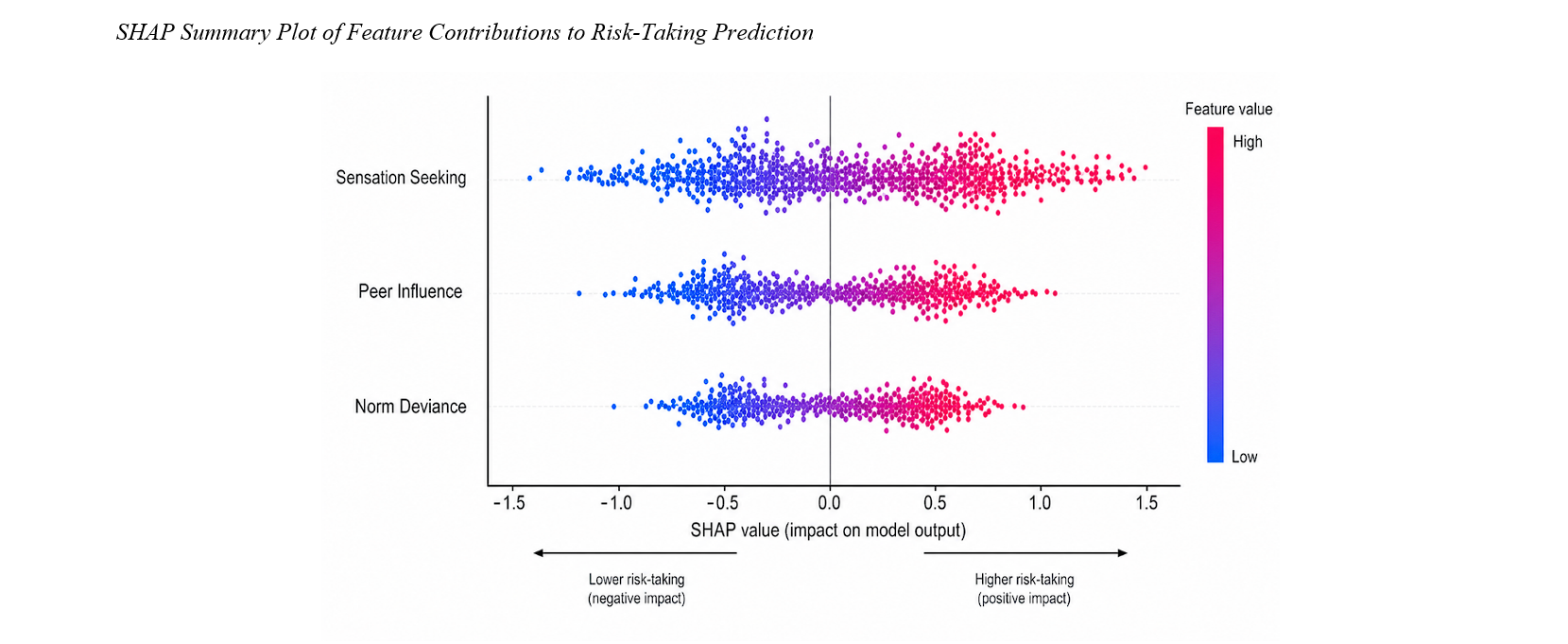
Findings: Inferential analyses indicated significant positive relationships between risk-taking behavior and sensation seeking (r = 0.54, p < 0.01), peer influence (r = 0.52, p < 0.01), and norm deviance (r = 0.49, p < 0.01). Machine learning results revealed that the Gradient Boosting model demonstrated the highest predictive performance (accuracy = 0.88, AUC-ROC = 0.93), followed by Random Forest and Neural Network models. Feature importance analysis using SHAP values showed that sensation seeking was the strongest predictor (mean SHAP = 0.37), followed by peer influence (0.31) and norm deviance (0.28), indicating that both individual and social factors significantly contribute to the prediction of risk-taking behavior.
Conclusion: The superior performance of ensemble machine learning models highlights the importance of capturing nonlinear and complex relationships among predictors.
Downloads
References
Aiken, M., Davidson, J., Walrave, M., Ponnet, K., Phillips, K., & Farr, R. (2024). Intention to Hack? Applying the Theory of Planned Behaviour to Youth Criminal Hacking. Forensic Sciences, 4(1), 24-41. https://doi.org/10.3390/forensicsci4010003
Allen, J. P. (2024). Rethinking Peer Influence and Risk Taking: A Strengths-Based Approach to Adolescence in a New Era. Development and Psychopathology, 36(5), 2244-2255. https://doi.org/10.1017/s0954579424000877
Archer, R. J. L., & Flexon, J. L. (2021). Unstructured Socializing With Peers and Delinquency: The Role of Mediation Through the Lens of Akers’ (1998) Social Structure Social Learning Theory of Crime and Deviance. American Journal of Criminal Justice, 47(5), 980-1005. https://doi.org/10.1007/s12103-021-09633-w
Askarzadeh, F., Lewellyn, K. B., Fainshmidt, S., & Judge, W. Q. (2024). Entrepreneurial Orientation and Underconformity to Female Board Representation Norms. Journal of Management Studies, 62(2), 539-564. https://doi.org/10.1111/joms.13062
Bass, E. C., Saldarriaga, L. M., Velásquez, A. M., Santo, J. B., & Bukowski, W. M. (2021). Unpacking the Misfit Effect: Exploring the Influence of Gender and Social Norms on the Association Between Aggression and Peer Victimization. International Journal of Behavioral Development, 46(5), 372-381. https://doi.org/10.1177/0165025421992867
Cheng, Y. (2023). The Impact of Social Media on Deviance and Crime. Journal of Education Humanities and Social Sciences, 22, 873-877. https://doi.org/10.54097/ehss.v22i.14555
Cioban, S., Lazăr, A., Bacter, C., & Hatos, A. (2021). Adolescent Deviance and Cyber-Deviance. A Systematic Literature Review. Frontiers in psychology, 12. https://doi.org/10.3389/fpsyg.2021.748006
d’Amato, A. L., & Hunter, S. T. (2025). Malevolent Innovation in the Workplace: Laying the Foundation. Organizational Psychology Review, 15(4), 420-452. https://doi.org/10.1177/20413866251370355
Duru, H., Deryol, R., & Çam, T. (2021). Adherence to Street Code and Violent Victimization and Delinquent Offending of Youth in Turkey: An Analysis of Mediation and Moderation Effects. European Journal of Criminology, 20(2), 422-446. https://doi.org/10.1177/14773708211006991
Han, S., Piquero, A. R., & Bersani, B. E. (2023). Does Rational Choice Help to Explain Offending Differences Across Immigrant Generations? Focusing on Serious Adolescent Offenders. Journal of Research in Crime and Delinquency, 61(6), 815-859. https://doi.org/10.1177/00224278231187311
Harris, M. R., Fein, E. C., & Machin, M. A. (2022). A Systematic Review of Multilevel Influenced Risk-Taking in Helicopter and Small Airplane Normal Operations. Frontiers in Public Health, 10. https://doi.org/10.3389/fpubh.2022.823276
Huzik, O. (2021). Relevant Issues of Research of Minors’ Antisocial Behavior. Journal of Legal Studies, 27(41), 17-25. https://doi.org/10.2478/jles-2021-0002
Joyce, B., Meriwether, J. L., & Perlow, E. (2024). Motivations for Hazing in Collegiate Settings: Employing Situational Strength to Identify, Disrupt, and Construct. New Directions for Student Services, 2024(187), 41-56. https://doi.org/10.1002/ss.20526
Kabiri, S., Sharepour, M., Howell, C. J., Wellen, H., Smith, H. P., Cochran, J. K., Shadmanfaat, S. M., & Andersen, T. S. (2022). Violations of Emergent Norms Regarding COVID-19 Mitigation and Social Hygiene: An Application of Agnew’s General Theory of Crime. Crime & Delinquency, 71(2), 575-610. https://doi.org/10.1177/00111287221130961
Korde, P., & Raghavan, V. (2023). Understanding Deviance From the Perspectives of Youth Labelled as Children in Conflict With Law in Mumbai, India. The Howard Journal of Crime and Justice, 62(2), 242-263. https://doi.org/10.1111/hojo.12511
Malizia, N., & Serban, I. V. (2024). A Study on Relationship Between the Individual, Deviance and the Power of Social Control. CCRL, 7(1), 6-23. https://doi.org/10.58179/cclr7101
Narayanan, K., & Moon, C. (2022). A Multigroup SEM Analysis of the Antecedents and Moderating Influence of Culture on Workplace Deviance Behavior. Cross Cultural & Strategic Management, 30(2), 169-196. https://doi.org/10.1108/ccsm-06-2021-0103
Nisar, Q. A., Haider, S., Ali, F., Naz, S., & Ryu, K. (2021). Depletion of Psychological, Financial, and Social Resources in the Hospitality Sector During the Pandemic. International Journal of Hospitality Management, 93, 102794. https://doi.org/10.1016/j.ijhm.2020.102794
Otten, R., & Ha, T. (2022). Drug Use Talk in Adolescent Friendship Interactions: Long-Term Effects of Social Learning on Lifetime Diagnosed Substance Use Disorders. Journal of Psychopathology and Clinical Science, 131(5), 507-516. https://doi.org/10.1037/abn0000763
Potipiroon, W. (2024). Mitigating the Adverse Impact of Coworker Incivility on Organizational Deviance: The Self‐regulatory Roles of Trait Conscientiousness and Gender. European Management Review, 22(1), 235-255. https://doi.org/10.1111/emre.12636
Şahin, İ., & Ünlü, A. (2020). The Effect of Muslim Religiosity on Youth Delinquency. Criminal Justice Review, 46(3), 361-381. https://doi.org/10.1177/0734016820966038
Schuck, A. M., & Rabe-Hemp, C. E. (2021). A Longitudinal Study of the Effects of Academy Socialization on Police Integrity. Police Quarterly, 24(4), 578-606. https://doi.org/10.1177/10986111211029958
Shukla, J., & Kark, R. (2020). Now You Do It, Now You Don’t: The Mixed Blessing of Creative Deviance as a Prosocial Behavior. Frontiers in psychology, 11. https://doi.org/10.3389/fpsyg.2020.00313
Stults, B. J., Hernández, J. L. I., & Hay, C. (2021). Low Self-Control, Peer Delinquency, and Crime: Considering Gendered Pathways. Journal of Research in Crime and Delinquency, 58(6), 666-709. https://doi.org/10.1177/00224278211001416
Subramanian, L., & Kattumuri, R. (2024). Comparison of Scheduled Caste Youth Lifestyles and Those of Other Castes in Tamil Nadu: Youth Subculture and Identity. Young, 33(4), 399-422. https://doi.org/10.1177/11033088241284479
Sutton, J. E. (2022). Athlete Multiple Perpetrator Rape (MPR) as Interactional and Organizational Deviance: Heuristic Insights From a Multilevel Framework. Violence Against Women, 28(14), 3608-3630. https://doi.org/10.1177/10778012211070312
Turvy, A., & Abidin, C. (2025). Patchwork Governance on KidTok: Balancing Regulation and Community Norms. Policy & Internet, 17(2). https://doi.org/10.1002/poi3.70003
Yim, H.-N. (2020). The Differential Relationship Between Self-Control and Peer Influences Over Time: Toward an Integrative Model of Offending Using a Dual-Systems Approach. Crime & Delinquency, 67(12), 1903-1934. https://doi.org/10.1177/0011128720977448
Zhang, V., Mohliver, A. C., & King, M. (2022). Where Is All the Deviance? Liminal Prescribing and the Social Networks Underlying the Prescription Drug Crisis. Administrative Science Quarterly, 68(1), 228-269. https://doi.org/10.1177/00018392221137681
Downloads
Additional Files
Publication Timeline
- Submitted
- Revised
- Accepted



