
Identifying Cultural Drivers of Help-Seeking Behavior Using Machine Learning: Stigma Internalization, Norm Salience, and Self-Construal
DOI:
https://doi.org/10.61838/kman.jprfc.5347Keywords:
Help-seeking behavior, stigma internalization, norm salience, self-construal, machine learning, cultural psychologyAbstract
Objective: The present study aimed to identify and model the cultural determinants of help-seeking behavior using machine learning techniques, focusing on stigma internalization, norm salience, and self-construal.
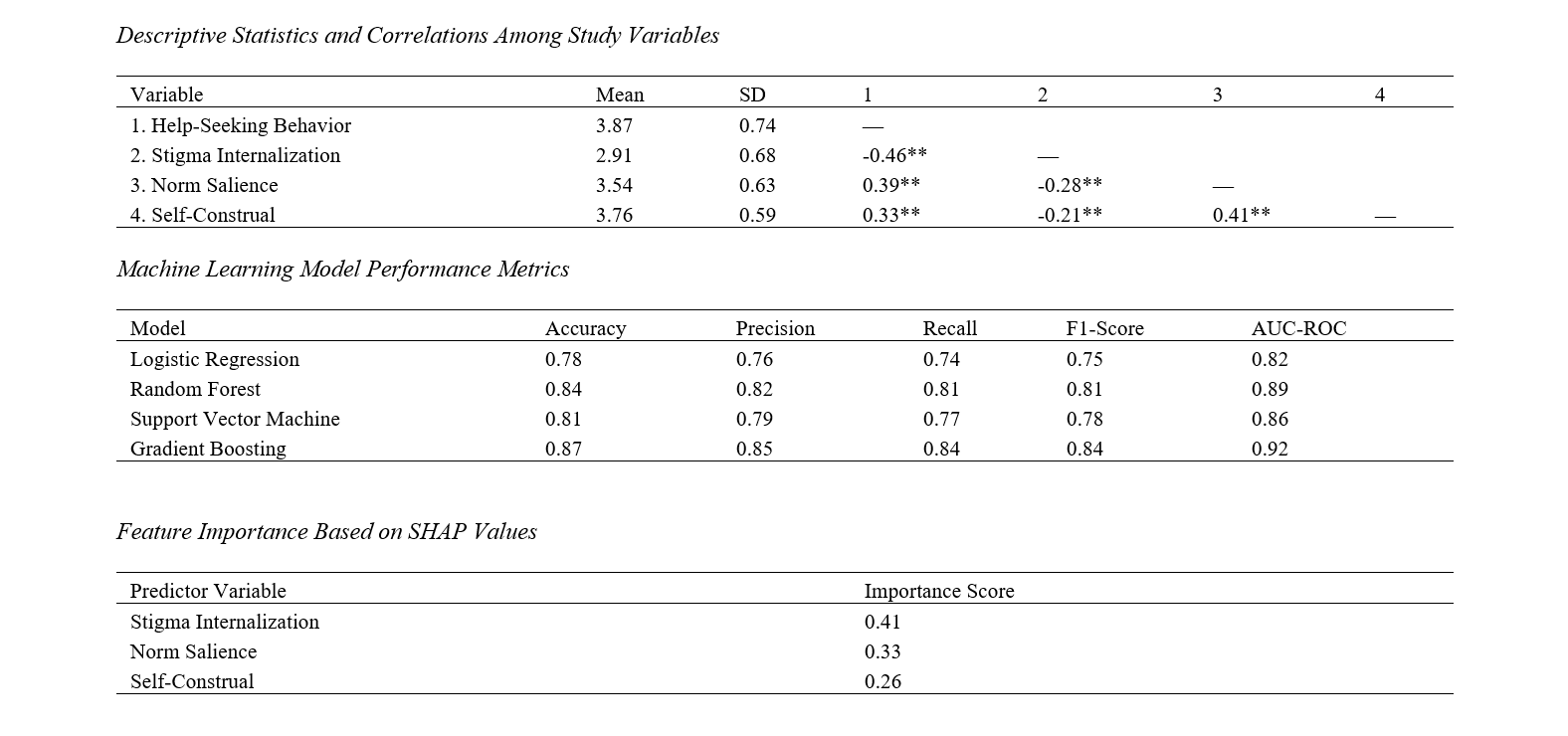
Methods and Materials: This cross-sectional predictive study was conducted among 512 adults residing in Canada, selected through a stratified sampling approach to ensure demographic diversity. Data were collected using standardized instruments, including the General Help-Seeking Questionnaire (GHSQ), the Internalized Stigma of Mental Illness Scale (ISMI), a validated Social Norms Salience Scale, and the Self-Construal Scale (SCS). Data preprocessing involved normalization, handling missing values via multiple imputation, and encoding categorical variables. Statistical analyses were performed using SPSS-27 for descriptive and correlational assessments. Machine learning models, including Logistic Regression, Support Vector Machine, Random Forest, and Gradient Boosting, were implemented in Python using Scikit-learn and XGBoost. Model performance was evaluated using accuracy, precision, recall, F1-score, and AUC-ROC metrics, with k-fold cross-validation ensuring robustness. Feature importance was examined using SHAP (SHapley Additive Explanations) to determine the relative contribution of predictors.
Findings: The results indicated that stigma internalization was the strongest negative predictor of help-seeking behavior, while norm salience and self-construal showed significant positive predictive effects. Gradient Boosting demonstrated the highest performance (AUC = 0.92), outperforming other models. Correlation analysis revealed significant negative associations between stigma internalization and help-seeking (p < .01), and positive associations for norm salience and self-construal (p < .01). SHAP analysis confirmed the hierarchical importance of predictors, with stigma internalization exerting the greatest influence, followed by norm salience and self-construal, and revealed nonlinear interaction effects among variables.
Conclusion: The findings highlight the central role of culturally embedded psychological factors in shaping help-seeking behavior and demonstrate the effectiveness of machine learning approaches.
Downloads
References
Akutsu, S., Krishnan, R., & Lee, J. (2022). The Cultural Variance Model of Organizational Shame and Its Implications on Health and Well‐Being1. Japanese Psychological Research, 64(2), 244-266. https://doi.org/10.1111/jpr.12417
Birtel, M. D., & Mitchell, B. L. (2022). Cross‐cultural Differences in Depression Between White British and South Asians: Causal Attributions, Stigma by Association, Discriminatory Potential. Psychology and Psychotherapy Theory Research and Practice, 96(1), 101-116. https://doi.org/10.1111/papt.12428
Camposano, G. A. A., Rodrigues, D. L., & Moleiro, C. (2022). Social and Cultural Correlates of Identity Management Strategies Among Lesbian and Gay People: The Role of Intergroup Structure and Self-Construal. Sexuality Research and Social Policy, 19(4), 1763-1777. https://doi.org/10.1007/s13178-022-00754-3
Dada, D., Abu-Ba’are, G. R., Turner, D., Mashoud, I. W., Owusu-Dampare, F., Apreku, A., Ni, Z., Djiadeu, P., Aidoo‐Frimpong, G., Zigah, E. Y., Nyhan, K., Nyblade, L., & Nelson, L. E. (2024). Scoping Review of HIV-related Intersectional Stigma Among Sexual and Gender Minorities in Sub-Saharan Africa. BMJ open, 14(2), e078794. https://doi.org/10.1136/bmjopen-2023-078794
Day, A., & Hammer, J. H. (2025). Exploring Sociocultural Predictors of Intention to Seek Help Among South Asians in the United States Using the Integrated Behavioral Model of Mental Health Help Seeking. Asian American Journal of Psychology. https://doi.org/10.1037/aap0000391
Dzokoto, V., Anum, A., Affram, A. A., Agbavitoh, J. K. M., Dadzie, H. A. N., Mintah, R. K., Norman, Q. A., Owusu-Prempeh, C., Tawam, L. N., Turkson, S. M., & Osei‐Tutu, A. (2022). “A Lot of Ghanaians Really Don’t Understand the Work We Do” – Cultural Adaptations and Barriers in Ghanaian Psychotherapy Practice. International Perspectives in Psychology, 11(1), 28-42. https://doi.org/10.1027/2157-3891/a000015
Firnhaber, J., Malone, S. M., O’Hagan, A. D., O'Keefe, S., McNamara, J., & O’Connor, S. (2024). ‘You Don't Want to Be Seen to Be Struggling’; Identifying Sociocultural Barriers and Facilitators for Irish Farmers’ Mental Health Help‐seeking. Sociologia Ruralis, 64(2), 353-375. https://doi.org/10.1111/soru.12469
Fung, K., & Kim, S. (2024). Commentary: Predictors of Professional Help-Seeking Intention Toward Depression Among Community-Dwelling Populations: A Structural Equation Modeling Analysis. Frontiers in Psychiatry, 15. https://doi.org/10.3389/fpsyt.2024.1363160
Ha, M., Chin, E. G., & Kim, C. L. (2024). Korean American Help-Seeking Behavior as Seen Through the Theory of Planned Behavior. https://doi.org/10.31219/osf.io/rekqs
He, D., Siau, C. S., Koo, H. C., Zheng, Y., He, P., & Singh, H. K. G. (2025). ‘My Body Isn’t Perfect, and I Get Quite Anxious’: A Qualitative Exploration of Body Image Dissatisfaction Among Chinese Female Undergraduates. BMJ open, 15(10), e099390. https://doi.org/10.1136/bmjopen-2025-099390
Ho‐Foster, A., Machisa, M., Moalusi, L. R., & Christofides, N. (2025). Gender Beliefs and Norms Underlying Intimate Partner Violence Stigma Among Women Living in Botswana: Results of an Exploratory Factor Analysis. Plos Global Public Health, 5(2), e0004113. https://doi.org/10.1371/journal.pgph.0004113
Ho, V. C., Gee, C. B., & Khera, G. S. (2025). Asian Indian Male International Graduate Students’ Help-Seeking Intentions Toward Formal and Informal Supports: The Role of Cultural and Familial Factors. Asian American Journal of Psychology, 16(2), 101-109. https://doi.org/10.1037/aap0000355
Ito, K., & Tsuda, S. (2025). Effects of Clinical Stage, Behavioral and Psychological Symptoms of Dementia, and Living Arrangement on Social Distance Towards People With Dementia. PLoS One, 20(1), e0317911. https://doi.org/10.1371/journal.pone.0317911
Jacobs, R., Schneider, M., Farina, N., Toit, P. d., & Evans‐Lacko, S. (2022). Stigma and Its Implications for Dementia in South Africa: A Multi-Stakeholder Exploratory Study. Ageing and Society, 44(4), 867-897. https://doi.org/10.1017/s0144686x2200040x
Lannin, D. G., Russell, L., Yazedjian, A., & Seidman, A. J. (2025). Which Personal Values Are Most Predictive of Anticipated Self-Stigma of Seeking Help? A Relative Weight Analysis. Stigma and Health. https://doi.org/10.1037/sah0000644
Li, S., Heath, P. J., Vidales, C. A., Vogel, D. L., & Nie, Y. (2022). Measurement Invariance of the Self-Stigma of Mental Illness Scale: A Cross-Cultural Study. International journal of environmental research and public health, 19(4), 2344. https://doi.org/10.3390/ijerph19042344
Liu, Y., Zhang, H., Miao, H., Zhang, J., & Guo, C. (2023). The Relationship Between Childhood Maltreatment and Social Anxiety Among Chinese Male Individuals With Drug Use Disorders: A Moderated Mediation Model of Fear of Negative Evaluation and Self-Construals. Frontiers in psychology, 14. https://doi.org/10.3389/fpsyg.2023.1193952
Ma, Y., Guo, X., Su, W., Feng, Y., & Han, F. (2022). Dual-Path Effect of Mortality Salience Induced by COVID-19 on Food Safety Behavior in China. International journal of environmental research and public health, 19(10), 6100. https://doi.org/10.3390/ijerph19106100
Reay, M., Mayers, A., Knowles-Bevis, R., & Knight, M. T. D. (2023). Understanding the Barriers Fathers Face to Seeking Help for Paternal Perinatal Depression: Comparing Fathers to Men Outside the Perinatal Period. International journal of environmental research and public health, 21(1), 16. https://doi.org/10.3390/ijerph21010016
Rutherford, K., Hiseler, L. E., & O’Hagan, F. (2023). Help! I Need Somebody: Help-Seeking Among Workers With Self-Reported Work-Related Mental Disorders. Journal of Occupational Rehabilitation, 34(1), 197-215. https://doi.org/10.1007/s10926-023-10123-5
Shannon, J. (2022). A Study of Help‐seeking Behaviors for African American Men: Implications for Counselor Education. Journal of Multicultural Counseling and Development, 51(3), 183-194. https://doi.org/10.1002/jmcd.12275
Shannon, J., Seward, D. X., Liu, Y., & Luke, M. (2022). Stigma, Help‐seeking, and Counseling With African American Male College Students. Journal of Counseling & Development, 100(4), 421-432. https://doi.org/10.1002/jcad.12435
Slewa‐Younan, S., Krstanoska-Blazeska, K., Blignault, I., Li, B., Reavley, N., & Renzaho, A. M. N. (2022). Conceptualisations of Mental Illness and Stigma in Congolese, Arabic-Speaking and Mandarin-Speaking Communities: A Qualitative Study. BMC public health, 22(1). https://doi.org/10.1186/s12889-022-14849-4
Steggals, P., Lawler, S., & Graham, R. (2022). The Personal Is Social: Four Sociological Approaches to Nonsuicidal Self‐injury. Sociology Compass, 16(5). https://doi.org/10.1111/soc4.12970
Surapaneni, S., Larson-Konar, D., Larson, L. M., & Wei, M. (2022). Differential Effects of Parental and Self-Stigma on Intentions to Seek Counseling. The counseling psychologist, 50(4), 561-588. https://doi.org/10.1177/00110000221075332
Üzümçeker, E. (2025). Traditional Masculinity and Men's Psychological Help‐Seeking: A Meta‐Analysis. International journal of psychology, 60(2). https://doi.org/10.1002/ijop.70031
Vogel, D. L., Zhao, N., Vidales, C. A., Al-Darmaki, F. R., Baptista, M. N., Brenner, R. E., Ertl, M. M., Liao, H.-Y., Mak, W. W. S., Rubin, M. A., Schomerus, G., Şahin, E., Topkaya, N., & Wang, Y.-F. (2024). Interdependent Stigma of Seeking Mental Health Services: Examining a New Scale Across Eight Countries/Regions. Journal of counseling psychology, 71(5), 356-368. https://doi.org/10.1037/cou0000757
Wang, H., Hu, Y., Li, J., Liu, S., & Feng, X. (2024). What Determines Healthcare Workers to Seek Professional Psychological Support? A Cross‐Sectional Study. Journal of Advanced Nursing, 81(7), 3821-3833. https://doi.org/10.1111/jan.16523
Wang, P., Chen, C., & Yim, I. S. (2024). Internalized Weight Bias and Eating Disorder Risk: The Moderating Role of Self-Construal Among Culturally Diverse Female Young Adults. Stigma and Health. https://doi.org/10.1037/sah0000569
Wojciechowska, M., & Łaska‐Formejster, A. (2025). Anti‐Stigma Strategies for Researching and Disseminating Findings: Insights From Qualitative Studies With Marginalised Populations. European Journal of Education, 60(2). https://doi.org/10.1111/ejed.70096
Yang, E. C. L., Liang, A. R., & Lin, J. H. (2023). A Market Segmentation Study of Solo Travel Intentions and Constraints. Journal of Hospitality & Tourism Research, 49(1), 132-145. https://doi.org/10.1177/10963480231163517
Zhuang, S., Bougoure, M., Leong, D.-j., Dean, L., Reddrop, S., Naragon‐Gainey, K., Maybery, M. T., Tan, D. W., & Magiati, I. (2024). Examining an Integrated Path Model of Psychological and Sociocultural Predictors of Camouflaging in Autistic Adults. Autism, 29(9), 2328-2343. https://doi.org/10.1177/13623613241262110
Downloads
Additional Files
Publication Timeline
- Submitted
- Revised
- Accepted



