The Impact of Teacher Instructional Competence on Service-Learning Outcomes in Primary Schools of Tonekabon: The Mediating Role of Resilience and the Moderating Role of Teacher Age
DOI:
https://doi.org/10.61838/kman.ooc.psynexus.3.9Keywords:
Instructional competence, Service-learning outcomes, Resilience, Teacher age, Structural equation modeling, Primary educationAbstract
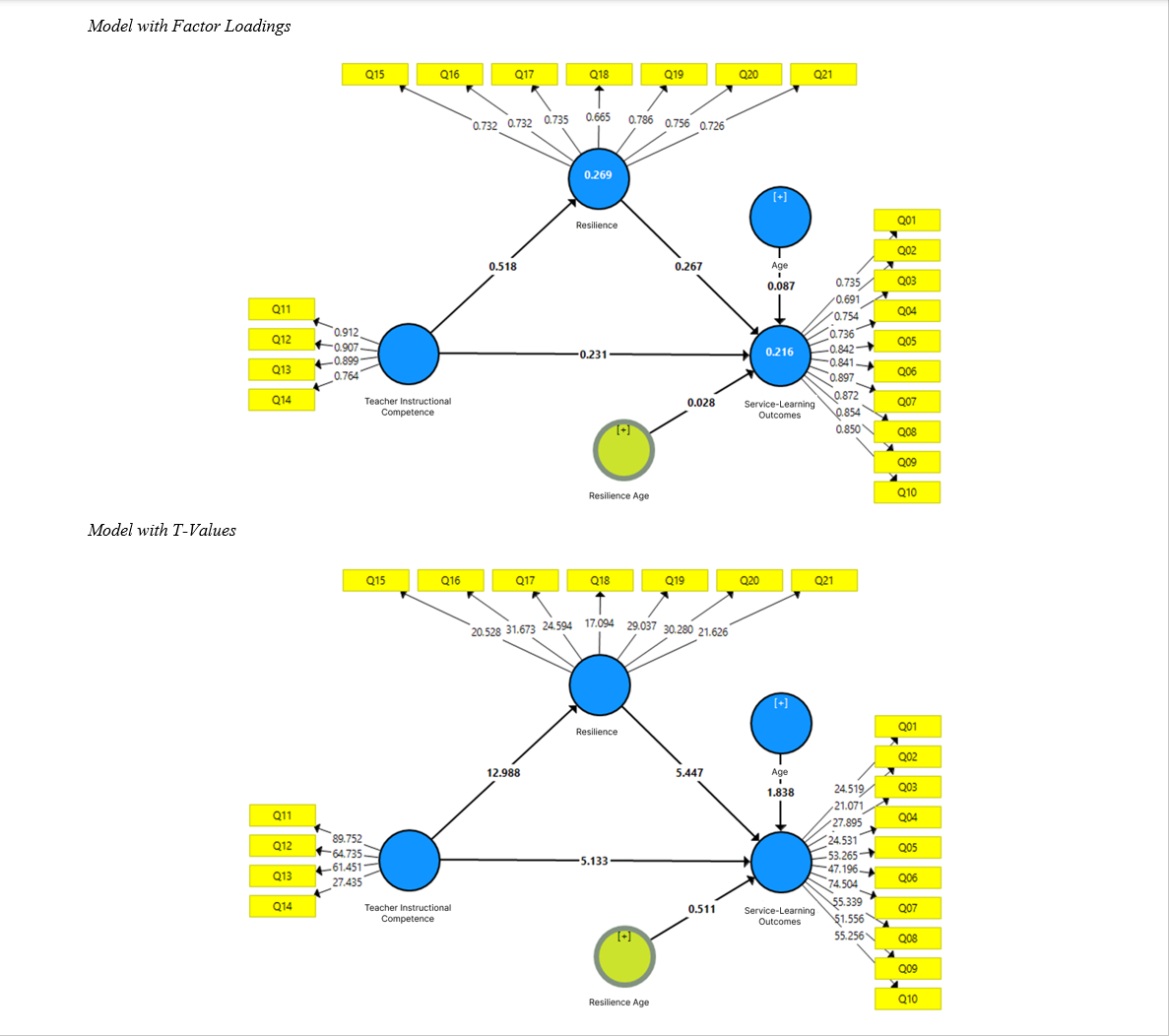
This study aimed to examine the impact of teacher instructional competence on service-learning outcomes in elementary schools in Tonekabon, with the mediating role of resilience and the moderating role of teacher age. The research employed a descriptive-survey design with an applied objective. The statistical population consisted of all primary school teachers in Tonekabon County, from which a sample of 384 participants was selected using simple random sampling based on Krejcie and Morgan’s table. Data were collected through three validated instruments: the Service-Learning Outcomes Questionnaire (10 items), the Teacher Instructional Competence Scale (4 items), and the Resilience Questionnaire (7 items), each rated on a 5-point Likert scale. Cronbach’s alpha coefficients confirmed the reliability of all instruments (α = 0.806 to 0.941). Descriptive statistics were used to describe the sample, and Structural Equation Modeling (SEM) using Smart PLS was applied to test the hypotheses. The Kolmogorov-Smirnov test confirmed the normal distribution of data before path analysis. The results demonstrated that teacher instructional competence had a significant positive direct effect on service-learning outcomes (β = 0.231, t = 5.133) and resilience (β = 0.518, t = 12.988). Resilience, in turn, positively predicted service-learning outcomes (β = 0.267, t = 5.447), confirming its mediating role. A partial mediation was identified, with both direct and indirect effects being significant (total effect = 0.370). The interaction effect of teacher age was also statistically confirmed, though weak (β = 0.028, t = 0.511), indicating a minor moderating role. Instructional competence and resilience jointly influence service-learning effectiveness in primary education. Resilience serves as a critical psychological mechanism linking pedagogical skill to student-centered outcomes.
Downloads
References
ÁVila, A. L. D., & Davel, E. (2024). Emotional Resilience in Entrepreneurial Education: The Educational Practice of Artistic Entrepreneurship. Regepe Entrepreneurship and Small Business Journal. https://doi.org/10.14211/regepe.esbj.e2550
Demshakwa, J. D., Prof Sati, Y. C. P. S. Y. C., & Prof Erekpitan Omoikhefe Ola, A. (2025). Assessing the Role of Green Spaces in Enhancing Pandemic Resilience a Case Study of Jos Metropolis. International Journal of Research and Innovation in Social Science, VIII(XII), 1778-1790. https://doi.org/10.47772/ijriss.2024.8120151
Gao, Y., Wang, X., & Reynolds, B. L. (2025). The Mediating Roles of Resilience and Flow in Linking Basic Psychological Needs to Tertiary EFL Learners’ Engagement in the Informal Digital Learning of English: A Mixed-Methods Study. Behavioral Sciences, 15(1), 85. https://doi.org/10.3390/bs15010085
Granero‐Gallegos, A., López-García, G. D., Extremera, A. B., & Baños, R. (2023). Relationship Between Psychological Needs and Academic Self-Concept in Physical Education Pre-Service Teachers: A Mediation Analysis. Sustainability, 15(5), 4052. https://doi.org/10.3390/su15054052
Hammond, S. P., Polizzi, G., Duddy, C., Bennett-Grant, Y. e., & Bartholomew, K. J. (2024). Children’s, Parents’ and Educators’ Understandings and Experiences of Digital Resilience: A Systematic Review and Meta-Ethnography. New Media & Society, 26(5), 3018-3042. https://doi.org/10.1177/14614448241232065
Hopkalo, Y. P. (2024). Resilience Model in the Context of Preschool Education. Habitus(68), 47-51. https://doi.org/10.32782/2663-5208.2024.68.7
Khan, I. U., Khan, F. U., & Mughal, Y. H. (2023). The Relationship Between Teachers’ Occupational Stress and Life Satisfaction: The Role of Resilience. Journal of Social Research Development, 4(03), 632-643. https://doi.org/10.53664/jsrd/04-03-2023-09-632-643
Liu, Y. (2025). Psychological Resources for Academic Buoyancy: The Roles of Growth Mindset and Emotional Intelligence in Chinese University Students. Frontiers in psychology, 16. https://doi.org/10.3389/fpsyg.2025.1580929
Lobo, J. (2024). Perceived Instructor’s Emotional Support and Its Mediating Effect to Students’ Academic Resilience and Study Engagement: In the Case of a Higher Education Institution in the Philippines. Interpersona an International Journal on Personal Relationships, 18(2), 238-264. https://doi.org/10.5964/ijpr.10549
Mao, Y., Luo, X., Wang, S., Mao, Z. Q., Xie, M., & Bonaiuto, M. (2024). Flow Experience Fosters University Students' Well‐being Through Psychological Resilience: A longitudinal Design With Cross‐lagged Analysis. British Journal of Educational Psychology, 94(2), 518-538. https://doi.org/10.1111/bjep.12661
Maravilla, V. S., & Flores, G. (2025). Entrepreneurial Competency, Resilience, and Financial Literacy: Drivers of Sustainable Performance in SMEs for Societal Welfare. Jssew, 2(2). https://doi.org/10.61511/jssew.v2i2.2025.1374
Musood, T. (2025). Building Resilience Among Pre-Service Teachers in the Digital Era: Examining the Role of Technological and Psychological Predictors. Journal of Information Systems Engineering & Management, 10(51s), 1013-1026. https://doi.org/10.52783/jisem.v10i51s.10610
Norhidayah, M. R., Efendy, M., & Pratikto, H. (2025). Peran Resiliensi Dalam Hubungan Self-Compassion Dan Psychological Well-Being Pada Mahasiswa Dengan Tradisi Bapukung. Personifikasi Jurnal Ilmu Psikologi, 16(1), 126-136. https://doi.org/10.21107/personifikasi.v16i1.28392
Simonton, K. L., Mercier, K., Richards, K. A. R., & Gaudreault, K. L. (2023). The Association of Perceived Mattering and Emotions With Physical Educator Teacher Resilience. European Physical Education Review, 29(4), 582-600. https://doi.org/10.1177/1356336x231166545
Song, S., Zhang, L., Yang, B., & Xu, C. (2024). The Relationship Between Resilience and Professional Well-Being Among Early Childhood Teachers: The Chain Me-Diating Role of Teacher Pedagogical Competence and Self-Efficacy. https://doi.org/10.21203/rs.3.rs-4770767/v1
Wang, J., Ge, Y., Du, Y., Yang, T., Liu, J., Li, S., Lv, J., Chang, S., Yao, Y., & Li, Y. (2023). Impact of Parents’ Satisfaction of Home-School Cooperation on Adolescent Mental Resilience: Chain Mediating Effects of Education Anxiety and Emotional Warmth. Journal of Clinical and Basic Psychosomatics, 1(2), 1109. https://doi.org/10.36922/jcbp.1109
Wang, P., Xiong, Z., & Zhao, Z. (2023). Exploring the Relationship Between Failure-Learning-Based Entrepreneurship Education and Youth Entrepreneurial Resilience: A Mediated Moderation Model. E+m Ekonomie a Management, 26(4), 51-65. https://doi.org/10.15240/tul/001/2023-5-001
Wang, T., Deng, J., Chen, R., Li, W., Liu, Y., & Zhang, Q. (2024). The Impact of Career Resilience on Job Burnout in University Physical Education Teachers: The Chain Mediating Role of Job Satisfaction and Job Performance. https://doi.org/10.21203/rs.3.rs-4106032/v1
Wang, X., Gao, Y., Wang, Q., & Zhang, P. (2024). Relationships Between Self-Efficacy and Teachers’ Well-Being in Middle School English Teachers: The Mediating Role of Teaching Satisfaction and Resilience. Behavioral Sciences, 14(8), 629. https://doi.org/10.3390/bs14080629
Yan-ni, H., Yang, F., & Yin, K. (2024). Positive Childhood Experiences and Subjective Well-Being Among Chinese University Students: The Mediating Role of Resilience. https://doi.org/10.20944/preprints202409.2063.v1
Yang, D., Liu, L., & Wei, Y. (2023). Social Support and Learning Burnout in Art Education Students: The Mediating Role of Resilience. Social Behavior and Personality an International Journal, 51(12), 1-7. https://doi.org/10.2224/sbp.12731
Zadok, A., Benoliel, P., & Schechter, C. (2024). Organizational Resilience and Transformational Leadership for Managing Complex School Systems. Frontiers in Education, 9. https://doi.org/10.3389/feduc.2024.1333551
Zhang, J., Liu, H., & Dai, W. (2024). Physical Exercise and Positive Coping Styles of Chinese College Students: Psychological Resilience as a Mediator. Social Behavior and Personality an International Journal, 52(5), 13098E-13106E. https://doi.org/10.2224/sbp.13098
Downloads
Additional Files
Publication Timeline
- Submitted
- Revised
- Accepted
Issue
Section
Categories
License
Copyright (c) 2025 Mehrnaz Namvar (Author); Samira Pali (Corresponding Author)

This work is licensed under a Creative Commons Attribution-NonCommercial 4.0 International License.