Effectiveness of a Task-Based Cognitive Rehabilitation Program on Executive Functions in Children with High-Functioning Autism
DOI:
https://doi.org/10.61838/kman.isn.psynexus.3.10Keywords:
cognitive rehabilitation, task-based, executive functions, autism spectrum disorder, childrenAbstract
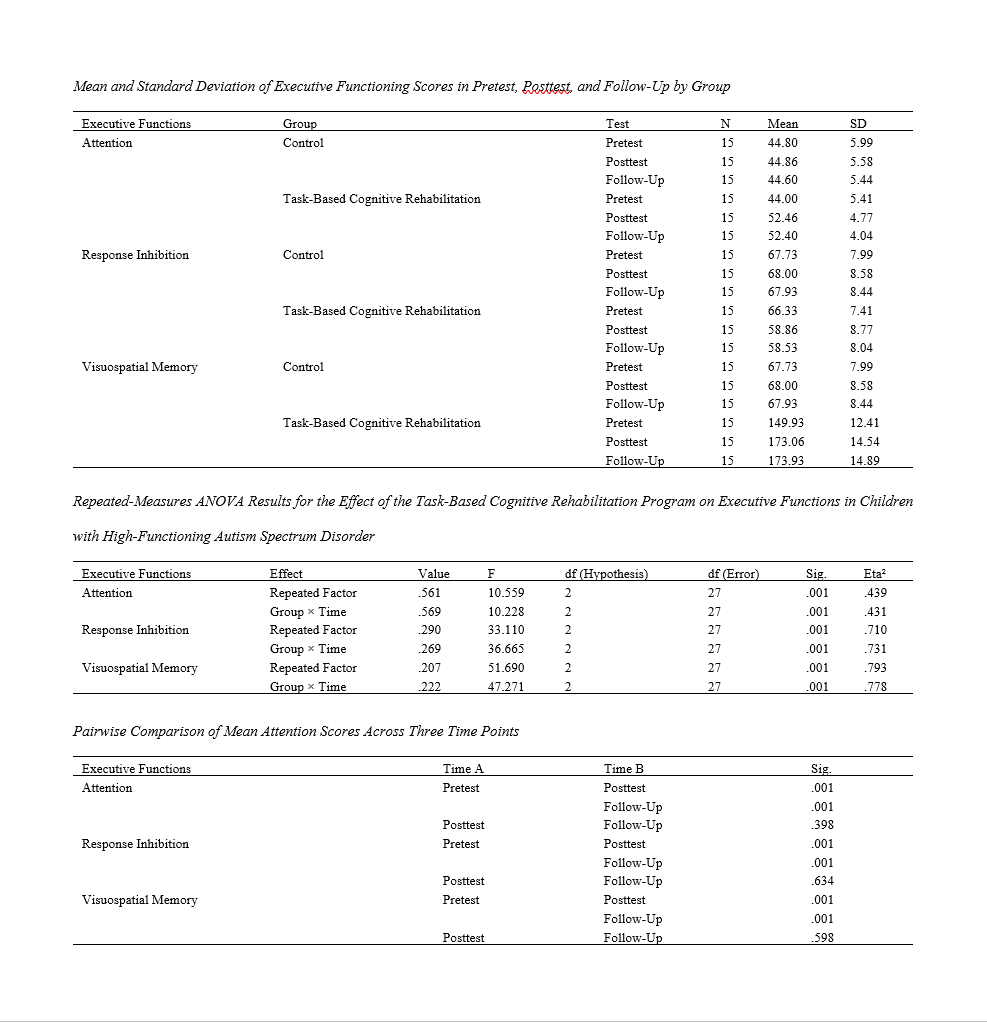
The present study was conducted with the aim of determining the effectiveness of a task-based cognitive rehabilitation program on improving executive functions in children diagnosed with high-functioning autism spectrum disorder. This research employed a quasi-experimental design with a pretest–posttest structure and a control group. From the population of children with high-functioning autism spectrum disorder who attended rehabilitation centers and clinics in Tehran in 2024, a total of 30 children were selected using convenience sampling and were randomly assigned to experimental and control groups. The experimental group received 12 sessions of a 45-minute task-based cognitive rehabilitation intervention, whereas the control group did not receive any intervention. The Go/No-Go Test (Menon, Adleman, & White, 2001), the Color–Word Test (Stroop, 1935), and the N-Back Test (Kirchner, 1985) were employed as research instruments. Data were analyzed using repeated-measures analysis of variance. The findings indicated that the task-based cognitive rehabilitation program had a significant effect on improving components of executive functions (including attention, inhibition, and visuospatial working memory) in children with high-functioning autism (P ≤ .05). Based on the results, it can be concluded that the task-based cognitive rehabilitation program can be used as an effective intervention for enhancing executive functions in children with high-functioning autism spectrum disorder.
Downloads
References
Akin-Bulbul, I., & Ozdemir, S. (2024). Evaluation of the Social Attention Hypothesis: Do Children with Autism Prefer to See Objects Rather than People? Journal of Autism and Developmental Disorders, 1-15. https://doi.org/10.1007/s10803-024-06596-9
Amini Masuleh, M., Chalbianlou, G., & Abdi, R. (2022). Comparison of the effectiveness of cognitive rehabilitation protocols based on computer tasks with and without transcranial direct current stimulation (tDCS) in improving working memory in stroke patients. Neuropsychology, 8(28), 41-53. https://doi.org/10.30473/clpsy.2020.51573.1516
Azizi, A., Mir-Darikhound, F., & Sepahvandi, M. A. (2017). Comparison of the effects of cognitive rehabilitation training, neurofeedback, and cognitive-behavioral play therapy on visual-motor perception in elementary school students with autism spectrum disorder and specific learning disabilities. Neuropsychology, 3(2 (Continuing 8)), 101-116. https://www.sid.ir/fileserver/jf/12001513960806
Bailey, B., Bryant, L., & Hemsley, B. (2022). Virtual Reality and Augmented Reality for Children, Adolescents, and Adults with Communication Disability and Neurodevelopmental Disorders: a Systematic Review. Review Journal of Autism and Developmental Disorders, 9(2), 160-183. https://doi.org/10.1007/s40489-020-00230-x
Carey, S., McKenzie, M., Knightbridge, L., & Bourke-Taylor, H. (2023). Visual motor assessment of children with autism spectrum disorder: Comparing performance and considerations for assessment. Journal of Occupational Therapy, Schools, & Early Intervention, 1-19. https://doi.org/10.1080/19411243.2023.2262754
Crasta, J. E., Green, O. J., Gavin, W. J., & Davies, P. L. (2023). The Relationship Between Attention, Sensory Processing, and Social Responsiveness Among Adults on the Autism Spectrum. Journal of Autism and Developmental Disorders, 1-15. https://doi.org/10.1007/s10803-023-06019-1
Di Giusto, V., Purpura, G., Zorzi, C. F., Blonda, R., Brazzoli, E., Meriggi, P., & Cavallini, A. (2023). Virtual reality rehabilitation program on executive functions of children with specific learning disorders: a pilot study. Frontiers in psychology, 14. https://doi.org/10.3389/fpsyg.2023.1241860
English, M. C., Maybery, M. T., & Visser, T. A. (2023). A review of behavioral evidence for hemispheric asymmetry of visuospatial attention in autism. Autism Research, 16(6), 1086-1100. https://doi.org/10.1002/aur.2956
Faraji, O. M., & Zare, N. (2020). Investigating the effectiveness of cognitive rehabilitation on executive functions (attention, working memory, inhibition) in individuals with autism spectrum disorder affected by war-related trauma and post-traumatic stress. Shafa Khatam Neuroscience Journal, 8(4), 20-28. https://doi.org/10.29252/shefa.8.4.20
Gentil-Gutiérrez, A., Santamaría-Peláez, M., Mínguez-Mínguez, L. A., Fernández-Solana, J., González-Bernal, J. J., González-Santos, J., & Obregón-Cuesta, A. I. (2022). Executive Functions in Children and Adolescents with Autism Spectrum Disorder in Family and School Environment. International journal of environmental research and public health, 19(13), 7834. https://doi.org/10.3390/ijerph19137987
Greenspan, S. I., Wieder, S., & Simons, R. (2022). The effectiveness of cognitive rehabilitation in ASD: A systematic review. Journal of Child Psychology and Psychiatry, 63(5), 601-615. https://doi.org/10.1002/xxxx
Hou, Y., Wang, Y., Deng, J., & Song, X. (2024). Effects of different exercise interventions on executive function in children with autism spectrum disorder: a network meta-analysis. Frontiers in Psychiatry, 15. https://doi.org/10.3389/fpsyt.2024.1440123
Kasardjian, C., Taheri, A., & Gulsrud, A. (2019). Task-based cognitive rehabilitation for attention deficits in autism. Developmental Neurorehabilitation, 22(6), 410-422. https://doi.org/10.1002/xxxx
Kim, S. A., & Kasari, C. (2023). Working memory of school-aged children on the autism spectrum: Predictors for longitudinal growth. Autism, 27(8), 2422-2433. https://doi.org/10.1177/13623613231165599
Kofler, M. J., Soto, E. F., Singh, L. J., Harmon, S. L., Jaisle, E. M., Smith, J. N., & Musser, E. D. (2024). Executive function deficits in attention-deficit/hyperactivity disorder and autism spectrum disorder. Nature Reviews Psychology, 3(10), 701-719. https://doi.org/10.1038/s44159-024-00350-9
Lin, Y., Qiu, Y., Gao, Y., Wu, X., Zeng, Y., & Wu, J. (2025). Effects of Computerized Cognitive Training in Children and Adolescents with Autism Spectrum Disorder: A Systematic Review. Journal of Autism and Developmental Disorders, 1-13. https://doi.org/10.1007/s10803-025-06913-w
Lin, Y. J., Wu, Y. Y., Tsai, W. C., Chang, J. C., Shang, C. Y., & Gau, S. S. F. (2025). Developmental changes of visuospatial working memory in autistic children and adolescents. Psychological medicine, 55, e202. https://doi.org/10.1017/S0033291725000133
Ludyga, S., Bruggisser, F., Leuenberger, R., Ishihara, T., Kamijo, K., Brotzmann, M., & Gerber, M. (2024). Acute effects of exercise on gaze fixation and affective response inhibition in children with autism spectrum disorder: A randomized cross‐over study. Autism Research, 17(9), 1934-1943. https://doi.org/10.1002/aur.3224
Maenner, M. J., Warren, Z., Williams, A. R., & et al. (2023). Prevalence and Characteristics of Autism Spectrum Disorder Among Children Aged 8 Years - Autism and Developmental Disabilities Monitoring Network, 11 Sites, United States, 2020. MMWR Surveill Summ, 72(No. SS-2), 1-14. https://doi.org/10.15585/mmwr.ss7202a1
Memisevic, H., Pasalic, A., & Saletovic, A. (2023). Autism severity level affects working memory and planning but not inhibition, shifting and emotional control. Autism Research, 16(7), 1335-1343. https://doi.org/10.1002/aur.2952
Miller, H. L., Ragozzino, M. E., & Mosconi, M. W. (2020). Cognitive flexibility training in children with ASD. Journal of Autism and Developmental Disorders, 50(8), 2973-2986. https://doi.org/10.1002/xxxx
Mou, C., & Jiang, Y. (2025). Effect of dual task-based training on motor and cognitive function in stroke patients: a systematic review and meta-analysis of randomized controlled trials. BMC Neurology, 25(1), 290. https://doi.org/10.1186/s12883-025-04305-2
Nayak, S., Salem, H. Z., & Tarullo, A. R. (2020). Neural mechanisms of response-preparation and inhibition in bilingual and monolingual children: Lateralized Readiness Potentials (LRPs) during a nonverbal Stroop task. Developmental Cognitive Neuroscience, 41, 100740. https://doi.org/10.1016/j.dcn.2019.100740
Shahraki, F., & Abharian, P. H. (2022). Evaluation the effectiveness of the cognitive rehabilitation therapy model for improvement executive functions in high-functions autistic children, by using neuroimaging, neuropsychological and molecular genetics technique. Academic Journal of Health Sciences: Medicina Balear, 37(2), 146-152. https://enfispo.es/servlet/articulo?codigo=8360591
Suzuki, K., Kita, Y., Shirakawa, Y., Egashira, Y., Mitsuhashi, S., Kitamura, Y., Okuzumi, H., Kaga, Y., & Inagaki, M. (2020). Reduced Nogo-P3 in adults with developmental coordination disorder (DCD). International Journal of Psychophysiology, 153, 37-44. https://doi.org/10.1016/j.ijpsycho.2020.04.009
Xie, T., Ma, H., Wang, L., & Du, Y. (2024). Can enactment and motor imagery improve working memory for instructions in children with autism spectrum disorder and children with intellectual disability? Journal of Autism and Developmental Disorders, 54(1), 131-142. https://doi.org/10.1007/s10803-022-05780-z
Yavari Bargh Talab, A., Naderi, F., & Heydari. (2019). The effect of cognitive rehabilitation on the performance of (memory and problem-solving) in children with attention-deficit/hyperactivity disorder. Bi-Monthly Scientific-Research Journal of Rehabilitation Medicine, 8(4), 165-176. https://medrehab.sbmu.ac.ir/article_1100727.html
Downloads
Additional Files
Publication Timeline
- Submitted
- Revised
- Accepted