Paradigmatic Model of Tacit Knowledge Sharing from the Perspective of Psychology Experts in Iranian Universities: A Grounded Theory Approach
DOI:
https://doi.org/10.61838/kman.ooc.psynexus.5030Keywords:
Tacit knowledge, Grounded theory, Empowerment, Academic psychologistsAbstract
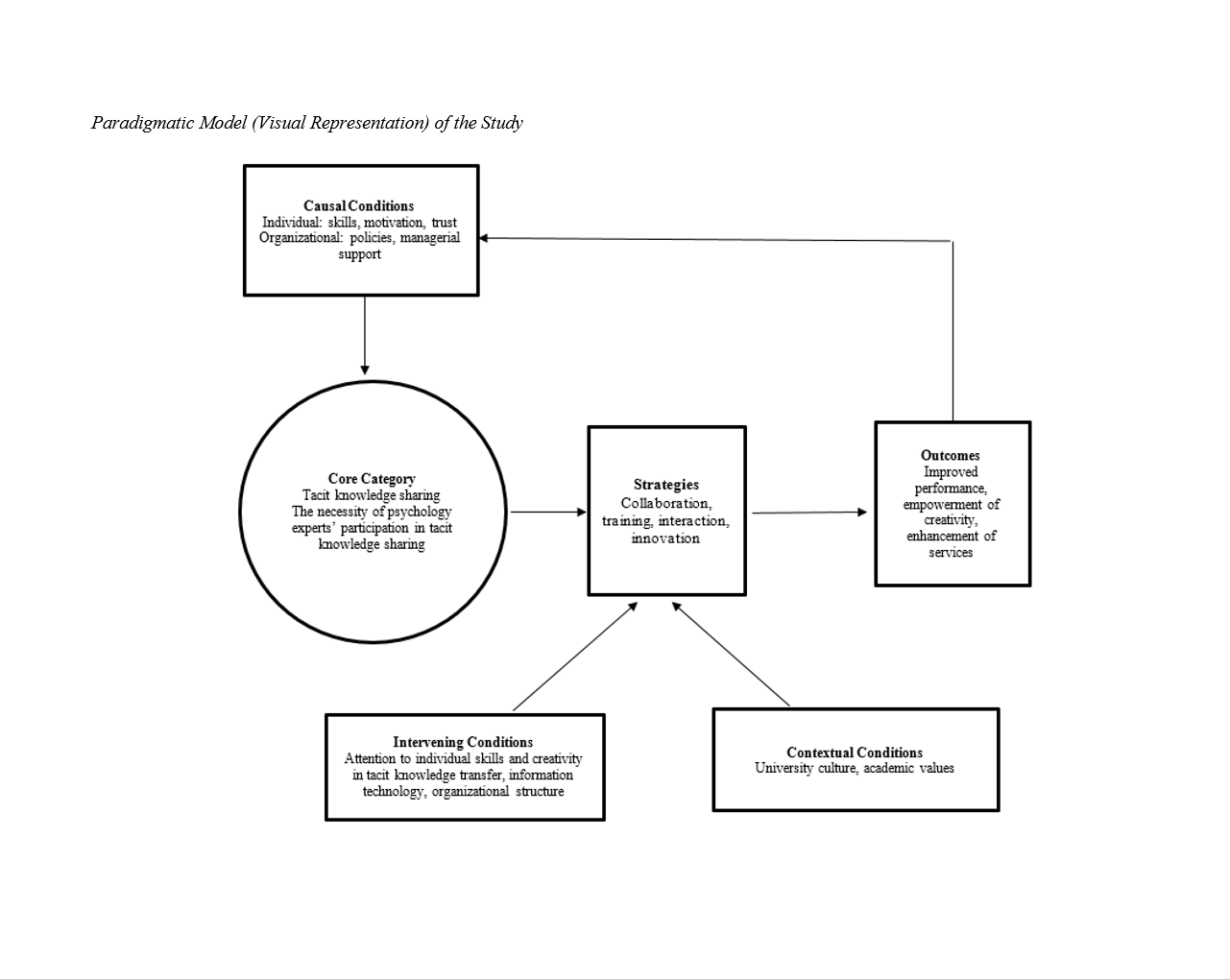
In the contemporary knowledge-based era, organizations—particularly universities—have become increasingly reliant on their knowledge capital. Within this context, tacit knowledge, as a hidden yet strategic resource, plays a critical role in enhancing the quality of education, research, and innovation. Unlike explicit knowledge, tacit knowledge is formed through experience, intuition, and personal skills, and is transmitted only through social interactions and human relationships. Despite the importance of this concept, academic research in Iran has largely focused on explicit knowledge, and no comprehensive model of tacit knowledge sharing from the perspective of academic psychologists has been proposed. The aim of the present study was to design a paradigmatic model of tacit knowledge sharing in Iranian universities using a grounded theory approach. This qualitative study was conducted through semi-structured interviews with psychology experts. The data were analyzed using open, axial, and selective coding, and the final model was extracted in the form of five core categories: causal conditions, contextual conditions, intervening conditions, strategies, and consequences. The results indicated that factors such as trust, motivation, interpersonal skills, organizational culture, and managerial support play a key role in tacit knowledge sharing. The outcomes of this process include the empowerment of psychologists, improved performance, increased creativity, and enhanced quality of psychological services. The findings suggest that tacit knowledge sharing is a dynamic and multi-level process shaped through the interaction between organizational structures and psychological components. By focusing on the perspectives of psychologists and integrating a psychological approach with grounded theory, this study represents a novel step toward the localization of knowledge management theories within the context of higher education in Iran.
Downloads
References
Abidi, O., Dženopoljac, V., & Safi, M. (2023). Online meeting tools, tacit knowledge sharing and entrepreneurial behaviours among knowledge workers during COVID-19. Knowledge Management Research & Practice, 21(6), 1137-1149. https://doi.org/10.1080/14778238.2023.2261885
Ariani, O., Yazdani, H., & Ramezan, M. (2025). Identification and Explanation of the Mechanism for Sharing Employees' Tacit Knowledge in Developing Successors at the University of Tehran. Strategic Management of Organizational Knowledge, 8(2), 105-133. https://jkm.ihu.ac.ir/article_210009.html?lang=en
Burnette, M. (2017). Tacit knowledge sharing among library colleagues: a pilot study. Reference Services Review, 45(3), 382-397. https://doi.org/10.1108/RSR-11-2016-0082
Castaneda, D. I., & Rojas, C. A. R. (2024). Organizational Conditions Associated with the Sharing of Tacit and Explicit Knowledge in the Financial Sector in Colombia. Knowledge Management & E-Learning, 16(3), 547-564. https://doi.org/10.34105/j.kmel.2024.16.025
Fan, Z., & Beh, L. S. (2024). Knowledge sharing among academics in higher education: A systematic literature review and future agenda. Educational Research Review, 42, 100573. https://doi.org/10.1016/j.edurev.2023.100573
Gubbins, C., & Dooley, L. (2021). Delineating the tacit knowledge‐seeking phase of knowledge sharing: The influence of relational social capital components. Human Resource Development Quarterly, 32(3), 319-348. https://doi.org/10.1002/hrdq.21423
Hu, R., Li, Y., Huang, J., Zhang, Y., Jiang, R., & Dunlop, E. (2023). Psychological capital and breakthrough innovation: The role of tacit knowledge sharing and task interdependence. Frontiers in psychology, 14, 1097936. https://doi.org/10.3389/fpsyg.2023.1097936
Jamshidi, E., Nedjat, S., Nedjat, S., Nikooee, S., Rostamigooran, N., & Majdzadeh, R. (2018). How to utilize tacit knowledge in health organizations: An Iranian perspective. Medical Journal of the Islamic Republic of Iran, 32, 116. https://doi.org/10.14196/mjiri.32.116
Kucharska, W., & Erickson, G. S. (2023). Tacit knowledge acquisition & sharing, and its influence on innovations: A Polish/US cross-country study. International Journal of Information Management, 71, 102647. https://doi.org/10.1016/j.ijinfomgt.2023.102647
Li, Y., & Li, H. (2024). Examining the Relationship Between Emotional Intelligence and Tacit Knowledge Sharing using a Moderated Mediation Model. Sage Open, 14(3). https://doi.org/10.1177/21582440241285331
Lincoln, Y. S., & Guba, E. G. (1985). Naturalistic Inquiry. SAGE, Thousand Oaks. https://books.google.com/books?hl=en&lr=&id=IKJnTcV58GQC&oi=fnd&pg=PA415&dq=Lincoln,+Y.+S.+and+E.+G.+Guba+(1985).+Naturalistic+Inquiry,+SAGE,+Thousand+Oaks.+%09&ots=M_RLOY9jmT&sig=GqcYK7cQ8uyxFgYH2--XuijWHAg
Niguse, T., Kant, S., & Borji, B. (2025). Green innovation strategy, sustainable business model innovation and sustainable competitive advantage with mediating role of green intellectual capital in emerging markets: evidence from Ethiopian eco-hotels. Future Business Journal, 11(1), 1-19. https://doi.org/10.1186/s43093-025-00669-6
Obrenovic, B., Jianguo, D., Tsoy, D., Obrenovic, S., Khan, M. A. S., & Anwar, F. (2020). The Enjoyment of Knowledge Sharing: Impact of Altruism on Tacit Knowledge-Sharing Behavior. Frontiers in psychology, 11, 1496. https://doi.org/10.3389/fpsyg.2020.01496
Roudi, G., Mousavi Chelak, A., Ziaeiy, S., & Sharif Moghaddam, H. (2019). Investigating the Role of Leadership Components and Organizational Culture on Employees' Tacit Knowledge Sharing in Iranian Public University Libraries. Academic Librarianship and Information Research, 54(3), 87-106. https://jlib.ut.ac.ir/article_80281.html
Shahzad, F., Chilba, S., & Arslan, A. (2024). Tacit knowledge exchange among senior management educators: A qualitative study. The International Journal of Management Education, 22(2), 100973. https://doi.org/10.1016/j.ijme.2024.100973
Strauss, A., & Corbin, J. (1998). Basics of qualitative research techniques. https://citeseerx.ist.psu.edu/document?repid=rep1&type=pdf&doi=18c7cfe7a46c7771b60dc384b1b4e350f65b13e2
Varghese, J. J., & Rao, M. K. (2024). Unlocking creativity in tech: How resonant leadership fuels creative performance through knowledge sharing in Indian IT firms. Journal of Open Innovation: Technology, Market, and Complexity, 10(4), 100432. https://doi.org/10.1016/j.joitmc.2024.100432
Yeboah, A. (2023). Knowledge sharing in organization: A systematic review. Cogent Business & Management, 10(1), 2195027. https://doi.org/10.1080/23311975.2023.2195027
Yıldız, T., Akan, B. B., Sığrı, Ü., & Dabić, M. (2025). Impact of knowledge-sharing culture on organizational creativity: integrating explicit and tacit knowledge sharing as mediators. Journal of Knowledge Management, 29(4), 1248-1277. https://doi.org/10.1108/JKM-05-2024-0633
Zavatin, I., Ene, A. B., Bujor, D., & Frațiloiu, B. A. (2023). Study on the impact of organizational culture, knowledge management and digitalization on sustainable leadership. Proceedings of the International Conference on Business Excellence,
Downloads
Additional Files
Publication Timeline
- Submitted
- Revised
- Accepted