Comparison of the Effectiveness of Positive Thinking Training and Emotional Self-Regulation Training on Self-Compassion and Psychological Well-Being in Mothers of Children with Autism Spectrum Disorder
Keywords:
self-compassion, psychological well-being, emotional self-regulation, positive thinking, autism spectrum disorderAbstract
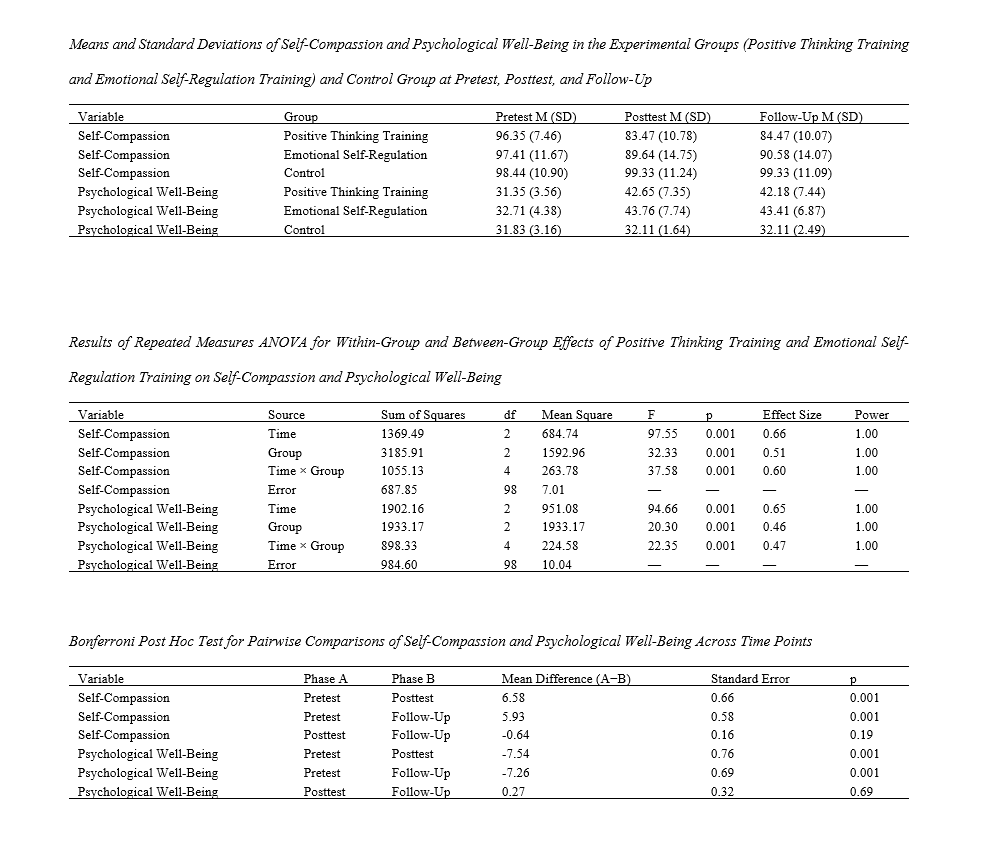
The present study was conducted with the aim of comparing the effectiveness of positive thinking training and emotional self-regulation training on self-compassion and psychological well-being in mothers of children with Autism Spectrum Disorder (ASD). This study was a quasi-experimental design with a pretest–posttest control group and a two-month follow-up. The statistical population consisted of mothers of children with ASD in the city of Isfahan during the years 2024–2025. From this population, 60 mothers were selected through purposive sampling and were then randomly assigned to two experimental groups and one control group. The research instruments included the Self-Compassion Scale (Neff, 2003) and the Psychological Well-Being Questionnaire (Ryff, 2002). Both experimental groups received interventions consisting of eight 90-minute sessions of positive thinking training and emotional self-regulation training. Data were analyzed using repeated measures analysis of variance (ANOVA) and Bonferroni post hoc tests. The results indicated that positive thinking training and emotional self-regulation training had a significant effect on parenting stress and distress tolerance (p < 0.001). The effects of both interventions were maintained at the two-month follow-up stage. Furthermore, emotional self-regulation training demonstrated greater effectiveness compared to positive thinking training in improving self-compassion and psychological well-being (p < 0.001). The findings suggest that therapists should prioritize emotional self-regulation training over positive thinking training to enhance self-compassion and psychological well-being in mothers of children with ASD.
Downloads
References
Anderson, T. R., & Miller, S. J. (2024). The role of Absolutist thinking in self-compassion: Implications for mental well-being. Journal of Positive Psychology, 19(1), 45-62.
Basurrah, A. A., Di Blasi, Z., Lambert, L., Murphy, M., Warren, M. A., Setti, A., Al-Haj Baddar, M., & Shrestha, T. (2023). The effects of positive psychology interventions in Arab countries: A systematic review. Applied Psychology: Health and Well-Being, 15(2), 803-821. https://doi.org/10.1111/aphw.12391
Büyüköksüz, E., & Kayaalp-pehlivan, R. (2025). Psychological Inflexibility, Mindfulness, Emotion Regulation, Self-Compassion, and Anxiety in Adults: A Serial Mediation Model. Muğla Sıtkı Koçman Üniversitesi Eğitim Fakültesi Dergisi, 12(1), 107-134. https://doi.org/10.21666/muefd.1643883
Curtis, S. J., & Izett, E. (2025). The Experience of Mothers of Autistic Children With a Pathological Demand Avoidance Profile: An Interpretative Phenomenological Analysis. Discover Mental Health, 5(1). https://doi.org/10.1007/s44192-025-00127-3
Cutajar, K., & Bates, G. (2025). Australian Women in the Perinatal Period During COVID-19: The Influence of Self-Compassion and Emotional Regulation on Anxiety, Depression, and Social Anxiety. Healthcare, 13(2), 120. https://doi.org/10.3390/healthcare13020120
Fooladchang, M., & Davoud, F. (2025). The mediating role of cognitive emotion regulation strategies in the relationship between proactive personality and perceived social support with emotional well-being in students: A descriptive study. Journal of Rafsanjan University of Medical Sciences, 24(1), 3-18. https://doi.org/10.61186/jrums.24.1.3
Golestani Bakht, T., Babaei, E., Karimi, M., & Ahmadi, A. (2022). The relationship between self-compassion and optimism in students: The mediating role of social adjustment. Social Psychological Research, 12(45), 65EP - 84. http://noo.rs/tDBT3
Huang, P., Lin, Z.-J., Wang, B. C., & Du, Z. (2025). A Mixed Methods Exploration of the Interrelationships Among Self-Compassion, Stress Management, Psychological Capital, and Life Satisfaction in Chinese University Students. Frontiers in psychology, 16. https://doi.org/10.3389/fpsyg.2025.1510987
Kavehfarsani, z., Salehi, R., & Rabiee, M. (2020). investigating the role of Self-Compassion and Psychological Capital (hope, resilience, Self-efficacy and Optimism) in predicting depression and death anxiety in Patients with Cancer. frooyesh, 9(10), 103-114. http://frooyesh.ir/article-1-2067-en.html
Martin, M., Moor, A. S., & Pellicano, E. (2025). Mental health of mothers of children with autism spectrum disorder: A review. Journal of Autism and Developmental Disorders, 48(6), 1994-2006. https://pmc.ncbi.nlm.nih.gov/articles/PMC8311509/
Matiz, A., Chiesa, A., D'Antoni, F., Barbieri, R., & Crescentini, C. (2025). Training for Mindfulness Teachers: Benefits for Mindfulness, Well-being, and Emotion Regulation. Mindfulness, 1–12. https://doi.org/10.1007/s12671-025-02520-z
Nguyen, A., Grummitt, L., Barrett, E. L., Bailey, S., Gardner, L. A., Champion, K. E., & Birrell, L. (2025). The relationship between emotion regulation and mental health in adolescents: Self-compassion as a moderator. Mental Health & Prevention, 38. https://doi.org/10.1016/j.mhp.2025.200430
Oppenheim, D., Mottes‐Peleg, M., Dolev, S., & Yirmiya, N. (2025). Play Interactions of Autistic Preschoolers With Their Mothers and Fathers Without Toys Yield More Positive Interactions Than Play With Toys. Autism. https://doi.org/10.1177/13623613251329975
Ramos-Serrano, L. (2025). “I Am Their Haven”: Mothering Experiences of Spanish Autistic Mothers. Neurodiversity, 3. https://doi.org/10.1177/27546330251349375
Rehman, S., Addas, A., Rehman, E., & Khan, M. A. (2024). The Mediating Roles of Self-Compassion and Emotion Regulation in the Relationship Between Psychological Resilience and Mental Health Among College Teachers. Psychology research and behavior management, Volume 17, 4119-4133. https://doi.org/10.2147/prbm.s491822
Rezagholiyan, M., Nemati, F., & Hashemi, T. (2025). Development of a Model of Students' Subjective Well-Being Based on Attachment Styles, Self-Compassion, and Emotion Regulation Styles with the Mediating Role of Quality of Life. Journal of Adolescent and Youth Psychological Studies (JAYPS), 6(1), 21-33. https://doi.org/10.61838/
Saghebi, K., Abolghasemi, A., & Akbary, B. (2020). The Effectiveness of Positive Thinking and Self-compassion Training on Cognitive Flexibility and Cognitive Failure in Girls With Primary Dysmenorrhea. Caspian Journal of Neurological Sciences, 6(1), 45-56. https://doi.org/10.32598/CJNS.6.20.221.1
Shapira, L. B., & Mongrain, M. (2010). The benefits of self-compassion and optimism exercises for individuals vulnerable to depression. The Journal of Positive Psychology, 5(5), 377-389. https://doi.org/10.1080/17439760.2010.516763
Uzun, K., & Karataş, Z. (2023). The examination of the mediator role of optimism, self-compassion, altruism and gratitude in the relationship between cognitive distortions and forgiveness of emerging adults. Emerging Adulthood, 11(4), 845-868. https://doi.org/10.1177/21676968231171200
Vidal, J., Ciudad-Fernández, V., Navarrete, J., Soler, J., Schmidt, C., Molinari, G., & Cebolla, A. (2024). From Self-Criticism to Self-Compassion: Exploring the Mediating Role of Two Emotion Dysregulation Variables in Their Relationship to Depressive Symptoms. Current Psychology. https://doi.org/10.1007/s12144-024-06325-6
Wild, M. G., Coppin, J. D., Mendoza, C., Metts, A., Pearson, R., & Creech, S. K. (2025). Self-compassion, mindfulness, and emotion regulation predict multiple dimensions of quality of life in US post-9/11 veterans. Quality of Life Research, 1-10. https://doi.org/10.1007/s11136-025-03908-
Xiang, Y., Zhan, X., Li, X., Wang, Y., & Kuang, Z. (2025). A Study of the Effects of Dance/Movement Therapy on Parenting Stress and Emotions in Mothers of Children With Autism Spectrum Disorder. Frontiers in Psychiatry, 16. https://doi.org/10.3389/fpsyt.2025.1465677
Yan, Y., & Abdullah, E. B. (2025). Clinical Interventions for Depression and Anxiety in Mothers of Children With Autism Spectrum Disorder in China. Ls, 1(3), 1-27. https://doi.org/10.71204/srdzv858
Downloads
Additional Files
Publication Timeline
- Submitted
- Revised
- Accepted