The Mediating Role of Emotional Intelligence in the Causal Relationship Between Spiritual Intelligence and School Attachment and Academic Achievement Among Lower Secondary School Students
Keywords:
Academic Achievement, School Attachment, Spiritual Intelligence, Emotional IntelligenceAbstract
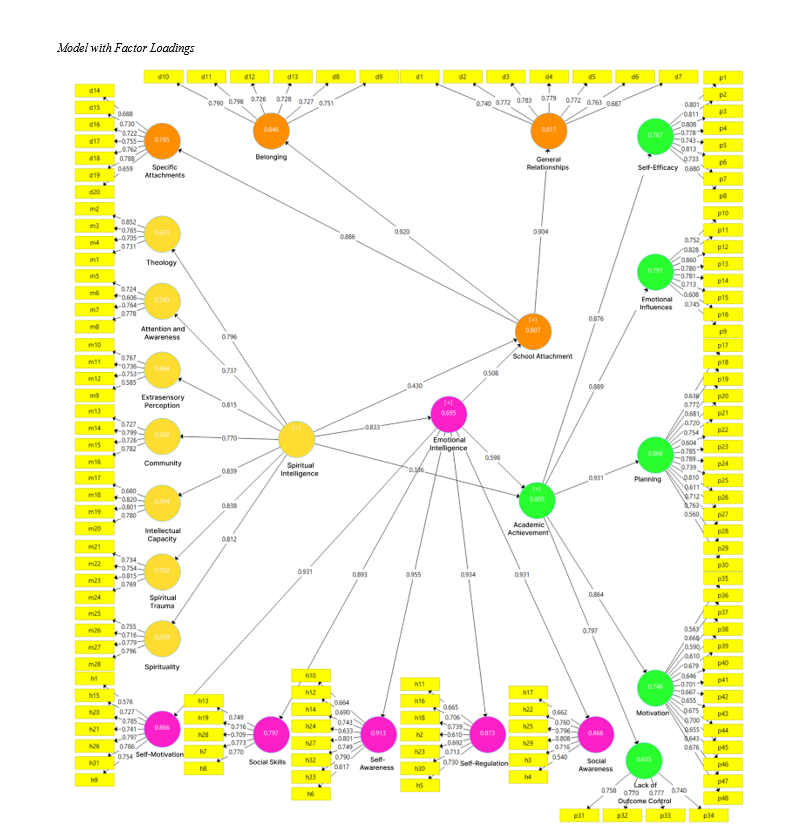
The present study was conducted with the aim of examining the mediating role of emotional intelligence in the causal relationship between spiritual intelligence and school attachment and academic achievement among lower secondary school students. This research is applied in terms of purpose and quantitative, descriptive-survey in terms of method. The participants consisted of 384 lower secondary school students from the city of Tabriz, who were selected using cluster random sampling. The research instruments included the Spiritual Intelligence Questionnaire by Wolman (2011), the Emotional Intelligence Questionnaire by Schering (1998), the Academic Achievement Questionnaire by Pham and Taylor (1994), and the School Attachment Questionnaire by Motton et al. (1993). Data analysis was conducted using structural equation modeling and the Sobel test in SmartPLS version 3.1.1 at a significance level of 0.05. The results indicated that the research model demonstrated a good fit. Spiritual intelligence had a significant effect on school attachment (t = 5.134, p = 0.001), academic achievement (t = 5.289, p = 0.001), and emotional intelligence (t = 25.850, p = 0.001). Emotional intelligence also had a significant effect on school attachment (t = 6.697, p = 0.001) and academic achievement (t = 9.179, p = 0.001). Furthermore, emotional intelligence played a mediating role in the effect of spiritual intelligence on school attachment (z = 8.674, p = 0.001) and academic achievement (z = 9.715, p = 0.001). Therefore, students with higher levels of emotional intelligence and spiritual intelligence exhibit stronger attachment to school and achieve higher levels of academic performance.
Downloads
References
Abidin, Z., & Sirojuddin, A. (2024). Developing spiritual intelligence through the internalization of sufistic values: Learning From pesantren education. Tafkir: Interdisciplinary Journal of Islamic Education, 5(2), 331-343. https://doi.org/10.31538/tijie.v5i2.783
Alizadeh, M., Rostami, F., Mortazavi, Z., Naderifar, H., Jormand, H., & Mortazavi, S. S. (2025). Emotional intelligence and academic achievement relationship in Students of Rehabilitation Faculty of Hamadan University of Medical Sciences in Iran. Horizon of Medical Education Development. https://doi.org/10.22038/hmed.2025.85176.1470
Aslan, M., & Kosir, S. (2021). Survey data showing the influences of school attachment among secondary school students in Albania. Data in Brief, 35, 106949. https://doi.org/10.1016/j.dib.2021.106949
Baratpour, S., & Naderi, F. (2023). The Causal Relationship of Spiritual Intelligence and Moral Intelligence with Attachment to God with Mediating Role of One's Image of God among Students. Psychological Achievements, 30(1), 205-222. https://doi.org/10.22055/psy.2022.39728.2774
Chastnyk, O., Zoria, M., Poletay, O., Shumskyi, O., & Klochkova, Y. (2024). Exploring the influence of interactive education on academic progress: Evaluating effectiveness and implementation approaches. http://erpub.chnpu.edu.ua:8080/jspui/handle/123456789/10834
Civitillo, S., Göbel, K., Preusche, Z., & Jugert, P. (2021). Disentangling the effects of perceived personal and group ethnic discrimination among secondary school students: The protective role of teacher–student relationship quality and school climate. New directions for child and adolescent development, 2021(177), 77-99. https://doi.org/10.1002/cad.20415
Donisi, V., Perlini, C., Mazzi, M. A., Rimondini, M., Garbin, D., Ardenghi, S., & Del Piccolo, L. (2022). Training in communication and emotion handling skills for students attending medical school: Relationship with empathy, emotional intelligence, and attachment style. Patient Education and Counseling, 105(9), 2871-2879. https://doi.org/10.1016/j.pec.2022.05.015
Eftekhari, H., Rezaei Fard, A., & Izadi, S. (2024). Investigating the Relationship between Parents' Parenting Style and Academic Achievement with the Mediation of Students' Self-esteem. Research In Instructional Methods, 2(3), 141-171. https://doi.org/10.22091/jrim.2024.11401.1107
Fathi-Azar, E., Hosseinzadeh, M., & Rahmani, F. (2014). Relationship between emotional intelligence and academic achievement in Iranian university students: A meta-analysis. DSME, 1(2), 1-8. https://dsme.hums.ac.ir/article-1-36-en.html
Gallego, A. G., Pérez, A. M., Fernández, V. F., Alcántara-López, M., & Sáez, M. C. (2021). Life satisfaction in adolescents: relationship with parental style, peer attachment and emotional intelligence. Electronic Journal of Research in Education Psychology, 19(53), 51-74. https://doi.org/10.25115/ejrep.v19i53.3425
Garcia-Rodriguez, L., Redín, C. I., & Abaitua, C. R. (2023). Teacher-student attachment relationship, variables associated, and measurement: A systematic review. Educational Research Review, 38, 100488. https://doi.org/10.1016/j.edurev.2022.100488
Gómez-Leal, R., Holzer, A. A., Bradley, C., Fernández-Berrocal, P., & Patti, J. (2022). The relationship between emotional intelligence and leadership in school leaders: A systematic review. Cambridge Journal of Education, 52(1), 1-21. https://doi.org/10.1080/0305764X.2021.1927987
Herut, A. H., Muleta, H. D., & Lebeta, M. F. (2024). Emotional intelligence as a predictor for academic achievement of children: Evidence from primary schools of southern Ethiopia. Social Sciences & Humanities Open, 9, 100779. https://doi.org/10.1016/j.ssaho.2023.100779
Kamboj, K. P., & Garg, P. (2021). Teachers' psychological well-being role of emotional intelligence and resilient character traits in determining the psychological well-being of Indian school teachers. International Journal of Educational Management, 35(4), 768-788. https://doi.org/10.1108/IJEM-08-2019-0278
Košir, S., Aslan, M., & Lakshminarayanan, R. (2023). Application of school attachment factors as a strategy against school dropout: A case study of public-school students in Albania. Children and Youth Services Review, 152, 107085. https://doi.org/10.1016/j.childyouth.2023.107085
Krishnan, R., Nair, S., Saamuel, B. S., Justin, S., Iwendi, C., Biamba, C., & Ibeke, E. (2022). Smart analysis of learner's performance using learning analytics for improving academic progression: a case study model. Sustainability, 14(6), 3378. https://doi.org/10.3390/su14063378
Ma, Q., & Wang, F. (2022). The role of students’ spiritual intelligence in enhancing their academic engagement: A theoretical review. Frontiers in psychology, 13, 857842. https://doi.org/10.3389/fpsyg.2022.857842
Momtaz, E. K., & Roozbahani, M. T. (2014). An investigating the effect of spiritual intelligence on employees’empowerment. Arabian Journal of Business and Management Review (Kuwait Chapter), 3(7), 205-216. https://j.arabianjbmr.com/index.php/kcajbmr/article/view/586
Murdiani, J., & Wulandari, M. D. (2025). The Implications of Parental Role Involvement on the Development of Primary School Students' Spiritual Intelligence. Jurnal Elementaria Edukasia, 9(2), 3704-3715. https://doi.org/10.31949/jee.v9i2.13650
Nemati, S., Badri Gargari, R., Torfeh, N., & Mahmoudi, E. (2023). The Role of Hope, Self-Compassion, and Parental Resilience in Predicting School Bonding of Students with Specific Learning Disorders. J Child Ment Health, 10(3), 31-47. https://childmentalhealth.ir/article-1-1360-en.html
Nooreddini, A., Sanagoo, A., & Kalteh, E. A. (2019). The effect of Emotional Intelligence component education on nursing student happiness and academic achievement. JNE, 8(5), 47-54. https://jne.ir/article-1-1059-en.html
Page, A., Charteris, J., Anderson, J., & Boyle, C. (2021). Fostering school connectedness online for students with diverse learning needs: Inclusive education in Australia during the COVID-19 pandemic. European Journal of Special Needs Education, 36(1), 142-156. https://doi.org/10.1080/08856257.2021.1872842
Poorrezagholi, M., & Naveh, A. S. (2022). Investigating the Relationship between Religiosity and Spiritual Intelligence with Attachment among High School Students in Rafsanjan. Journal of Positive School Psychology, 6(7). https://journalppw.com/index.php/jpsp/article/view/9455
Rahmawaty, A., Rokhman, W., Bawono, A., & Irkhami, N. (2021). Emotional intelligence, spiritual intelligence and employee performance: The mediating role of communication competence. International Journal of Business and Society, 22(2), 734-752. https://doi.org/10.33736/ijbs.3754.2021
Ramezani Khamsi, Z., Khademi Ashkezari, M., & Naghsh, Z. (2017). The relationship between emotional intelligence and academic achievement: The mediating role of procrastination, self-regulation,self- efficacy. The Journal of New Thoughts on Education, 13(3), 163-186. https://doi.org/10.22051/jontoe.2017.13980.1669
Rosadi, K. I. (2023). The effect of emotional intelligence, spiritual intelligence, and school culture on strengthening senior high school student’s character in Jambi Province. Cogent Social Sciences, 9(1), 2194564. https://doi.org/10.1080/23311886.2023.2194564
Rosadi, K. I., Musyaffa, A. A., Anwar, K., El Widdah, M., & Idarianty, M. F. (2024). Strengthening emotional intelligence, spiritual intelligence, and school culture on student character. In Religion, Education, Science and Technology towards a More Inclusive and Sustainable Future (pp. 90-96). https://doi.org/10.1201/9781003322054-14
Rose, J., Gilbert, L., McGuire-Snieckus, R., Gus, L., McInnes, K., & Digby, R. (2023). Attachment aware schools: working with families to enhance parental engagement and home-school relationships. The Open Family Studies Journal, 9(1), 160-171. https://doi.org/10.2174/1874922401709010160
Sassirekha, M. S., & Vijayalakshmi, S. (2022). Predicting the academic progression in student’s standpoint using machine learning. Automatika: časopis za automatiku, mjerenje, elektroniku, računarstvo i komunikacije, 63(4), 605-617. https://doi.org/10.1080/00051144.2022.2060652
Seifi, F., Hejazi, M., Sobhi, A., & Kiani, Q. (2025). The Relationship of Spiritual Intelligence/Academic Conscience with Academic Performance: The Mediating Role of Academic Hardiness. JRRH, 8(1), 65-80. https://journals.sbmu.ac.ir/jrrh/article/view/33341
Sheykholreslami, A., Dadjooei, R., & Seyedesmaili Ghomi, N. (2020). The Role of Teachers' Job Engagement and Job Satisfaction in Prediction Students' School Bonding. Journal of Educational Psychology Studies, 17(40), 33-20. https://doi.org/10.22111/jeps.2020.5838
Susanto, S., & Dwijayanto, A. (2022). Student's Attachment to social media and the Challenges of Moderate Islamic Education (Implementation During the Covid-19 Pandemic). Jurnal Ilmiah Peuradeun, 10(2), 331-352. https://doi.org/10.26811/peuradeun.v10i2.728
Yaghoobi, A., Farhadi, M., Ghanbari, N., & Kakbaraei, K. (2008). Study of Relationship between Emotional Intelligence with Homesickness and Mental Health in University Students. Journal of Modern Psychological Researches, 3(9), 135-151. https://psychologyj.tabrizu.ac.ir/article_4350.html?lang=en
Yosefi nejad, R., & Keramati nojedeh sadat, M. (2025). The Effectiveness of the Four-component Instructional Design Model on the Academic Progress and Resilience of the Biology Course in Shad Application. The Journal of New Thoughts on Education, 21(1), 73-91. https://doi.org/10.22051/jontoe.2023.44472.3814
Zhou, Z., Tavan, H., Kavarizadeh, F., Sarokhani, M., & Sayehmiri, K. (2024). The relationship between emotional intelligence, spiritual intelligence, and student achievement: a systematic review and meta-analysis. BMC Medical Education, 24(1), 217. https://doi.org/10.1186/s12909-024-05208-5
Downloads
Additional Files
Publication Timeline
- Submitted
- Revised
- Accepted