Structural Model of Marital Conflict Based on Self-Differentiation and Alexithymia with the Mediating Role of Frustration Tolerance in Divorce-Seeking Individuals
Keywords:
Marital conflict, self-differentiation, alexithymia, frustration tolerance, structural equation modelingAbstract
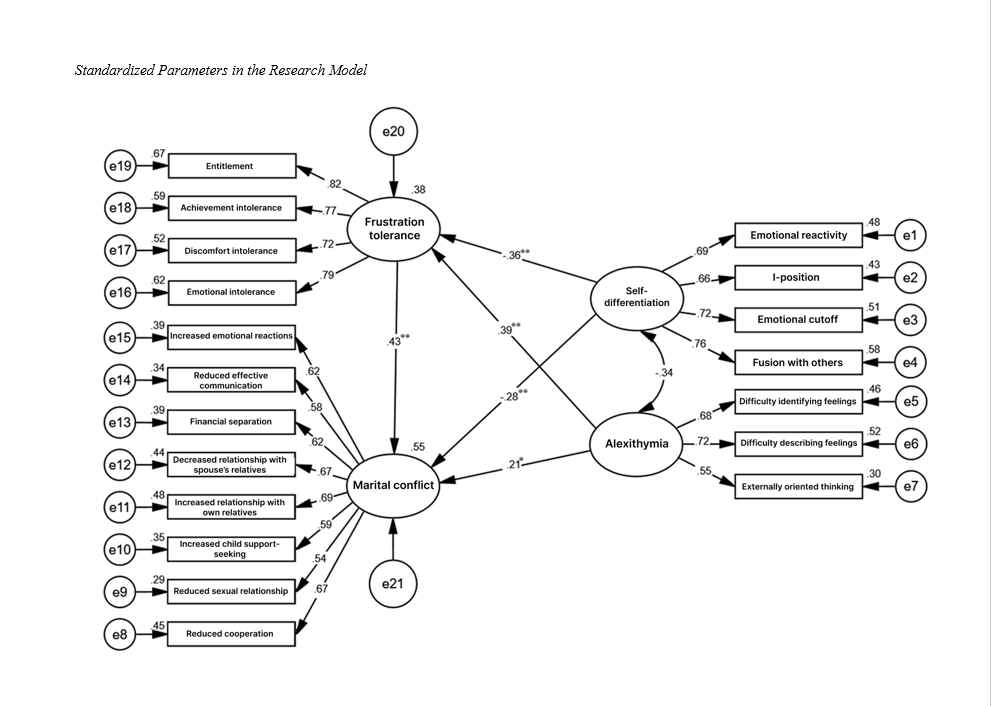
The present study aimed to examine the structural model of marital conflict based on self-differentiation and alexithymia with the mediating role of frustration tolerance in individuals seeking divorce. This study was fundamental in purpose and descriptive-correlational in design. The statistical population consisted of all divorce-seeking individuals who referred to family counseling centers affiliated with the judiciary in Karaj and Hashtgerd between February 2025 and October 2025. A sample of 250 participants (139 women and 111 men) was selected using convenience sampling and completed the research instruments voluntarily. Data were collected using the Marital Conflict Questionnaire (Sanaei et al., 2008), the Self-Differentiation Inventory (Skowron & Friedlander, 1998), the Toronto Alexithymia Scale (Bagby et al., 1994), and the Frustration Discomfort Scale (Harrington, 2005). Data analysis was conducted using Structural Equation Modeling (SEM) with SPSS version 27 and AMOS version 26 through Maximum Likelihood estimation. Model fit was evaluated using standard fit indices including χ²/df, GFI, AGFI, CFI, and RMSEA. The results indicated that the proposed structural model demonstrated acceptable fit with the data (χ²/df = 1.67, CFI = 0.94, RMSEA = 0.05). Alexithymia had a positive and significant direct effect on marital conflict (β = 0.206, p < .05), whereas self-differentiation had a negative and significant direct effect (β = -0.276, p < .01). Frustration tolerance significantly predicted marital conflict (β = 0.431, p < .001) and also mediated the relationships between alexithymia and marital conflict (β = 0.167, p < .001) and between self-differentiation and marital conflict (β = -0.156, p < .001). The model explained 55% of the variance in marital conflict (R² = 0.55). The findings suggest that alexithymia and self-differentiation play significant roles in predicting marital conflict both directly and indirectly through frustration tolerance, highlighting the importance of emotional processing and coping capacity in marital dynamics and offering implications for targeted psychological interventions.
Downloads
References
Alizadeh, S., Aryan, R., & Moradi, S. (2024). Investigating the relationship between emotional alexithymia and maladaptive schemas with marital conflict in married female students. Journal of Cognition, Behavior, and Learning, 1(4), 106-116. https://doi.org/10.61838/jcbl.1.4.9
Amirkhosravi, A., Bahrami, H., & Sa'adati Shamir, E. (2022). Structural model of emotional divorce in relation to alexithymia and interpersonal forgiveness with the mediating role of marital dissatisfaction in women. Quarterly of Psychometrics, 10(40), 7-20. https://www.magiran.com/paper/2482160/structural-model-of-alexithymia-in-relation-to-alexithymia-and-interpersonal-forgiveness-with-mediating-role-of-marital-dissatisfaction-in-women?lang=en
Arini, D. U. (2023). Intolerance of Marriage Relations Between Husband and Wife (Psychological Case Study of Marital Rape). East Asian Journal of Multidisciplinary Research, 2(5), 2111-2122. https://doi.org/10.55927/eajmr.v2i5.4046
Ashouri, A., Rostami, K., Rahmani, S., Gholizadeh, S., & Hossein, M. (2023). Investigating the role of alexithymia and spiritual intelligence in predicting marital quality of life. Islamic Lifestyle Centered on Health, 7(1), 442-448. https://www.islamiilife.com/article_185466.html?lang=en
Emadoleslami, V., Ahmadi Ragh-Abadi, A., & Rahimi, A. (2021). Investigating the relationship between marital burnout, cognitive flexibility, and distress tolerance in graduate students of Khorasan. Seventh International Conference on Knowledge and Technology in Educational Sciences, Social Studies, and Psychology of Iran, Tehran.
Esmaeili Anamogh, B., Paknejad, H., & Narimani, M. (2024). The relationship between emotional alexithymia and marital satisfaction: A meta-analytic study. Cultural-Educational Journal of Women and Family, 19(67), 167-188. https://cwfs.ihu.ac.ir/article_209059.html
Ghasemi, H., Demehri, F., & Abooei, A. (2023). Prediction of Mental Health Based on Emotional Alexithymia and Marital Burnout of Women Affected by Infidelity. Aftj, 4(4), 428-455. https://doi.org/10.61838/kman.aftj.4.4.25
Gholipour, E., Akbari, H., & Shariatnia, K. (2022). The Effectiveness of Marital Relationship Enrichment Training on Emotional Literacy, Couple Compatibility, Marital Boredom and Distress Tolerance in Couples. Aftj, 3(1), 632-653. https://doi.org/10.61838/kman.aftj.3.1.31
Habibi Kordabad, N., & Darbani, S. A. (2023). The Mediating Role of Triangulation in the Family on the Relationship Between Differentiation and Marital Conflict in Parents with Disabled Children. KMAN Counseling & Psychology Nexus, 1(2), 164-171. https://journals.kmanpub.com/index.php/psychnexus/article/view/1936
Jo, M., & Lee, S. (2025). The Effects of Self-Differentiation on Newly-Wedded Couples' Marital Satisfaction: The Moderated Mediating Effect of Conflict Management Style According to Gender. Korean Assoc Learner-Centered Curric Instr, 25(12), 573-590. https://doi.org/10.22251/jlcci.2025.25.12.573
Kazemi, N., Narimani, M., SadeghiHashjin, G., & Basharpoor, S. (2021). The effectiveness of brief self-regulation couple therapy (srct) on reducing marital covert relational aggression, changing of communication patterns and reduction of alexithymia among conflicting couples. Journal of Psychological Science, 20(108), 2225-2238. https://doi.org/10.52547/JPS.20.108.2225
Lyvers, M., Pickett, L., Needham, K., & Thorberg, F. A. (2022). Alexithymia, Fear of Intimacy, and Relationship Satisfaction. Journal of Family Issues, 43(4), 1068-1089. https://doi.org/10.1177/0192513x211010206
Moayed, F., Haji Ali Akbari Mehrizi, S., & Hobbi, M. B. (2018). The role of Alexithymia in marital conflicts in women who apply for divorce in Tehran. Women and Family Studies, 11(42), 125-140. https://jwsf.tabriz.iau.ir/article_667510_206647681807ebe6d240b9872cc55566.pdf
Mohammadi, L., Abbasi, G., & Hassanzadeh, R. (2025). The Effectiveness of Rational Emotive Behavior Therapy (REBT) on Feelings of Rejection and Alexithymia in Women with Marital Conflict. International Journal of Education and Cognitive Sciences, 1-11. https://doi.org/10.61838/kman.ijecs.287
Montazer, R., & Razavi Nematollahi, V. S. (2024). Investigating the relationship between psychological flexibility and marital adjustment with the mediating role of ambiguity tolerance. Proceedings of the 14th International Conference on Psychology, Educational Sciences and Lifestyle. https://www.sid.ir/paper/1387266/fa
Ramzy, L. (2023). Predicting resilience based on marital adjustment and tolerance for ambiguity among women referring to the Jahrom City Counseling Center. Iranian Journal of Psychology and Behavioral Sciences, 25(3), 73-83. https://www.psyj.ir/user/articles/2965
Rauf, U., Fatima, H., & Mushtaq, M. (2023). Distress tolerance, mental health problems and marital satisfaction among married couples. Pakistan Journal of Social Research, 5(01), 559-567. https://doi.org/10.52567/pjsr.v5i01.1377
Sadeghi, I., Salahian, A., & Salehi, M. (2022). Modeling Marital Conflicts based on Self-Knowledge, Love and Emotional Intelligence Mediated by Differentiation. Journal of Family Research, 18(2), 309-332. https://doi.org/10.48308/jfr.18.2.309
Salehi, M., Abkenar, B. N., & Rashidi, T. (2024). The Effectiveness of Gottman's Systemic Cognitive Couple Therapy on Marital Conflicts, Communication Patterns, and Alexithymia in Couples With Marital Conflict. Jarac, 6(3), 145-152. https://doi.org/10.61838/kman.jarac.6.3.16
Sarhani, Z., & Homaei, R. (2023). Association Between Marital Infidelity Based on Fear of Intimacy and Self-Differentiation Through the Mediating Role of Sexual Satisfaction in Women With Marital Conflict. Archives of Hygiene Sciences, 12(1), 50-55. https://doi.org/10.34172/ahs.12.1.1.386
Shahabi, S., Jenaabadi, H., & Tamini, B. K. (2021). The Mediating Role of Marital Intimacy in the Relationship Between Distress Tolerance and Sexual Self-Concept Among Couples With Marital Conflict. Aftj, 2(3), 361-380. https://doi.org/10.61838/kman.aftj.2.3.18
Downloads
Additional Files
Publication Timeline
- Submitted
- Revised
- Accepted