The Relationship Between Gender Schema and Dysfunctional Sexual Beliefs with the Mediating Role of Psychological Hardiness in Women
Keywords:
Gender Schema, Dysfunctional Sexual Beliefs, Psychological Hardiness, Structural Equation Modeling, Married WomenAbstract
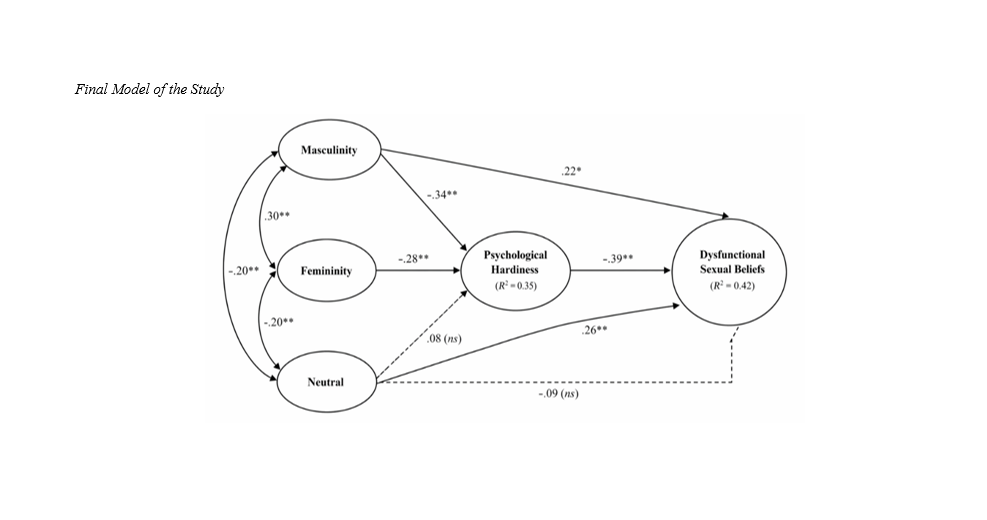
The present study aimed to examine the relationship between gender schema and dysfunctional sexual beliefs with the mediating role of psychological hardiness in married women. This study employed a descriptive-correlational design using structural equation modeling (SEM). The statistical population consisted of all married women aged 30 to 40 years working in official and governmental bank branches in Bushehr in 2025. A sample of 266 participants was selected through convenience sampling based on Cochran’s formula. Data were collected using the Dysfunctional Sexual Beliefs Questionnaire (SDBQ), the Bem Sex Role Inventory (BSRI), and the Ahvaz Psychological Hardiness Inventory (APHI). Data analysis was conducted using SPSS version 28 for descriptive statistics and correlation and regression analyses, and AMOS software for testing the structural model and mediating effects. The results indicated that masculinity (β = 0.22, p = 0.017) and femininity (β = 0.26, p = 0.010) had positive and significant effects on dysfunctional sexual beliefs, while the effect of neutral gender schema was not significant (β = -0.09, p = 0.212). Masculinity (β = -0.34, p = 0.010) and femininity (β = -0.28, p = 0.010) had significant negative effects on psychological hardiness, whereas neutral traits showed no significant effect (β = 0.08, p = 0.432). Psychological hardiness had a significant negative effect on dysfunctional sexual beliefs (β = -0.39, p = 0.010). Additionally, the indirect effects of masculinity (β = 0.13, p = 0.050) and femininity (β = 0.11, p = 0.050) on dysfunctional sexual beliefs through psychological hardiness were significant, while the indirect effect of neutral traits was not significant (β = -0.03, p = 0.268). The findings highlight the significant role of gender schema dimensions and psychological hardiness in shaping dysfunctional sexual beliefs, emphasizing that psychological hardiness partially mediates the relationships between masculinity and femininity with dysfunctional sexual beliefs, and suggesting that enhancing resilience and promoting flexible gender schemas may reduce maladaptive sexual beliefs in women.
Downloads
References
Astle, S., Anders, K. M., McAllister, P., Hanna-Walker, V., & Yelland, E. (2025). The Conceptualization and Measurement of Sexual Self-Concept and Sexual Self-Schema: A Systematic Literature Review. The Journal of Sex Research, 62(1), 95-106. https://doi.org/10.1080/00224499.2023.2244937
Bailey, R., Oba, E. C., & Allen, R. (2025). The Role of Metacognitive Beliefs in Generalized Anxiety Disorder in Men Who Have Sex with Men Living with HIV in Nigeria. Journal of Health Psychology. https://doi.org/10.1177/13591053251314989
Brotto, L. A., Atallah, S., Carvalho, J., Gordon, E., Pascoal, P. M., Reda, M., & Tavares, I. M. (2025). Psychological and Interpersonal Dimensions of Sexual Function and Dysfunction: Recommendations from the Fifth International Consultation on Sexual Medicine (ICSM 2024). Sexual Medicine Reviews, 13(2), 118-143. https://doi.org/10.1093/sxmrev/qeae073
Fedorova, A. I., & Vorobevskii, A. A. (2025). The Influence of Shame and Guilt on Sexuality in Men and Women. Neurology Bulletin, 57(1), 54-63. https://doi.org/10.17816/nb640827
Goodarzi, S. (2023). Comparison of Defense Mechanisms, Psychological Hardiness, and Social Adjustment in Female and Male Students. Hoorin Psychology Journal, 1(1), 59-70.
Hashemi, S., & Ahmadi, O. (2015). The Role of Self-Efficacy and Masculine and Feminine Gender Roles in Psychological Hardiness. New Psychological Research Quarterly, 10(37), 71-87.
Heidari, S., Pouyaifar, Z., & Delavar, F. (2024). Examining the Relationship Between Psychological Hardiness and Depression in the Academic Progress of Psychology Students in Golpayegan Khorramabad. https://civilica.com/doc/2289464
Jafar Tabatabaei, T. S., & Zakeri, A. (2023). The Effect of Moral Intelligence on Psychological Hardiness and Social Adjustment of Students. Islamic Lifestyle Journal, 7(1), 432-441.
Jarwan, A. S., & Al-frehat, B. M. (2020). Emotional Divorce and Its Relationship with Psychological Hardiness. International Journal of Education and Practice, 8(1), 72-85. https://doi.org/10.18488/journal.61.2020.81.72.85
Kowalski, C. M., & Schermer, J. A. (2019). Hardiness, Perseverative Cognition, Anxiety, and Health-Related Outcomes: A Case for and Against Psychological Hardiness. Psychological Reports, 122(6), 2096-2118. https://doi.org/10.1177/0033294118800444
Levent, K. U. R. T. (2025). Metacognition in Couple Relationships. Clinical Psychology Research, 1, 39.
Mahdikhani, B., & Izadi, M. (2021). Determining the Relationship of Psychological Hardiness and Responsibility with Quality of Life in Couples with Marital Conflicts. Modern Advances in Psychology, 5(41), 11-20.
Najafi, Z., & Fakhimi Farhadi, R. (2023). Effectiveness of Psychological Hardiness Training on Sexual Satisfaction and Marital Conflicts in Couples with Emotional Divorce. Journal of Psychology, 2(1), 1-12.
Nkurunziza, A., Niyonsenga, J., Munganyinka, C., Ntete, J. M., & Mutabaruka, J. (2025). Do Gender and Relationship Length Jointly Moderate the Effects of Marital Dysfunctional Beliefs and Expectations on Marital Commitment Among Rwandan Married Couples? Journal of Family Issues. https://doi.org/10.1177/0192513X251347318
Parsafar, S., & Yazdkhasti, F. (2014). Examining the Causal Relationships Among Gender Roles, Resilience, Hardiness, Learned Helplessness, and Codependency in Spouses of Addicted Individuals. Social Psychological Studies of Women, 12(4), 69-92.
Raeisi, Z. (2024). Examining the Relationship Between Psychological Hardiness and Self-Differentiation with Mother-Child Interaction in Employed Mothers of Marvdasht Hamedan. https://civilica.com/doc/2215231
Seifi, Y., & Taghavi, M. (2019). The Relationship Between Spiritual Well-Being and Marital Satisfaction: The Mediating Role of Psychological Hardiness. Contemporary psychology, 1(14), 31-41.
Strand, E. R., Anyan, F., Hjemdal, O., Nordahl, H. M., & Nordahl, H. (2024). Dysfunctional Attitudes Versus Metacognitive Beliefs as Within-Person Predictors of Depressive Symptoms Over Time. Behavior therapy, 55(4), 801-812. https://doi.org/10.1016/j.beth.2023.12.004
Traylor, J., Overstreet, L., & Lang, D. (2024). Psychodynamic Perspective: Psychoanalysis. Lifespan Development, 2(1), 3-13.
Urrea, G. E. V., Cibrian, L. J. S., & Armenta, R. E. A. (2025). The Relationship of Cognitive Distortions and Female Sexual Dysfunction. Enfermeria Global, 75(1), 2-13.
Wahyuni, S., Pranata, S., Mubin, M. F., & Ernawati, E. (2024). Discovering Factors Causing Divorce Through Biblio. Journal of Client-Centered Nursing Care, 10(2), 79-90. https://doi.org/10.32598/JCCNC.10.2.79
Yan, C. M., Yin, C. N. C., & Qing, C. C. Y. (2024). Exploring the Modern Malaysian Marriage: Understanding the Relationship of Gender Role Attitudes, Attitudes Toward Childbearing, Family Functioning and Attitudes Toward Marriage Among Young Adults in Malaysia. Journal Psychology Malaysia, 38(2), 1-13.
Downloads
Additional Files
Publication Timeline
- Submitted
- Revised
- Accepted