The Role of Sexual Taboos in Explaining Premature Ejaculation in Men: The Mediating Role of Intrusive Memories and Personality Traits
Keywords:
Sexual taboos, intrusive memories, personality traits, premature ejaculation, married menAbstract
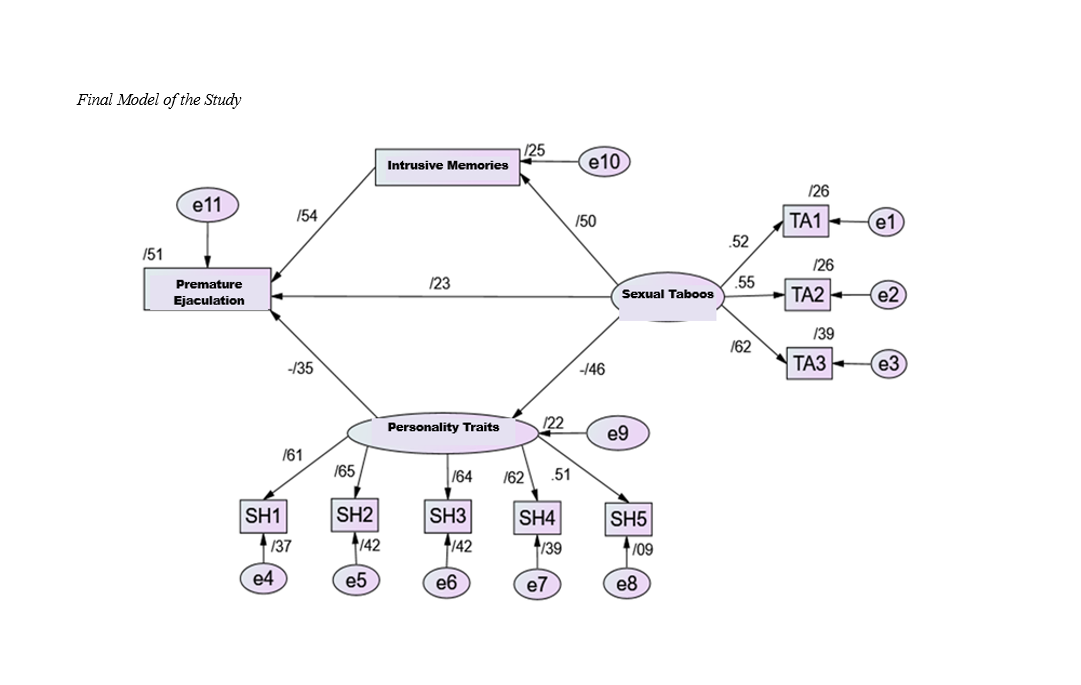
The present study aimed to examine the role of sexual taboos in explaining premature ejaculation in men, with the mediating roles of intrusive memories and personality traits. In terms of nature, this study was applied–descriptive, and methodologically, it employed a correlational–regression design using structural equation modeling. For sample selection, a convenience sampling method combined with a snowball approach was used. The statistical population consisted of all married men or those with a stable sexual partner, aged 25 to 45 years, residing in Bushehr. From this population, 170 participants were voluntarily and conveniently selected. This sample size was determined based on the statistical requirements of structural equation modeling with a 95% confidence level. Data collection was conducted using the Sexual Taboo Beliefs Questionnaire by Abbasi and Kashkooli (2019), the Intrusive Memories Questionnaire by Clohessy and Ehlers (1999), the Big Five Personality Questionnaire by Gosling et al. (2003), and the Premature Ejaculation Diagnostic Questionnaire by Symonds et al. (2007). Data analysis was performed using descriptive and inferential statistics, including correlational–regression methods, via SPSS version 27. Path analysis was conducted using AMOS version 22. The results indicated that sexual taboos had a significant direct effect on premature ejaculation (β = 0.023, p = 0.045). Intrusive memories also played a significant mediating role in the relationship between sexual taboos and premature ejaculation (β = 0.027, p = 0.002). Furthermore, personality traits demonstrated a significant mediating effect in this relationship (β = 0.016, p = 0.001). The findings showed that intrusive memories increased the direct effect coefficient of sexual taboos on premature ejaculation from 0.23 to 0.27, whereas personality traits reduced this coefficient from 0.23 to 0.16. These results suggest that intrusive memories act as an amplifying factor, while personality traits function as a mitigating factor in the impact of sexual taboos on male sexual performance.
Downloads
References
Amzat, J., Kanmodi, K. K., Aminu, K., & Egbedina, E. A. (2023). Research on Natal and Neonatal Teeth in Africa: A Systematic Scoping Review of Empirical Evidence. Health Science Reports, 6(5). https://doi.org/10.1002/hsr2.1242
Canavan, R. (2022). Recognition Rates, Treatment Recommendations and Stigma Attributions for Clients Presenting With Taboo Intrusive Thoughts: A Vignette‐based Survey of Psychotherapists. Counselling and Psychotherapy Research, 24(1), 51-62. https://doi.org/10.1002/capr.12557
Caropreso, F. (2024). Death Instinct and Mental Conflict in Sabina Spielrein’s Early Work (1911–1912). American Imago, 81(4), 501-521. https://doi.org/10.1353/aim.2024.a951893
Chang, X., Xu, M., Chen, Y., Che, C., Du, Y., & Wang, X. (2022). Selective Serotonin Reuptake Inhibitors Combined With Traditional Chinese Medicine for Premature Ejaculation: A Systematic Review and Meta‐analysis. Andrology, 11(1), 112-124. https://doi.org/10.1111/andr.13307
Dwijayani, N. M., Beratha, N. L. S., & Sukarini, N. W. (2023). A Study of Gender Difference of Using Taboo Words in the Euphoria Series. Humanis, 27(3), 342. https://doi.org/10.24843/jh.2023.v27.i03.p09
Egwunatum, A. E., & Okonta, B. C. (2023). Assessment of Habitat Fragmentation Impact on Community Taboo Species for Adoption as Conservation Portfolios in Lowland Rainforest Ecological Zone of Delta State, Nigeria. Journal of Biodiversity Conservation and Bioresource Management, 9(2), 29-38. https://doi.org/10.3329/jbcbm.v9i2.70054
Gouniai, J. M., Smith, K. D., & Leonte, K. G. (2022). Many Common Presentations of Obsessive-Compulsive Disorder Unrecognized by Medical Providers in a Pacific Island Community. The Journal of Mental Health Training Education and Practice, 17(5), 419-428. https://doi.org/10.1108/jmhtep-09-2021-0105
Javier, I. d. l. I.-L., González-Bolaños, R. K., Navarro, I. M. P., Alarcón, R. d., Casado‐Espada, N. M., & Montejo, Á. L. (2025). Sexuality and Related Disorders in OCD and Their Symptoms. Journal of clinical medicine, 14(19), 6819. https://doi.org/10.3390/jcm14196819
Jepsen, D., Luck, T., Bernard, M., Moor, I., & Watzke, S. (2023). Study Protocol: Hypersexual and Hyposexual Behavior Among Adults Diagnosed With Alcohol- And Substance Use Disorders—Associations Between Traumatic Experiences and Problematic Sexual Behavior. Frontiers in Psychiatry, 14. https://doi.org/10.3389/fpsyt.2023.1088747
Kellett, S., Gaskell, C. J., Keslake, A., Seneviratne, M., & Simmonds‐Buckley, M. (2024). Treating Taboo Thoughts on a Psychiatric Intensive Care Unit: A Four-Phase Mixed Methods Single Case Experimental Design. Behavioural and Cognitive Psychotherapy, 52(5), 508-521. https://doi.org/10.1017/s1352465824000146
Levkovich, I. (2024). Harnessing Large Language Models for Identification and Treatment of Obsessive-Compulsive Disorder. https://doi.org/10.20944/preprints202406.0857.v1
Liu, Y. S., Wang, Y., Pu, Z., Wang, Y.-C., Zhang, Y., Dong, C., Zeng, Y., & Shu, Z. (2022). Sexual Dysfunction in Infertile Men: A Systematic Review and Meta-Analysis. Sexual Medicine, 10(4), 100528-100528. https://doi.org/10.1016/j.esxm.2022.100528
Löchner, C., Sudhir, P. M., & Stein, D. J. (2024). Obsessive-Compulsive and Related Disorders. 155-173. https://doi.org/10.1037/0000392-009
Markey, K. (2023). Unlawful Intimacy: The Criminalization of Interracial Relationships in Progressive-Era Chicago. Law & Social Inquiry, 49(2), 1169-1191. https://doi.org/10.1017/lsi.2023.29
Mulcahy, M., Long, C., Morrow, T., Galbally, M., Rees, C. S., & Anderson, R. (2023). Consensus Recommendations for the Assessment and Treatment of Perinatal Obsessive–compulsive Disorder (OCD): A Delphi Study. Archives of Women S Mental Health, 26(3), 389-399. https://doi.org/10.1007/s00737-023-01315-2
Pedersen, S. C., Maindal, H. T., & Ryom, K. (2021). “I Wanted to Be There as a Father, but I Couldn’t”: A Qualitative Study of Fathers’ Experiences of Postpartum Depression and Their Help-Seeking Behavior. American Journal of Men S Health, 15(3). https://doi.org/10.1177/15579883211024375
Pedro, D. (2022). “I Did as Others Did and as Others Had Me Do”: Postcolonial (Mis)Representations and Perpetrator Trauma in Season 1 of Taboo (2017-). Miscelánea a Journal of English and American Studies, 66, 91-111. https://doi.org/10.26754/ojs_misc/mj.20227357
Perez, M. I., Limon, D. L., Candelari, A. E., Cepeda, S. L., Ramírez, A. C., Guzick, A. G., Kook, M., Buissonnière-Ariza, V. L., Schneider, S. C., Goodman, W. K., & Storch, E. A. (2022). Obsessive-Compulsive Disorder Misdiagnosis Among Mental Healthcare Providers in Latin America. Journal of Obsessive-Compulsive and Related Disorders, 32, 100693. https://doi.org/10.1016/j.jocrd.2021.100693
Proshina, E., Gaidareva, A., Beskhizhko, M., Kazaryan, G., Bainbridge, E., & Khayrullina, G. (2025). Biomarkers of Obsessive-Compulsive Disorder Subtypes: A Literature Review. International Journal of Molecular Sciences, 26(17), 8578. https://doi.org/10.3390/ijms26178578
Samadi, P., Alipour, Z., & Maasoumi, R. (2023). Perceived Barriers and Needs in Accessing Sexual Health Services for Iranian Couples: A Qualitative Research. Iranian Journal of Nursing and Midwifery Research, 28(4), 461-467. https://doi.org/10.4103/ijnmr.ijnmr_96_21
Santacroce, L. A., & Tamber-Rosenau, B. J. (2024). Crisis-Related Stimuli Do Not Increase the Emotional Attentional Blink in A general University Student Population. Cognitive Research Principles and Implications, 9(1). https://doi.org/10.1186/s41235-023-00525-7
Şekerci, Ö. (2023). Culpeper’s Impoliteness Strategies in Neil Simon’s ‘Biloxi Blues’. Baltic Journal of English Language Literature and Culture, 13, 125-141. https://doi.org/10.22364/bjellc.13.2023.09
Sheikh, M. A. (2025). Telehealth-Delivered Mindfulness-Based Exposure and Response Prevention for Sexual Obsessive-Compulsive Disorder With Comorbid Depression: Feasibility and Clinical Outcomes. Clinical Case Studies, 25(1), 3-24. https://doi.org/10.1177/15346501251405859
Shrim, E., & Baum, N. (2020). Treating Sex Offenders: Effects on Male and Female Therapists. Journal of interpersonal violence, 37(3-4), NP1733-NP1758. https://doi.org/10.1177/0886260520933032
Stirn, A., & Zannoni, R. (2021). Sexuelle Funktionsstörungen Bei Frauen Und Männern. Psych Up2date, 15(03), 239-253. https://doi.org/10.1055/a-1221-5838
Williams, M. T., Whittal, M. L., & Torre, J. L. (2022). Best Practices for CBT Treatment of Taboo and Unacceptable Thoughts in OCD. The Cognitive Behaviour Therapist, 15. https://doi.org/10.1017/s1754470x22000113
Zannoni, R., Dobberkau, E., Kaduszkiewicz, H., & Stirn, A. (2021). Addressing Sexual Problems in German Primary Care: A Qualitative Study. Journal of Primary Care & Community Health, 12. https://doi.org/10.1177/21501327211046437
Downloads
Additional Files
Publication Timeline
- Submitted
- Revised
- Accepted