Design of an Emotion-Focused Painting Training Program and Evaluation of Its Effectiveness on Autism Symptoms in Children with High-Functioning Autism
Keywords:
Emotion-focused painting, autism symptoms, high-functioning autism, social skillsAbstract
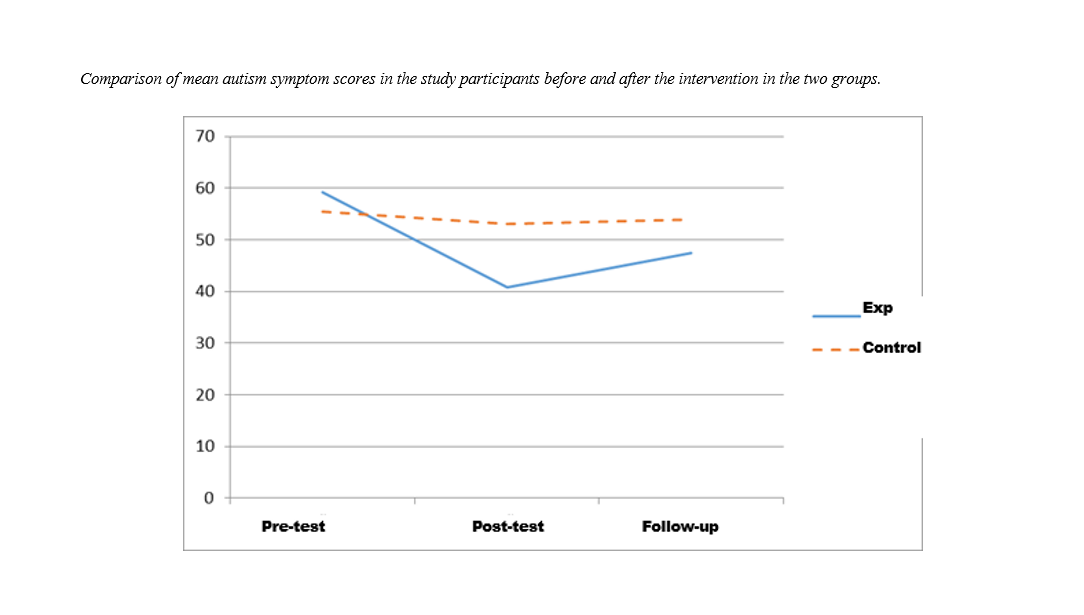
The present study aimed to design an emotion-focused painting training program and evaluate its effectiveness on autism symptoms in children with high-functioning autism. The research method was quasi-experimental, employing a pretest–posttest design with a control group and a two-month follow-up period. The statistical population consisted of children diagnosed with high-functioning autism, aged 10 to 18 years, in Karaj in 2025. From this population, 30 participants were selected through purposive sampling and randomly assigned to an experimental group (n = 15) and a control group (n = 15). The training program was implemented for the experimental group in 10 sessions, each lasting 45 to 60 minutes (two sessions per week). The research instrument included the Gilliam Autism Rating Scale (GARS-3). Data were analyzed using repeated measures analysis of variance with SPSS version 26. The results indicated that the mean scores of autism symptoms in the experimental group significantly decreased compared to the control group at both posttest and follow-up stages (p < .001). Based on the findings, it can be concluded that the emotion-focused painting training program, emphasizing the identification, expression, and regulation of emotions through painting, was effective in reducing autism symptoms in children with high-functioning autism, and this effect remained stable over time. The use of this program as a complementary intervention in rehabilitation centers and special education schools is recommended.
Downloads
References
Bakhshi, M., Morovati, Z., Elahi, T., & Shahmohamadian, S. (2018). Effectiveness of Art Therapy on Social-Communication Skills, Behavioral Flexibility, and Emotion Regulation in Children with Autism Spectrum Disorder. Psychology of Exceptional Individuals, 8(30), 155-177.
Bhat, A. N. (2021). Motor impairment increases in children with autism spectrum disorder as a function of social communication, cognitive and functional impairment, repetitive behavior severity, and comorbid diagnoses: A SPARK study report. Autism Research, 14(1), 202-219. https://doi.org/10.1002/aur.2453
Eisner, E. W. (2002). What Can Education Learn from the Arts About the Practice of Education? Journal of Curriculum and Supervision, 18(1), 4-16.
Eo, S. K., Kim, C., Park, K. H., & Eo, E. K. (2022). The effectiveness of emotion-focused art therapy on the resilience and self-image of emergency physicians. World Journal of Emergency Medicine, 13(6), 479. https://doi.org/10.5847/wjem.j.1920-8642.2022.098
Esmaeili, L., Seidinezhad, A., & Masoudnia, M. (2021). Investigating the effect of play therapy in improving symptoms of children with autism spectrum disorder and hyperactivity. Journal of Psychological Studies and Educational Sciences, 25, 71-81.
Glod, M., Riby, D. M., & Rodgers, J. (2019). Relationships between sensory processing, repetitive behaviors, anxiety, and intolerance of uncertainty in autism spectrum disorder and Williams syndrome. Autism Research, 12(5), 759-765. https://doi.org/10.1002/aur.2096
Hyman, S. L., Levy, S. E., Myers, S. M., Kuo, D. Z., Apkon, S., Davidson, L. F., & Leppert, M. O. C. (2020). Identification, evaluation, and management of children with autism spectrum disorder. Pediatrics, 145(1). https://doi.org/10.1542/peds.2019-3447
Ibrahimagic, A., Patkovic, N., Radic, B., & Hadzic, S. (2021). Communication and language skills of autistic spectrum disorders in children and their parents' emotions. Materia socio-medica, 33(4), 250-256. https://doi.org/10.5455/msm.2021.33.250-256
Inci, R., & Saglam, M. (2025). Investigation of the effect of interactive art activity program on repetitive behaviors, social skills and parents' emotions in children with autism spectrum disorder. Advances in Autism, 11(1), 5-18. https://doi.org/10.1108/AIA-06-2024-0041
Iversen, R. K., & Lewis, C. (2021). Executive function skills are linked to restricted and repetitive behaviors: Three correlational meta analyses. Autism Research, 14(6), 1163-1185. https://doi.org/10.1002/aur.2468
Li, G., Wei, D., Xing, Y., Li, Y., & Song, W. (2025). Drawing therapy based on embodied cognition theory on emotional expression and social behavior in students with autism: A mixed-methods study. Frontiers in psychology, 16, 1664699. https://doi.org/10.3389/fpsyg.2025.1664699
Lu, Q. (2022). Composition and analysis of psychological emotional expression in painting. Psychiatria Danubina, 34(suppl 5), 96-96.
Ma, S., & Cao, T. (2024). Effects of painting therapy on psychological rehabilitation in children with autism spectrum disorder
Malhotra, B. (2019). Art therapy with puppet making to promote emotional empathy for an adolescent with autism. Art Therapy, 36(4), 183-191. https://doi.org/10.1080/07421656.2019.1645500
Mammadova, M. (2025). Social adaptation problem of a child with early childhood autism. Bulletin of Postgraduate Education: Social and Behavioral Sciences; Management and Administration, 31(60), 111-126. https://doi.org/10.58442/3041-1858-2025-31(60)-111-126
Papaeliou, C. F. (2024). Communication in Atypical Infants and Toddlers. Routledge. https://doi.org/10.4324/9780367815028
Qin, L., Wang, H., Ning, W., Cui, M., & Wang, Q. (2024). New advances in the diagnosis and treatment of autism spectrum disorders. European Journal of Medical Research, 29(1), 322. https://doi.org/10.1186/s40001-024-01916-2
Russell, K. M., Frost, K. M., & Ingersoll, B. (2019). The relationship between subtypes of repetitive behaviors and anxiety in children with autism spectrum disorder. Research in Autism Spectrum Disorders, 62, 48-54. https://doi.org/10.1016/j.rasd.2019.03.006
Sabet, S., & GholamiHeidarAbadi, Z. (2021). The Effect of Art Therapy on Motor Skills of Children with Autism. International Journal of Applied Behavioral Sciences, 8(4), 27-34.
Wright, A. C. (2023). Art therapy with an autistic person with learning disabilities: Communication and emotional regulation. International Journal of Art Therapy, 28(4), 154-166. https://doi.org/10.1080/17454832.2023.2172439
Xu, X. (2024). Exploring the Art Rehabilitation Model for Children with Autism Spectrum Disorder from the Perspective of Holistic Development
Zhu, Q. (2025). The Influence of Art Therapy Intervention on Executive Function Development and Emotional Security in Children with Autism Spectrum Disorder
Downloads
Additional Files
Publication Timeline
- Submitted
- Revised
- Accepted