Comparison of the Effectiveness of Mode-Based Schema Therapy and Rumination-Focused Cognitive Behavioral Therapy on Psychological Capital in Women Seeking Cosmetic Surgery with Histrionic Personality Disorder Symptoms
Keywords:
Schema Therapy, Rumination-Focused Cognitive Behavioral Therapy, Psychological Capital, Cosmetic Surgery, Histrionic Personality Disorder, WomenAbstract
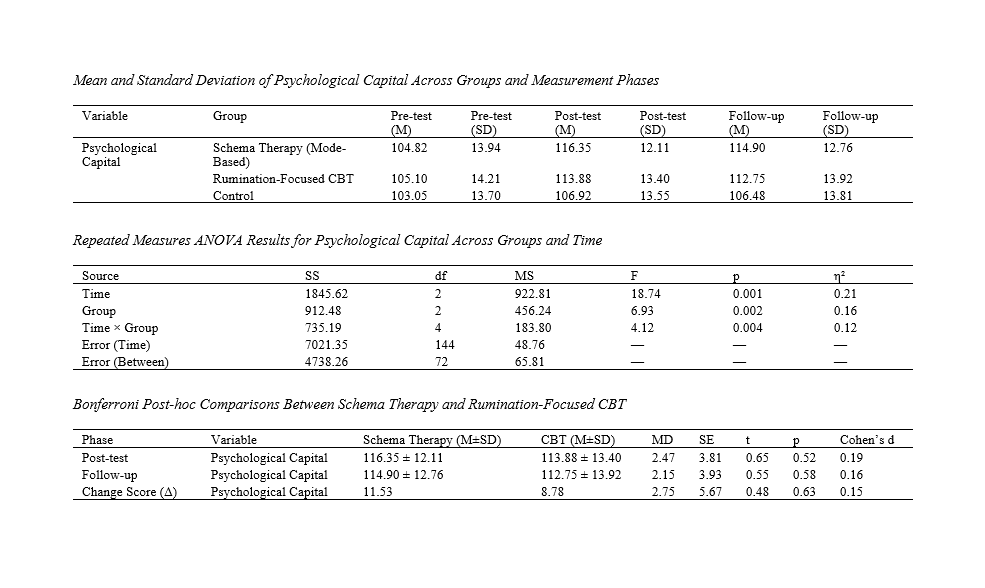
The present study aimed to compare the effectiveness of mode-based schema therapy and rumination-focused cognitive behavioral therapy (RFCBT) on psychological capital in women seeking cosmetic surgery with symptoms of histrionic personality disorder. This study employed a quasi-experimental design with pre-test, post-test, and follow-up phases across three parallel groups. The statistical population consisted of women referred to cosmetic surgery clinics in Isfahan during 2024–2025, from whom 75 participants were selected using convenience sampling after screening for histrionic personality disorder symptoms via the MCMI. Participants were randomly assigned into three groups: schema therapy (n = 25), RFCBT (n = 25), and control (n = 25). Both intervention groups received 12 weekly 90-minute group sessions based on standardized protocols, while the control group remained on a waiting list. Data were collected using the Psychological Capital Questionnaire (PCQ) and analyzed using repeated measures ANOVA and Bonferroni post-hoc tests in SPSS-26. The results of repeated measures ANOVA revealed a significant main effect of time (p < 0.01) and a significant main effect of group (p < 0.01) on psychological capital, indicating overall changes across measurement phases and differences between groups. Moreover, the interaction effect of time × group was statistically significant (p < 0.01), demonstrating that the pattern of change differed across the three groups. Bonferroni post-hoc comparisons showed no significant difference between the schema therapy and RFCBT groups at post-test (p > 0.05) and follow-up (p > 0.05), although both interventions produced significantly greater improvements compared to the control group (p < 0.01). Both mode-based schema therapy and rumination-focused cognitive behavioral therapy are effective interventions for enhancing psychological capital in women seeking cosmetic surgery with histrionic personality disorder symptoms, with no significant difference in their effectiveness, suggesting that each approach can be appropriately utilized depending on clinical needs and treatment context.
Downloads
References
Babaei, H., Rezaei, N., Pakmaram, A., & Abdi, R. (2025). Identifying behavioral financial components using emotional-cognitive dimensions and its role in the capital market crisis. Iranian Journal of Accounting, Auditing and Finance, 9(3), 53-80. https://doi.org/10.22067/ijaaf.2025.45734.1465
Bozorgvari, A., & Khosh-Lahjeh Sedgh, E. (2024). The Effectiveness of Group Schema Therapy on Psychological Capital in Patients with Binge Eating Disorder Seeking Sleeve Gastrectomy / Gastric Bypass Surgery. Journal of Nursing Psychology, 12(6), 108-121. https://ijpn.ir/article-1-2516-en.html
Danesh, S., & Foruzandeh, E. (2018). The Big Five Personality Factors and Body Image in Applicants for Cosmetic Surgery in Isfahan. Shenakht Journal of Psychology and Psychiatry, 5(1), 115-128. https://doi.org/10.29252/shenakht.5.1.115
Gholami, S., Vatankhah, H., & Banisi, P. (2019). Effectiveness of Cognitive-Behavioral Training on Self-Esteem of Women Seeking Cosmetic Surgery. 5th National Conference on Recent Innovations in Psychology, Applications, and Empowerment with a Focus on Psychotherapy, Tehran.
Hoskin, R., Reynolds, K., & Ford, T. (2022). Personality disorders and their influence on cosmetic surgery desires: A review. Psychological Reports, 125(4), 892-905.
Izanloo, H., Shahabizadeh, F., Hojjat, S. K., & Bahrainian, S. A. (2021). The Effectiveness of Rumination-Focused Cognitive Behavioral Therapy and Mindfulness-Based Cognitive Therapy on Mood and Anxiety Symptoms and Rumination of Depressed Adolescent Girls Attempting Suicide. Research in Clinical Psychology and Counseling, 10(2), 65-88. https://doi.org/10.22067/tpccp.2021.67390.1001
Khabbaz Sabt, S., Poladi Rishahri, A., Keykhosravani, M., & Bahrani, M. (2022). Structural model of the relationships between tendency for cosmetic surgery with maladaptive schemas and fashion tendency, mediated by emotion regulation in women seeking cosmetic surgery in Bushehr. Social Cognition, 11(1), 147-160. https://sc.journals.pnu.ac.ir/article_9273.html?lang=en
Khayatan, F., Hadian, S., & Golparvar, M. (2025). A Comparison of the Effectiveness of Emotion-Focused Schema Therapy, Compassion-Focused Forgiveness Therapy, and Cognitive-Behavioral Therapy on Emotional Capital and Its Dimensions in Women Victims of Domestic Violence. Yazd Health Dawn, 23(6), 92-108. https://tbj.ssu.ac.ir/browse.php?a_id=3704&sid=1&slc_lang=en&html=1
Langenecker, S. A., Schreiner, M. W., Bessette, K. L., Roberts, H., Thomas, L., Dillahunt, A., Pocius, S. L., Feldman, D. A., Jago, D., Farstead, B., & Pazdera, M. (2024). Rumination-focused cognitive behavioral therapy reduces rumination and targeted cross-network connectivity in youth with a history of depression: replication in a preregistered randomized clinical trial. Biol Psychiatry Glob Open Sci, 4(1), 1-10. https://doi.org/10.1016/j.bpsgos.2023.08.012
Luo, Y., Zhao, Y., & Sun, S. (2021). The relationship between personality traits and cosmetic surgery intention: The mediating role of self-discrepancy. Journal of Cosmetic Dermatology, 20(2), 345-356.
Moshkouri, M., Bagherzadeh Golmakani, Z., Mansouri, A., & Khodabakhsh, M. R. (2024). The effectiveness of schema therapy on perfectionism, body shame, and symptoms of body dysmorphic disorder in women seeking cosmetic surgery. Journal of Psychological Sciences, 23(143), 216-197. https://www.noormags.ir
Nazari, A., Saedi, S., & Abdi, M. (2022). Comparing the effectiveness of schema therapy and acceptance and commitment therapy on the tolerance of emotional distress, sexual dysfunction and psychological capital of patients with multiple sclerosis. Journal of Applied Family Therapy, 3(1), 461-485. https://doi.org/10.22034/aftj.2022.313070.1240
Rashidi, S., Gholami, M., & Ranjbaripour, T. (2022). Prediction of the Tendency Toward Cosmetic Surgery Based on Histrionic Personality Disorder Traits and Cognitive Emotion Regulation in University-Educated Women. Quarterly Journal of New Ideas in Psychology, 12(16), 1-13. http://jnip.ir/article-1-694-fa.html
Shafiabady, A., Hasani, J., & Yari, M. (2023). Comparing effectiveness of emotion-focused cognitive-behavioral therapy and mindfulness based cognitive therapy on body image and cognitive emotion regulation in adolescent girls interested in cosmetic surgery. Psychological Achievements, 30(1), 19-36. https://doi.org/10.22055/psy.2022.34239.2569
Shahmoradi, M., & Mostafavi, S. (2022). Effectiveness of Rumination-Focused Cognitive Behavioral Therapy on Cognitive Functions in Adults With High Levels of Rumination. https://doi.org/10.31234/osf.io/p3bcn
Soleymani, A., Arani, A. M., Raeissadat, S. A., & Davazdahemami, M. H. (2020). Rumination-Focused Cognitive-Behavioral Therapy for Chronic Low Back Pain: A Randomized Controlled Trial. Galen Medical Journal, 9, e1722. https://doi.org/10.31661/gmj.v9i0.1722
Umegaki, Y., Nakagawa, A., Watkins, E., & Mullan, E. (2022). A Rumination-Focused Cognitive-Behavioral Therapy Self-Help Program to Reduce Depressive Rumination in High-Ruminating Japanese Female University Students: A Case Series Study. Cognitive and Behavioral Practice, 29(2), 468-484. https://doi.org/10.1016/j.cbpra.2021.01.003
Yari, M., Shafiabady, A., & Hasani, J. (2020). Comparing the efficacy of emotion-focused cognitive-behavioral therapy with mindfulness based cognitive therapy on body image and cognitive fusion in adolescent girls interested in cosmetic surgery [Research]. Dermatology and Cosmetic, 11(2), 107-118. http://jdc.tums.ac.ir/article-1-5459-en.html
Downloads
Additional Files
Publication Timeline
- Submitted
- Revised
- Accepted