The Mediating Role of Perceived Stress and Coping Styles in the Association Between Sleep Quality and Job Burnout Among Physicians at Medical Centers Affiliated with Mashhad University of Medical Sciences
Keywords:
Perceived Stress, Coping Styles, Sleep Quality, Job Burnout, Structural Equation ModelingAbstract
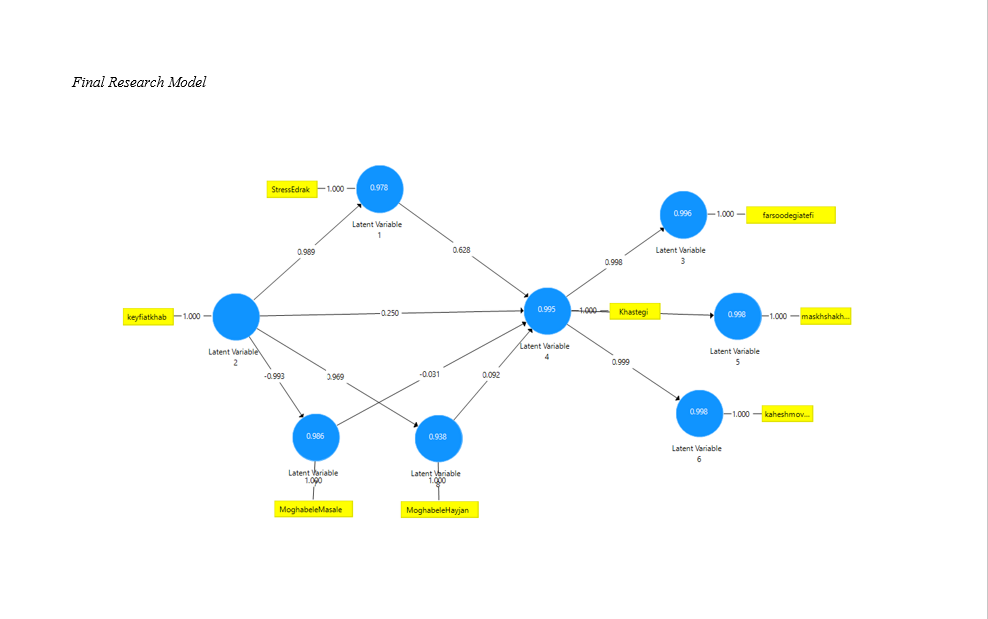
The present study aimed to investigate the mediating role of perceived stress and coping styles in the relationship between sleep quality and job burnout among physicians working in medical centers affiliated with Mashhad University of Medical Sciences. This study employed a descriptive–correlational design and was conducted using structural equation modeling (SEM). The statistical population consisted of physicians employed in medical centers affiliated with Mashhad University of Medical Sciences as well as active clinics across Mashhad during the 2024–2025 academic year. Based on Cochran’s formula, a final sample size of 367 participants was determined. Data were collected using the Pittsburgh Sleep Quality Index (PSQI), the Maslach Burnout Inventory (MBI), and the Perceived Stress Scale developed by Cohen et al. (1983). Data analysis was performed using SPSS version 26 and SMART PLS 3 software. The results indicated that the mediating role of perceived stress and coping styles in the relationship between sleep quality and job burnout was confirmed. The indirect effect (0.331) was greater than the direct effect (0.187), highlighting the substantial importance of the mediating variables in this relationship.
Downloads
References
Al Sabei, S. D., Al-Rawajfah, O., AbuAlRub, R., Labrague, L. J., & Burney, I. A. (2022). Nurses' Job Burnout and Its Association with Psychological Stress During COVID-19. İnternational journal of nursing practice, 28(5), e13077. https://doi.org/10.1111/ijn.13077
Allahyari, T., & Mahboobi, A. (2024). Relationship Between Shift Work, Sleep Quality, and Work Ability Index Among Prehospital Emergency Personnel in Urmia. Journal of Ergonomics, 12(1), 1-10. https://doi.org/10.32592/IJE.12.1.1
Cheng, W. L. S., Young, P. M. C., & Luk, K. K. H. (2022). Moderating Role of Coping Style on the Relationship Between Stress and Psychological Well-Being. International journal of environmental research and public health, 19(18), 11822. https://doi.org/10.3390/ijerph191811822
Elyasi Gomari, A., Fooladi, B., Ghanbari, S., & Mohammadi, A. (2023). Effects of Workload, Fatigue, Sleep Quality, and Posture on Musculoskeletal Disorders in Steel Industry Workers. Journal of Ergonomics, 11(3), 179-189. https://doi.org/10.32592/IJE.11.3.179
Galanis, P., Katsiroumpa, A., Moisoglou, I., Kalogeropoulou, M., Gallos, P., & Vraka, I. (2024). Emotional Intelligence Protects Nurses Against Quiet Quitting, Turnover Intention, and Job Burnout. Aims Public Health, 11(2), 601. https://doi.org/10.3934/publichealth.2024030
Gun, I., Balsak, H., & Ayhan, F. (2025). Mediating Effect of Job Burnout on the Relationship Between Organisational Support and Quiet Quitting in Nurses. Journal of Advanced Nursing, 81(8), 4644-4652. https://doi.org/10.1111/jan.16599
Hani, A., Rafiei, M., & Eskandari, T. (2024). Relationship Between Occupational Stress, Burnout, and Musculoskeletal Disorders Among Prehospital Emergency Personnel. Journal of Ergonomics, 11(3), 220-228.
Heydari, A., Imani Gargi, S., Koochak, F., & Khatirnamani, Z. (2023). Relationship Between Burnout and Sleep Quality Among Nurses in Teaching Hospitals. Journal of Community Health Research, 9(1), 99-107.
Kim, J., & Jung, H. S. (2022). The Effect of Employee Competency and Organizational Culture on Employees' Perceived Stress. International journal of environmental research and public health, 19(8), 4428. https://doi.org/10.3390/ijerph19084428
Lai, F., Luo, Z., Zhang, J., Xia, W., & Tian, L. (2024). Bright Light Therapy Has a Positive Effect on Sleep Quality in Patients with Cancer: A Meta-Analysis. Sleep Medicine Reviews, 75, 101925. https://doi.org/10.1016/j.smrv.2024.101925
Mahmoudi, H., & Karimian, S. (2025). Mediating Role of Rumination in the Relationship Between Occupational Stress, Chronic Fatigue, and Sleep Quality Among Female Prehospital Emergency Staff. Journal of psychiatric nursing, 13(3), 1-11.
Nasr Esfahani, A., Esmaili, R., Pourabedian, S., & Shakerian, M. (2025). Relationship Between Stress Coping Styles and Burnout Among Female School Transportation Drivers. Journal of Health System Research, 21(2), 249-256.
Pierson-Bartel, R., & Ujma, P. P. (2024). Objective Sleep Quality Predicts Subjective Sleep Ratings. Scientific reports, 14(1), 5943. https://doi.org/10.1038/s41598-024-56668-0
Rashidi, M. A., Kazemi, M., Kazemi, M., Rashidi, A. H., & Seyfifard, M. (2021). Sleep Quality and Burnout Status Among Nurses in Public Hospitals. Journal of Occupational Health and Health Promotion, 5(1), 60-75.
Rezaei, F. (2023). Relationship Between Sleep Quality, Work Life Quality, and Occupational Stress Among Nurses During COVID-19. Military Paramedical Sciences and Health, 18(1), 28-37.
Sadra Abrghouei, N., Akhavan, A., Mirasmaeili, M. A., & Nazari, M. (2025). Relationship Between Occupational Stress, Insomnia, and Burnout Among Train Attendants. Journal of Occupational Medicine, 17(1), 62-72.
Scott, A. J., Webb, T. L., Martyn-St James, M., Rowse, G., & Weich, S. (2021). Improving Sleep Quality Leads to Better Mental Health: A Meta-Analysis of Randomised Controlled Trials. Sleep Medicine Reviews, 60, 101556. https://doi.org/10.1016/j.smrv.2021.101556
Downloads
Additional Files
Publication Timeline
- Submitted
- Revised
- Accepted