The Effectiveness of Acceptance and Commitment Therapy on Difficulties in Emotion Regulation and Distress Tolerance in Students with High Academic Stress
Keywords:
difficulties in emotion regulation, distress tolerance, Acceptance and Commitment Therapy, academic stressAbstract
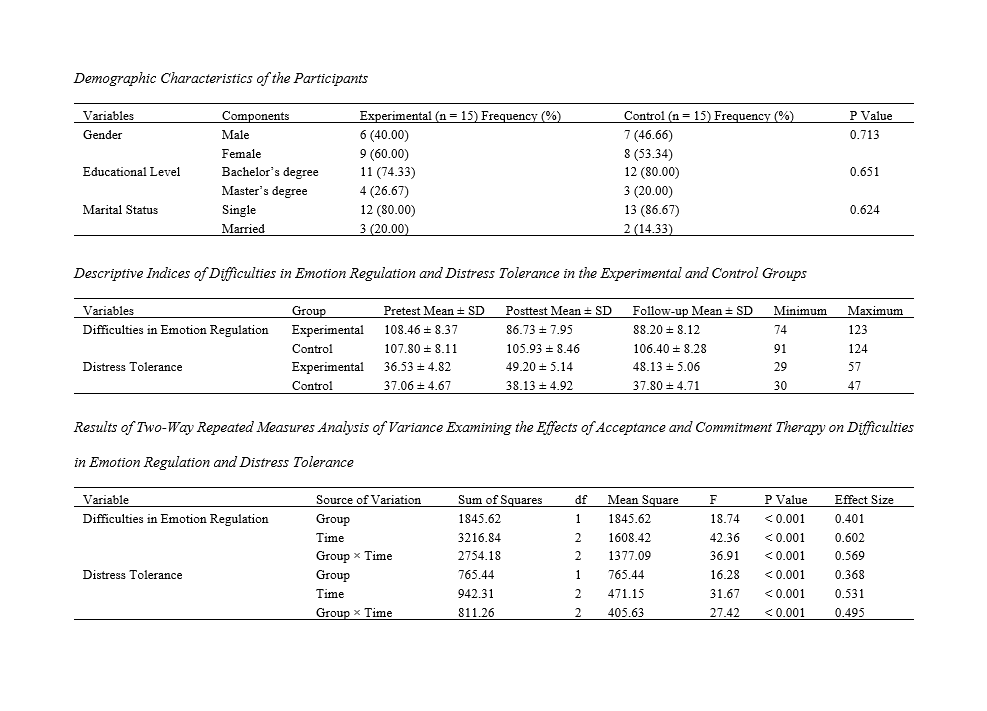
The present study was conducted to determine the effectiveness of Acceptance and Commitment Therapy (ACT) on difficulties in emotion regulation and distress tolerance among students with high academic stress. This was a quasi-experimental study with a pretest–posttest design and a two-month follow-up with a control group. The statistical population consisted of students at Islamic Azad University, Tonekabon Branch during the 2024–2025 academic year. After administering the Gadzella Student-Life Stress Inventory, students who obtained scores of 188 and above were identified as individuals with high academic stress. Subsequently, 30 eligible students were selected through purposive sampling and randomly assigned to two groups: an experimental group and a control group, with 15 participants in each group. The experimental group received Acceptance and Commitment Therapy during 10 sessions of 90 minutes each, whereas the control group received no intervention during this period. Data were collected using the Difficulties in Emotion Regulation Scale and the Distress Tolerance Scale. Data analysis was performed using the independent samples t-test, Fisher’s exact test, and two-way repeated measures analysis of variance in IBM SPSS Statistics version 26. The results indicated that the experimental and control groups did not differ significantly in terms of demographic characteristics. Furthermore, the results of the two-way repeated measures analysis of variance demonstrated that the interaction effect of group and time on difficulties in emotion regulation and distress tolerance was significant. Based on mean comparisons, scores for difficulties in emotion regulation decreased from pretest to posttest in the experimental group, while distress tolerance scores increased. These changes remained largely stable at the two-month follow-up stage, whereas no substantial changes were observed in the control group. Based on the findings of the study, Acceptance and Commitment Therapy can reduce difficulties in emotion regulation and increase distress tolerance in students with high academic stress. Therefore, the use of this approach in university counseling centers may be beneficial in helping students manage negative emotions and enhance their ability to tolerate stressful academic situations.
Downloads
References
Amirian, K., Mami, S. H., & Ahmadi, V. (2018). Comparison of the Effectiveness of Acceptance and Commitment Therapy (ACT) and Dialectic Behavioral Therapy (DBT) on Behavioral Inhibition and Behavioral Activation on Men with Substance Abuse. Community Health Journal, 11(3-4), 86-95.
da-Silva-Domingues, H., Palomino-Moral, P. Á., Gutiérrez-Sánchez, B., Moreno-Cámara, S., Almeida Macedo Loureiro, H. M., & Del-Pino-Casado, R. (2024). Lifestyles of University Students: Analyzing the Role of Social Support and Family Dynamics. BMC public health, 24(1), 3447. https://doi.org/10.1186/s12889-024-21021-7
Deng, Y., Cherian, J., Khan, N. U. N., Kumari, K., Sial, M. S., Comite, U., Gavurova, B., & Popp, J. (2022). Family and Academic Stress and Their Impact on Students' Depression Level and Academic Performance. Frontiers in Psychiatry, 13, 869337. https://doi.org/10.3389/fpsyt.2022.869337
Gkofa, V., Godfrey, E., & Scott, W. (2026). Acceptance and Commitment Therapy (ACT) for Distress in University Students with Chronic Physical Health Conditions: A Single-Arm Feasibility Study of an App-Based Intervention. Journal of Contextual Behavioral Science, 40, 100994. https://doi.org/10.1016/j.jcbs.2026.100994
Katajavuori, N., Vehkalahti, K., & Asikainen, H. (2023). Promoting University Students’ Well-Being and Studying with an Acceptance and Commitment Therapy (ACT)-Based Intervention. Current Psychology, 42(6), 4900-4912. https://doi.org/10.1007/s12144-021-01837-x
Khoyshavand, M., Rezapour, D., & Haroun Rashidi, H. (2024). The Effectiveness of Acceptance and Commitment Therapy on Distress Tolerance and Character Strengths in Older Adults. Psychology of Aging, 10(3), 283-301.
Kozubal, M., Szuster, A., & Wielgopolan, A. (2023). Emotional Regulation Strategies in Daily Life: The Intensity of Emotions and Regulation Choice. Frontiers in psychology, 14, 1218694. https://doi.org/10.3389/fpsyg.2023.1218694
Leyro, T. M., Zvolensky, M. J., & Bernstein, A. (2010). Distress Tolerance and Psychopathological Symptoms and Disorders: A Review of the Empirical Literature among Adults. Psychological bulletin, 136(4), 576-600. https://doi.org/10.1037/a0019712
Liang, H., & Mao, X. (2025). Emotion Regulation and Perceptions of Academic Stress as Key Predictors of Academic Motivation in Second Language Learning. PLoS One, 20(8), e0327071. https://doi.org/10.1371/journal.pone.0327071
Lyu, Z., Ouyang, S., & Zhang, S. (2025). How Drawing Practice Enhances Distress Tolerance in University Students: The Mediating Roles of Psychological Resilience and Self-Disclosure. Frontiers in psychology, 16, 1540900. https://doi.org/10.3389/fpsyg.2025.1540900
Mohammadi Bytamar, J., Saed, O., & Khakpoor, S. (2020). Emotion Regulation Difficulties and Academic Procrastination. Frontiers in psychology, 11, 524588. https://doi.org/10.3389/fpsyg.2020.524588
Roohi, R., Soltani, A. A., Zinedine Meimand, Z., & Razavi Nematollahi, V. (2019). The Effect of Acceptance and Commitment Therapy (ACT) on Increasing the Self-Compassion, Distress Tolerance, and Emotion Regulation in Students with Social Anxiety Disorder. Quarterly Journal of Child Mental Health, 6(3), 173-187.
Stromájer, G. P., Csima, M., Iváncsik, R., Varga, B., Takács, K., & Stromájer-Rácz, T. (2023). Stress and Anxiety among High School Adolescents: Correlations between Physiological and Psychological Indicators in a Longitudinal Follow-Up Study. Children, 10(9), 1548. https://doi.org/10.3390/children10091548
Downloads
Additional Files
Publication Timeline
- Submitted
- Revised
- Accepted