The Impact of AI-Enabled Prompt Engineering Intervention on Sixth-Grade Students’ Academic Achievement, Motivation, and Engagement
Keywords:
Artificial Intelligence in Education, Prompt Engineering, Self-Determination Theory (SDT), Agentic Engagement, Academic Motivation, Academic AchievementAbstract
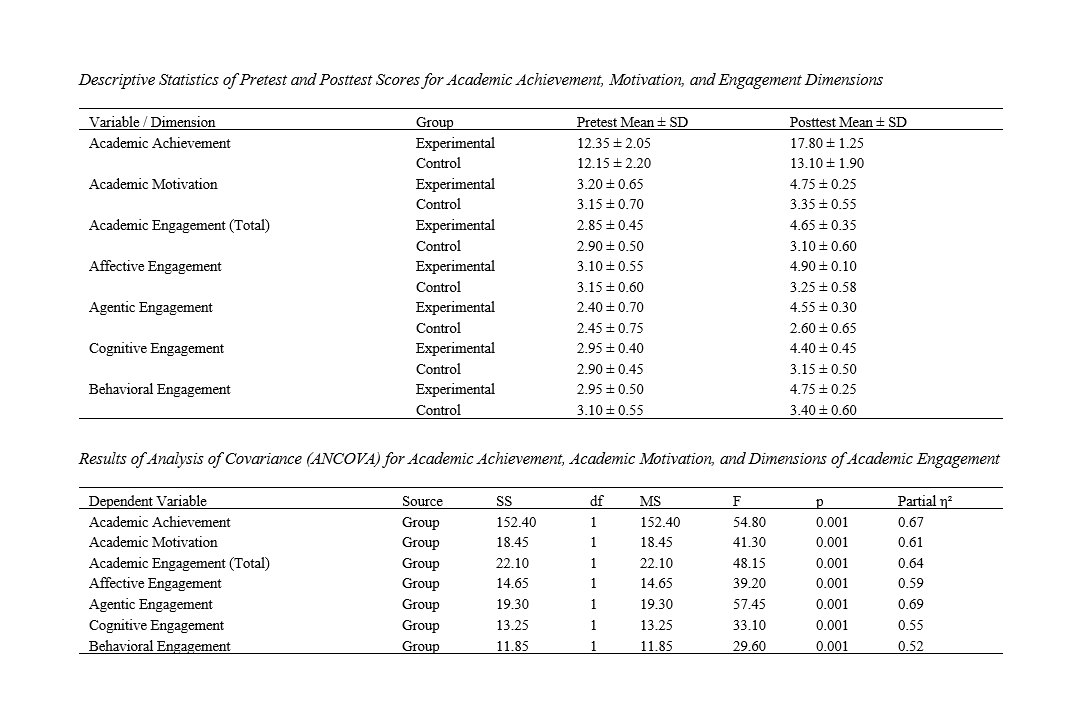
The present study aimed to investigate the effectiveness of an AI-enabled prompt engineering intervention on sixth-grade students’ academic achievement, academic motivation, and multidimensional engagement in science learning. This study employed a quasi-experimental pretest–posttest design with a non-equivalent control group. The sample consisted of 30 sixth-grade female students who were assigned to an experimental group (n = 15) and a control group (n = 15). The experimental group participated in an eight-session AI-supported science learning program in which prompt engineering techniques were used to position the AI system as a Socratic and facilitative tutor rather than a direct provider of answers. Data collection instruments included the Academic Motivation Scale (AMS), a multidimensional engagement questionnaire based on Reeve’s model, and a researcher-developed science achievement test. The intervention was implemented over four weeks with two 45-minute sessions per week. Data were analyzed using descriptive statistics and Analysis of Covariance (ANCOVA) in SPSS at a significance level of 0.05. The ANCOVA findings demonstrated a statistically significant effect of the AI-based intervention on all dependent variables (p < .001). The intervention explained 67% of the variance in academic achievement (Partial η² = .67), 61% of the variance in academic motivation (Partial η² = .61), and 64% of the variance in total academic engagement (Partial η² = .64). The experimental group showed significantly higher posttest scores compared with the control group across all dimensions of engagement. The strongest effect was observed in agentic engagement, where students demonstrated greater proactive participation, questioning behavior, and instructional agency. Significant improvements were also observed in affective, cognitive, and behavioral engagement dimensions, indicating that AI-assisted instruction enhanced students’ emotional involvement, strategic thinking, and persistence in learning activities. The findings provide strong empirical evidence that AI-enabled prompt engineering interventions can substantially improve academic achievement, motivation, and engagement among primary school students.
Downloads
References
Al Nabhani, F., Hamzah, M. b., & Abu Hassna, H. (2024). Learning Motivation via Artificial Intelligence: A Bibliometric and Systematic Literature Analysis. International Journal of Academic Research in Business and Social Sciences, 14(7). https://doi.org/10.6007/IJARBSS/v14-i7/22107
Alasgarova, R., & Rzayev, J. (2024). The Role of Artificial Intelligence in Shaping High School Students' Motivation. International Journal of Technology in Education and Science, 8(2), 311-324.
Aravantinos, S., Lavidas, K., Voulgari, I., Papadakis, S., Karalis, T., & Komis, V. (2024). Educational Approaches with AI in Primary School Settings: A Systematic Review of the Literature Available in Scopus. Education Sciences, 14(7), 744.
Artemova, I. (2024). Bridging Motivation and AI in Education: An Activity Theory Perspective. Digital Education Review(45), 59-67. https://doi.org/10.1344/der.2024.45.59-67
Chiu, T. K. F., Moorhouse, B. L., Chai, C. S., & Ismailov, M. (2024). Teacher Support and Student Motivation to Learn with Artificial Intelligence (AI) Based Chatbot. Interactive Learning Environments, 32(7), 3240-3256. https://doi.org/10.1080/10494820.2023.2172044
Fredricks, J. A., Parr, A. K., Amemiya, J. L., Wang, M. T., & Brauer, S. (2019). What Matters for Urban Adolescents’ Engagement and Disengagement in School: A Mixed-Methods Study. Journal of Adolescent Research, 34(5), 491-527. https://doi.org/10.1177/0743558419830638
Fuchs, K. (2023). Exploring the Opportunities and Challenges of NLP Models in Higher Education: Is ChatGPT a Blessing or a Curse? Frontiers in Education, 8. https://doi.org/10.3389/feduc.2023.1166682
Guo, J., Ma, Y., Li, T., Noetel, M., Liao, K., & Greiff, S. (2024). Harnessing Artificial Intelligence in Generative Content for Enhancing Motivation in Learning. Learning and Individual Differences, 116, 102547. https://doi.org/10.1016/j.lindif.2024.102547
Javaid, Z. K. (2024). A Systematic Review on Cognitive and Motivational Impact on English Language Learning through Artificial Intelligence. International Journal of Literature, Linguistics and Translation Studies, 4(1).
Jeon, J. (2024). Exploring AI Chatbot Affordances in the EFL Classroom: Young Learners' Experiences and Perspectives. Computer Assisted Language Learning, 37(1-2), 1-26. https://doi.org/10.1080/09588221.2021.2021241
Pardamean, B., Suparyanto, T., Cenggoro, T. W., Sudigyo, D., & Anugrahana, A. (2022). AI-Based Learning Style Prediction in Online Learning for Primary Education. IEEE Access, 10, 35725-35735. https://doi.org/10.1109/ACCESS.2022.3160177
Reeve, J., Cheon, S. H., & Jang, H. (2020). How and Why Students Make Academic Progress: Reconceptualizing the Student Engagement Construct to Increase Its Explanatory Power. Contemporary Educational Psychology, 62, 101899. https://doi.org/10.1016/j.cedpsych.2020.101899
Reeve, J., Jang, H. R., Shin, S. H., Ahn, J. S., Matos, L., & Gargurevich, R. (2022). When Students Show Some Initiative: Two Experiments on the Benefits of Greater Agentic Engagement. Learning and Instruction, 80, 101564. https://doi.org/10.1016/j.learninstruc.2021.101564
Ryan, R., & Deci, E. L. (2017). Self-Determination Theory: Basic Psychological Needs in Motivation, Development, and Wellness (1st ed.). Guilford Publications. https://doi.org/10.1521/978.14625/28806
Ryan, R. M., Reeve, J., Kaplan, H., Matos, L., & Cheon, S. H. (2023). Education as Flourishing: Self-Determination Theory in Schools as They Are and as They Might Be. In The Oxford Handbook of Self-Determination Theory (pp. 429-449). Oxford University Press. https://doi.org/10.1093/oxfordhb/9780197600047.013.60
Sajja, R., Sermet, Y., Cikmaz, M., Cwiertny, D., & Demir, I. (2024). Artificial Intelligence-Enabled Intelligent Assistant for Personalized and Adaptive Learning in Higher Education. Information, 15(10), 596. https://doi.org/10.3390/info15100596
Song, Y., Wen, Y., Yang, Y., & Cao, J. (2023). Developing a 'Virtual Go Mode' on a Mobile App to Enhance Primary Students' Vocabulary Learning Engagement: An Exploratory Study. Innovation in Language Learning and Teaching, 17(2), 354-363.
Suyu, H., Xiaoqi, J., Xixi, S., Yike, L., & Shounan, L. (2024). The Impacts of Technology on Learning Motivation of Primary and Secondary School Students: A Systematic Review. Social science research, 3(5).
Yim, I. H. Y., & Su, J. (2025). Artificial Intelligence (AI) Learning Tools in K-12 Education: A Scoping Review. Journal of Computers in Education, 12(1), 93-131. https://doi.org/10.1007/s40692-023-00304-9
Yuan, L., & Liu, X. (2025). The Effect of Artificial Intelligence Tools on EFL Learners' Engagement, Enjoyment, and Motivation. Computers in human Behavior, 162, 108474. https://doi.org/10.1016/j.chb.2024.108474
Zafari, M., Bazargani, J. S., Sadeghi-Niaraki, A., & Choi, S. M. (2022). Artificial Intelligence Applications in K-12 Education: A Systematic Literature Review. IEEE Access, 10, 61905-61921. https://doi.org/10.1109/ACCESS.2022.3179356
Downloads
Additional Files
Publication Timeline
- Submitted
- Revised
- Accepted