Design and Effectiveness of a Choice Theory Educational Package on Academic Integration among Male High School Students in District Two of Kerman City
Keywords:
Educational package, Choice Theory, academic integrationAbstract
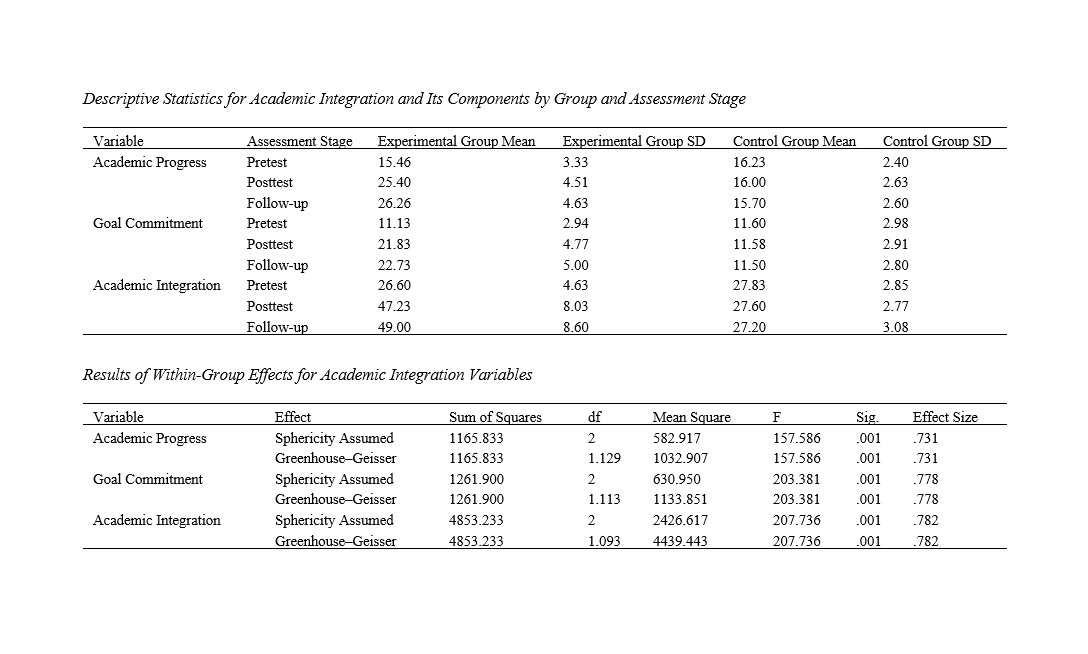
This study was conducted to design and examine the effectiveness of a Choice Theory educational package on the academic integration of male students in the second cycle of secondary education in District Two of Kerman City. The study employed a quasi-experimental design with a pretest–posttest control group. The statistical population consisted of all male students in the second cycle of secondary education in District Two of Kerman City (N = 450). A multistage cluster random sampling method was used, and the sample included 60 students who were randomly assigned to an experimental group (30 participants) and a control group (30 participants). Data were collected using the Academic Integration Questionnaire developed by Terenzini and Pascarella (1980). Participants in the experimental group received the Choice Theory educational package over eight sessions, whereas the control group received no intervention. Data were analyzed using repeated-measures analysis of variance with SPSS software. The results indicated that the educational package developed based on Choice Theory had a significant effect on academic integration and its components at the posttest stage, and the continuity of this effect was also observed at the follow-up stage (p < .01). Therefore, the educational package developed based on Choice Theory can be considered an effective method for increasing students’ academic integration.
Downloads
References
Abdollahi Mehraban, N., Shafiabadi, A., & Behboudi, M. (2014). The Effectiveness of Group Counseling with a Reality Therapy Approach on Increasing Self-Esteem among Mothers of Children with Cerebral Palsy. Journal of Behavioral Sciences Research, 12(3), 360-368.
Alizadeh Fard, S., & Mahpouya, R. (2017). The Effect of Choice Theory Training on Students' Cognitive Learning Strategies. Journal of Educational Psychology Studies, 14(27), 161-180.
Bhargava, R. (2013). The use of reality therapy with a depressed deaf adult. Clinical Case Studies, 12(5), 388-396. https://doi.org/10.1177/1534650113496869
Bojrukland, S. A., Parente, J., & Sathianatham, D. (2012). Effects of faculty interaction and feedback on gains in student skills. 32nd Annual Frontiers in Education Conference, Boston.
Byl, E., Struyven, K., Meurs, P., Bieke, A., Tom, V., Nadine, E., & Koen, L. (2016). The value of peer learning for first-year postgraduate university students' social and academic integration. Procedia - Social and Behavioral Sciences, 228, 299-304. https://doi.org/10.1016/j.sbspro.2016.07.044
Daniel, S. D. (2014). Gender differences in scholastic achievement: A meta-analysis. Psychological bulletin, 140(4), 1174-1204. https://doi.org/10.1037/a0036620
Darbai, M. (2015). Study of efficiency of teaching choice theory and reality therapy courses on increasing intimacy among irreconcilable wives. Welfare and Rehabilitation University, 10(5), 81-99.
Davidson, C., & Wilson, K. (2013). Reassessing Tinto's concepts of social and academic integration in student retention. Journal of College Student Retention: Research, Theory & Practice, 15(3), 329-346. https://doi.org/10.2190/CS.15.3.b
Dortaj, F., Ebrahimi Ghavamabadi, S., Delavar, A., & Rasouli, F. (2022). Development and Validation of a Classroom Management Educational Package Based on Choice Theory and Determination of Its Effectiveness on Teachers' Management Style and Students' Responsibility. Military Psychology Quarterly, 13(49), 125-146.
Dowell, D. A., & Neal, J. A. (2015). A selective review of the validity of student ratings of teaching. Journal of Higher Education, 53(1), 51-62. https://doi.org/10.1080/00221546.1982.11780424
Glasser, W. (2017). An Introduction to the Psychology of Hope: Choice Theory. Sayeh Sokhan.
Gundogdu, R. (2018). The influence of Choice Theory Anger Management Program (CTAMP) on the ability of prospective psychological counselors for anger management. International Education Studies, 11(4), 43. https://doi.org/10.5539/ies.v11n4p43
Kakia, L. (2014). Effect of group counseling based on reality therapy on identity crisis in students of guidance school. Journal of Fundamentals of Mental Health, 84(12), 30-52.
Kember, D., & Leung, D. Y. P. (2015). The influence of active learning experiences on the development of graduate capabilities. Studies in Higher Education, 30(3), 155-170. https://doi.org/10.1080/03075070500043127
Kianipour, O., & Hoseini, B. (2012). Effectiveness of Training Glasser's Choice Theory to Teachers on Improvement of Students' Academic Qualification. Allameh Tabataba'i University Department of Psychology and Educational Sciences, 2(2), 2146-7463.
Lakhal, S., Mukamurera, J., Bedard, M., Heilporn, G., & Chauret, M. (2020). Features fostering academic and social integration in blended synchronous courses in graduate programs. International Journal of Educational Technology in Higher Education, 17, 1-22. https://doi.org/10.1186/s41239-020-0180-z
Law, F. M., & Guo, G. J. (2015). Choice and hope: A preliminary study of the effectiveness of choice-based reality therapy in strengthening hope in recovery for women convicted of drug offences in Taiwan. International journal of offender therapy and comparative criminology, 61(3), 56-67. https://doi.org/10.1177/0306624X15596392
Mason, C. (2016). Using reality therapy trained group counselors in comprehensive school counseling programs to decrease the academic achievement gap. International Journal of Choice Theory and Reality Therapy, 35(2), 14-25.
Mohammadi, M., & Ghatraei, H. (2015). The Role of Students' Social and Academic Integration in Their Evaluation of the Educational Performance Quality of Faculty Members at Shiraz University of Medical Sciences. Iranian Journal of Medical Education, 15(58), 460-474.
Nematzadeh, A., & Mari, H. (2014). The Effect of Group Reality Therapy on Increasing Teachers' Happiness. Journal of Behavioral and Social Sciences, 16(9), 114-116.
Nurjanah, A. S., Sarryata, S., & Zatrahadi, M. F. (2020). The effectiveness of reality therapy in improving learning motivation and discipline. Psikopedagogia: Jurnal Bimbingan dan Konseling, 5(2), 87-91. https://doi.org/10.12928/psikopedagogia.v9i2.19470
Pourhossein Malayousefi, S., Hosseini Nasab, S. D., & Panah, A. A. (2020). Comparison of the Effectiveness of Motivational Self-Regulation Strategies and Communication Skills Training on Academic Self-Efficacy among Gifted Students in Tabriz. Rehabilitation Medicine, 9(2), 25-32.
Rabban Pouroloklaei, Z., & Emadian, S. A. (2020). The Effectiveness of Life Skills Training Based on Choice Theory on Academic Emotions and Academic Performance of Female Students. Sixth International Conference on School Psychology, Tehran.
Sahebi, A. (2017). Choice Theory and Reality Therapy in School. School Counselor Development(22), 25-35.
Samadian, M., Livargani, S., & Panahali, A. (2019). The Effectiveness of Choice Theory Training on Self-Efficacy, Goal Orientation, and Academic Motivation of Ninth-Grade Female Students in Bonab. Educational Research Letter, 14(60), 79-100.
Shahsavari, F., ansary, m., & elmimanesh, N. (2025). The Effectiveness of Reality Therapy on the Life Adjustment after Divorce and Meaning of Life in Divorced Heads of Household Women in Isfahan City. Knowledge & Research in Applied Psychology, 98(25), 175-190. https://doi.org/10.30486/jsrp.2023.1978995.3673
Shariati Pour, S., Barabadi, H. A., & Heidarnia, A. (2019). The Effectiveness of Group Reality Therapy Based on Choice Theory on Psychological Capital of Orphaned Adolescent Girls. Counseling Research, 18(71), 36-59.
Sohrabnejad, S., Younesi, S., Dadkhah, A., & Biglarian, A. (2015). The Effectiveness of Reality Therapy Training on Parent-Child Conflicts and Self-Efficacy Beliefs in Male Adolescents. Journal of Ilam University of Medical Sciences, 25(13), 48-49.
Toope, M., Mirzamani Bafghi, S. M., & Hatami, M. (2025). The Effectiveness of Reality Therapy and Emotion-Focused Therapy on Cognitive Avoidance in Women with Marital Distress. Iranian Journal of Educational Research, 4(2), 0-0. https://ijer.hormozgan.ac.ir/article-1-389-en.pdf
Yadollahi Saber, F., Ebrahimi, M. E., Zamani, N., & Sahebi, A. (2019). Determining the Effectiveness of Choice Theory Training on Responsibility and Hopefulness among Female Students. Social Cognition, 1(13), 20-32.
Yousefi, M., Mahdian, H., & Jahangiri, A. (2025). Comparing the Effectiveness of Reality Therapy and Acceptance and Commitment Therapy on Distress Tolerance of Male Students. Psychology of Motivation, Behavior, and Health, 2(4), 1-14.
Zahed, H., Namazi, M., & Arab, N. (2025). Comparing the Effectiveness of Reality Therapy and Emotion-Focused Therapy on Irrational Beliefs and Marital Perfectionism in Women Experiencing Emotional Divorce. Journal of New Psychological Research, 20(77), 195-207. https://journals.tabrizu.ac.ir/article_19419.html?lang=en
Zepke, N., Leach, L., & Prebble, T. (2016). Being learner centred: One way to improve student retention? Studies in Higher Education, 31(5), 587-600. https://doi.org/10.1080/03075070600923418
Downloads
Additional Files
Publication Timeline
- Submitted
- Revised
- Accepted