Comparison of the Effectiveness of Storytelling Therapy and Cognitive-Behavioral Play Therapy in Improving Cognitive Emotion Regulation in Children with Attention-Deficit/Hyperactivity Disorder
Keywords:
Storytelling therapy, cognitive-behavioral play therapy, cognitive emotion regulation, attention-deficit/hyperactivity disorderAbstract
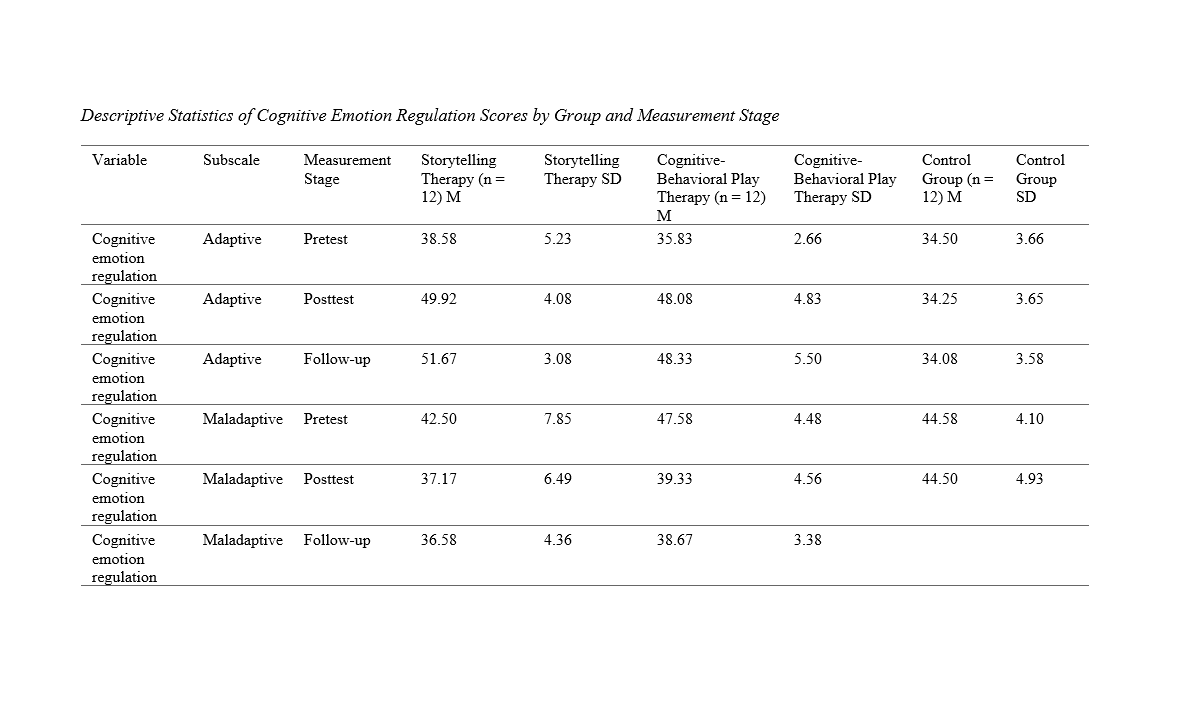
This study aimed to determine and compare the effects of storytelling therapy and cognitive-behavioral play therapy on improving cognitive emotion regulation in children with attention-deficit/hyperactivity disorder. In terms of variable control, the present study was quasi-experimental and was conducted using an extended pretest–posttest–follow-up design with a control group. The statistical population included all children aged 7–10 years with attention-deficit/hyperactivity disorder in the city of Jam during 2025–2027. A total of 36 participants were selected through purposive sampling and were randomly and equally assigned to two experimental groups and one control group. The experimental groups separately received the interventions, consisting of eight 60-minute sessions, while the control group received no intervention. Data were collected using the SNAP test and the Cognitive Emotion Regulation Questionnaire developed by Garnefski et al. (children’s version). The data were analyzed using two-way analysis of variance with repeated measures on one factor, also known as mixed-design analysis of variance, and Bonferroni post hoc tests. The results showed that both interventions led to a significant improvement in cognitive emotion regulation, including adaptive and maladaptive cognitive emotion regulation strategies, and that there was no significant difference between the two interventions. Moreover, the intervention effects remained stable at the follow-up stage. The findings emphasize the necessity of using play-based and narrative-based interventions as complementary interventions in the treatment of children with attention-deficit/hyperactivity disorder.
Downloads
References
Abdi, F., Karamoozian, A., Lotfilou, M., Gholami, F., Shaterian, N., Niasar, A. A., & Jandaghian-Bidgoli, M. (2025). Effect of play therapy and storytelling on the anxiety level of hospitalized children: A randomized controlled trial. BMC Complementary Medicine and Therapies, 25(1), 23. https://doi.org/10.1186/s12906-025-04767-4
Amel, A. K., Rahnamaei, H., & Hashemi, Z. (2023). Play therapy and storytelling intervention on children's social skills with attention-deficit/hyperactivity disorder. Journal of education and health promotion(1), 317.
American Psychiatric, A. (2022). Diagnostic and Statistical Manual of Mental Disorders: DSM-5 (Vol. 5). American Psychiatric Association Publishing. https://doi.org/10.1176/appi.books.9780890425787
Aminian, M., & Asli Azad, M. (2024). The effectiveness of cognitive-behavioral play therapy on executive functions and social competence of female students with symptoms of attention-deficit/hyperactivity disorder. Psychological Achievements, 31(4), 99-120.
Baharlouei, F. (2021). The effectiveness of cognitive-behavioral play therapy on emotion regulation, social skills, and alexithymia in children with internalizing behavior disorder Payame Noor University]. Asaluyeh.
Bayat, F., Rezaei, A. M., & Behnam, B. (2019). Comparison of the effectiveness of play therapy and storytelling on improvement of ADHD symptoms. Qom University of Medical Sciences Journal, 12(8), 59-68.
Bodaghi, M., Pirani, Z., & Taghvaei, D. (2021). Effectiveness of Floortime play on emotion management, self-control, and executive functions in students with attention-deficit/hyperactivity disorder. Journal of Research in Behavioral Sciences, 19(3), 381-391. https://doi.org/10.52547/rbs.19.3.381
Brockington, G., Gomes Moreira, A. P., Buso, M. S., Gomes da Silva, S., Altszyler, E., Fischer, R., & Moll, J. (2021). Storytelling increases oxytocin and positive emotions and decreases cortisol and pain in hospitalized children. Proceedings of the National Academy of Sciences, 118(22), e2018409118. https://doi.org/10.1073/pnas.2018409118
Darvish-Damavandi, Z., Dortaj, F., Ghanbari-Hashemabadi, B., & Delavar, A. (2020). The effect of storytelling therapy on cognitive emotion regulation of children with ADHD. Journal of Cognitive Sciences, 19(90), 787-797.
Ghaderi, E. (2022). Comparison of the effectiveness of play therapy and storytelling therapy in improving aggression and anxiety of children with hyperactivity in elementary school in Sanandaj County Payame Noor University]. Sanandaj.
Ghasemian Koops, M. (2021). The effectiveness of storytelling therapy on reducing aggression and attention deficit and improving academic achievement in children with ADHD based on the emotional-words play method Payame Noor University, South Tehran Center].
Hosseinnezhad, A., Abolghasemi, S., Vatankhah, H. R., & Khalatbari, J. (2020). Comparison of the effectiveness of anger management training based on cognitive behavioral therapy approach and narrative therapy on academic self-efficacy and academic resilience in students with attention-deficit/hyperactivity disorder (ADHD). Journal of Children Mental Health, 7(2), 1-16. https://doi.org/10.29252/jcmh.7.2.2
Karibwende, F., Niyonsenga, J., Biracyaza, E., Nyirinkwaya, S., Hitayezu, I., Sebatukura, G. S., & Mutabaruka, J. (2023). Efficacy of narrative therapy for orphan and abandoned children with anxiety and attention-deficit and hyperactivity disorders in Rwanda: A randomized controlled trial. Journal of Behavior Therapy and Experimental Psychiatry, 78, 101802. https://doi.org/10.1016/j.jbtep.2022.101802
Khatoon, A., Iqbal, N., & Masroor, U. (2021). Cognitive behavioral play therapy. Clinical and Counselling Psychology Review, 2(2). https://doi.org/10.32350/ccpr.22.02
Mehranizadeh, & Khoshlahjeh, S. (2025). The effectiveness of cognitive rehabilitation on improving working memory, cognitive emotion regulation, and attention deficits in adolescents with attention-deficit/hyperactivity disorder. Rooyesh-e-Ravanshenasi, 14(7).
Morshedi, A. (2021). The effectiveness of cognitive-behavioral play therapy on reducing impulsivity, increasing responsibility, and emotional control of first-cycle elementary school students Payame Noor University]. Najafabad.
Mostafaei Paydar, N., Ghasemzadeh, S., Arjmandnia, A. A., Majaver, S., & Mohammadi. (2021). The effectiveness of storytelling therapy on resilience. Journal of Exceptional Education, 21(6).
Nejati, V., & Derakhshan, Z. (2024). Attention training improves executive functions and ameliorates behavioral symptoms in children with attention-deficit hyperactivity disorder: Implication of tele-cognitive-rehabilitation in the era of coronavirus disease. Games for Health Journal, 13(1). https://doi.org/10.1089/g4h.2023.0002
Norouzi Homayoun, M., Hataminejad, M., & Sadri Damirchi, E. (2023). The effectiveness of psychodrama group therapy and cognitive-behavioral play therapy on executive functions (working memory, response inhibition, cognitive flexibility, and emotional self-regulation) in male students with social anxiety disorder. Neuropsychology, 9(35), 1-17.
Roghani, F. (2018). The effectiveness of Floortime play therapy on executive functions Islamic Azad University]. Shahr-e Qods.
Roshan, A. (2020). Storytelling: How to Use Stories to Help Children Resolve Life Problems. Javaneh-ye Roshd.
Safer, D. J. (2018). Is ADHD really increasing in youth? Journal of Attention Disorders, 22(2), 107-115. https://doi.org/10.1177/1087054715586571
Sibley, M. H., Graziano, P. A., Coxe, S. J., Bickman, L., Martin, P., & Flores, S. (2023). A randomized community-based trial of behavior therapy vs. usual care for adolescent ADHD: Secondary outcomes and effects on comorbidity. Behavior therapy, 54(5), 839-851. https://doi.org/10.1016/j.beth.2023.03.001
Taghizadeh Hir, S., Aghajani, S., & Khoshsarvar, S. (2022). The effectiveness of cognitive-behavioral play therapy on attention and planning of students with ADHD. School and Educational Psychology Quarterly, 11(4).
Torkaman, M., Kakabaraei, K., & Hosseini, S. a.-S. (2021). Comparison of the effectiveness of pharmacological treatments, neurofeedback, and integrated psychological interventions on behavioral problems of attention-deficit/hyperactivity disorder. Journal of Research in Behavioral Sciences, 19(1), 58-71.
Vacher, C., Romo, L., Dereure, M., Soler, M., Picot, M. C., & Purper-Ouakil, D. (2022). Efficacy of cognitive behavioral therapy on aggressive behavior in children with attention-deficit/hyperactivity disorder and emotion dysregulation: Study protocol of a randomized controlled trial. Trials, 23(1), 124. https://doi.org/10.1186/s13063-022-05996-5
Winarsunu, T., Nurfadillah, T. H., & Fasikhah, S. S. (2022). Attention improvement through play puzzle therapy to promote self-regulation in children with attention-deficit/hyperactivity disorder (ADHD). Journal of Education, Health and Community Psychology, 11(4), 818-832. https://doi.org/10.12928/jehcp.v11i4.23477
Yadi, F., Kiamanesh, A., & Bahrami, H. (2020). Comparison of the effectiveness of narrative therapy and play therapy training on the level of compatibility, attention and concentration of female students suffering from ODD. Revista Turismo Estudos e Práticas-RTEP/GEPLAT/UERN(1), 1-13.
Zad Afshar, S. (2021). Development of a compassion-based play therapy intervention and comparison of its effectiveness with cognitive-behavioral play therapy on emotion regulation, self-control, irritability, and anger in children with disruptive mood dysregulation disorder University of Isfahan]. Isfahan.
Downloads
Additional Files
Publication Timeline
- Submitted
- Revised
- Accepted