Identifying the Components of Cognitive Decline from the Perspective of Older Adults: A Qualitative Study
Keywords:
cognitive decline, aging, qualitative analysisAbstract
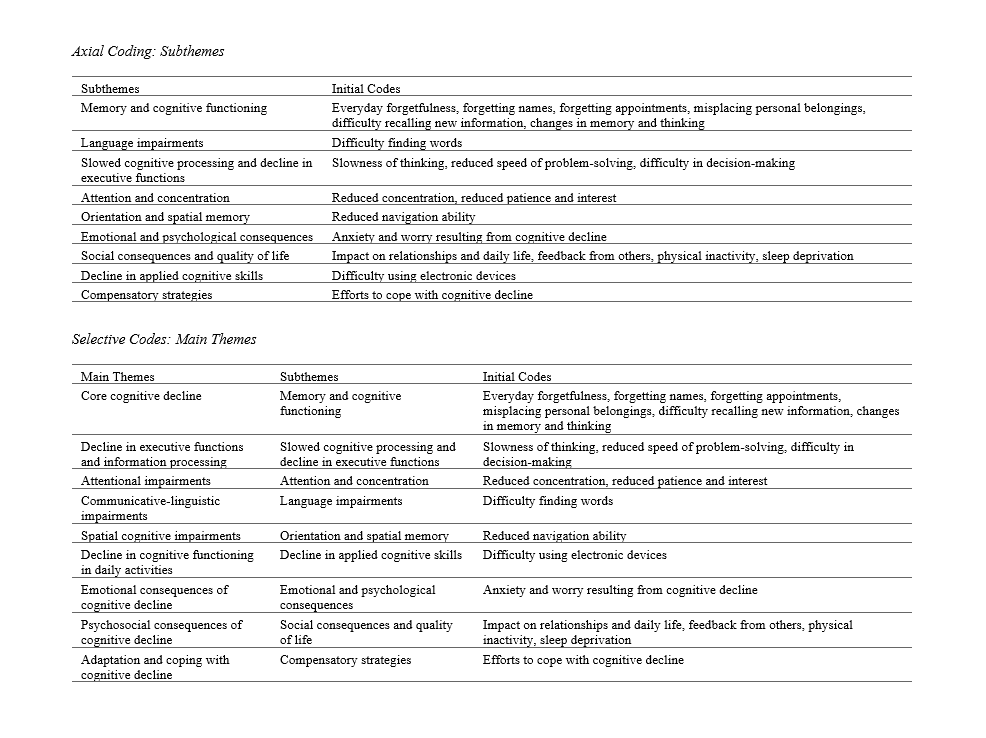
The aim of this study was to identify the components of cognitive decline from the perspective of older adults: a qualitative study. In terms of purpose, this research was applied, and in terms of methodology, it was qualitative. The statistical population of the study included all older adults in Districts 1 and 3 of Tehran, among whom 17 older adults were selected as the sample through theoretical sampling. The data collection instrument was a semi-structured interview. The qualitative analysis of the interviews resulted in 20 initial codes. Based on these codes, 9 subthemes were identified, and ultimately, 9 main themes were considered as the components of cognitive decline, which formed the basis for designing the cognitive decline questionnaire in this study. For each component, 10 items were proposed. Based on the opinions of 9 experts and university professors, the total content validity score was obtained as 0.78; therefore, the designed questionnaire had appropriate validity. The reliability of the questionnaire was obtained as 85% through two stages of coding with a one-month interval.
Downloads
References
Alsenany, S. A. (2025). Psychological predictors of gerascophobia among middle-aged and older adults: The role of health anxiety and body image satisfaction. Geroscience, 1-13. https://doi.org/10.1007/s11357-025-01807-2
Banimahdi, R., Akbarfahimi, N., Sahaf, R., & Rezasoltani, P. (2019). Comparing the attitudes of occupational therapy students and alumni towards old people. Iranian Journal of Ageing, 14(1), 64-73.
Costa, F. (2025). The fear of old age: A survey of adults in the UK. Educational Gerontology, 51(5), 532-549. https://doi.org/10.1080/03601277.2024.2402056
Ghanbarnia, M. J., Hosseini, S. R., Ahangar, A. A., Ghadimi, R., & Bijani, A. (2024). Prevalence of cognitive frailty and its associated factors in a population of Iranian older adults. Aging Clinical and Experimental Research, 36(1), 134. https://doi.org/10.1007/s40520-024-02790-y
Holland, C. A., Dravecz, N., Broughton, S., Barker, L. A., Bature, F., Clarke, C., & Fowler Davis, S. (2025). Interventions for cognitive frailty: Developing a Delphi consensus with multidisciplinary and multisectoral experts. Frontiers in Aging Neuroscience, 17, 1541048. https://doi.org/10.3389/fnagi.2025.1541048
Ijaz, N., Jamil, Y., Brown Iv, C. H., Krishnaswami, A., Orkaby, A., Stimmel, M. B., & Damluji, A. A. (2024). Role of cognitive frailty in older adults with cardiovascular disease. Journal of the American Heart Association, 13(4), e033594. https://doi.org/10.1161/JAHA.123.033594
Invernizzi, S., Bodart, A., Lefebvre, L., & Loureiro, I. S. (2023). The role of semantic assessment in the differential diagnosis between late-life depression and Alzheimer's disease or amnestic mild cognitive impairment: Systematic review and meta-analysis. European Journal of Ageing, 20(1), 34. https://doi.org/10.1007/s10433-023-00780-z
Kim-Knauss, Y., Degen, N. M., & Lang, F. R. (2024). The paradox of aging-related fears: Fear of loneliness in old age as a motivator for loneliness preventive activities. Gerontology, 70(8), 884-891. https://doi.org/10.1159/000539540
Laine, M., & Martin, N. (2023). Anomia: Theoretical and Clinical Aspects. Routledge. https://doi.org/10.4324/9781003222057
Mahmoudi, Z., Rahimian Boogar, I., & Tale Pasand, S. (2023). Predicting age-related cognitive decline and executive functions based on social isolation, physical activity, and dietary habits in older adults. Psychology of Aging, 9(4), 437-454.
Mander, B. A., Winer, J. R., & Walker, M. P. (2017). Sleep and human aging. Neuron, 94(1), 19-36. https://doi.org/10.1016/j.neuron.2017.02.004
Mogle, J., Munoz, E., Hill, N. L., Smyth, J. M., & Sliwinski, M. J. (2019). Daily memory lapses in adults: Characterization and influence on affect. The Journals of Gerontology: Series B, 74(1), 59-68. https://doi.org/10.1093/geronb/gbx012
Mustafa Khalid, N., Haron, H., Shahar, S., & Fenech, M. (2022). Current evidence on the association of micronutrient malnutrition with mild cognitive impairment, frailty, and cognitive frailty among older adults: A scoping review. International journal of environmental research and public health, 19(23), 15722. https://doi.org/10.3390/ijerph192315722
Pakpour, A. H., Namjoo, S., Sabahiazar, K., Jafarabadi, M. A., Chattu, V. K., & Allahverdipour, H. (2021). Psychometric properties of the Lasher and Faulkender Anxiety About Aging Scale (AAS) among Iranian older adults. European Journal of Investigation in Health, Psychology and Education, 11(3), 829-837. https://doi.org/10.3390/ejihpe11030060
Piolatto, M., Bianchi, F., Rota, M., Marengoni, A., Akbaritabar, A., & Squazzoni, F. (2022). The effect of social relationships on cognitive decline in older adults: An updated systematic review and meta-analysis of longitudinal cohort studies. BMC public health, 22(1), 278. https://doi.org/10.1186/s12889-022-12567-5
Reuter-Lorenz, P. A., & Park, D. C. (2024). Cognitive aging and the life course: A new look at the scaffolding theory. Current opinion in psychology, 56, 101781. https://doi.org/10.1016/j.copsyc.2023.101781
Ruan, Q., Yu, Z., Chen, M., Bao, Z., Li, J., & He, W. (2015). Cognitive frailty, a novel target for the prevention of elderly dependency. Ageing Research Reviews, 20, 1-10. https://doi.org/10.1016/j.arr.2014.12.004
Shimada, H., Makizako, H., Lee, S., Doi, T., Lee, S., Tsutsumimoto, K., & Suzuki, T. (2016). Impact of cognitive frailty on daily activities in older persons. The Journal of Nutrition, Health & Aging, 20(7), 729-735. https://doi.org/10.1007/s12603-016-0685-2
Sugimoto, T., Ono, R., Kimura, A., Saji, N., Niida, S., Toba, K., & Sakurai, T. (2019). Cross-sectional association between cognitive frailty and white matter hyperintensity among memory clinic patients. Journal of Alzheimer's Disease, 72(2), 605-612. https://doi.org/10.3233/JAD-190622
von Bastian, C. C., Reinhartz, A., Udale, R. C., Gregoire, S., Essounni, M., Belleville, S., & Strobach, T. (2022). Mechanisms of processing speed training and transfer effects across the adult lifespan: Protocol of a multi-site cognitive training study. BMC psychology, 10(1), 168. https://doi.org/10.1186/s40359-022-00877-7
Yang, S., & Ge, D. (2025). Why does aging anxiety emerge? A study on the influence of socioeconomic status. Frontiers in psychology, 16, 1602284. https://doi.org/10.3389/fpsyg.2025.1602284
Yousefpour, N. (2025). The effectiveness of positive psychology training on anxiety, social skills, and meaning in life among older adults. Psychology of Aging, 11(4).
Zaccari, V., Mancini, F., & Rogier, G. (2024). State of the art of the literature on definitions of self-criticism: A meta-review. Frontiers in Psychiatry, 15, 1239696. https://doi.org/10.3389/fpsyt.2024.1239696
Downloads
Additional Files
Publication Timeline
- Submitted
- Revised
- Accepted