Predicting Behavioral Problems of Sixth-Grade Elementary Students Based on Digital Media Use and Parent-Child Interaction Quality with the Mediating Role of Emotion Regulation Level
Keywords:
Behavioral Problems, Digital Media, Parent-Child Relationship, Emotion Regulation, StudentsAbstract
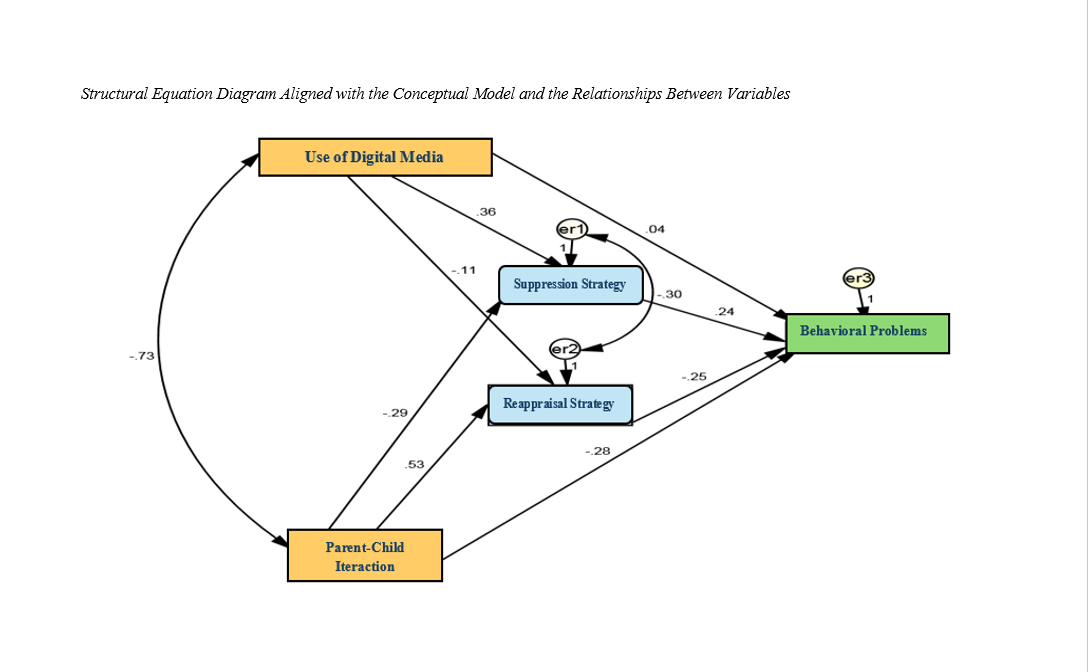
This study aimed to predict behavioral problems in sixth-grade students based on digital media use and parent-child interaction quality, with the mediating role of emotion regulation. This applied research employed a descriptive-correlational design using structural equation modeling (SEM). The statistical population included all sixth-grade students in District 5 of Isfahan in the academic year 2025-2026 (N = 3419). A sample of 343 students was selected using combined stratified random-cluster sampling. Instruments included the Child Behavior Checklist, Media Use Questionnaire, Parent-Child Relationship Scale (Pianata, CPRS), and Emotion Regulation Questionnaire (Gross & John, ERQ). Data were analyzed using SPSS-26 and Smart-PLS 3 via Pearson correlation and path analysis with bootstrapping. SEM results showed excellent model fit (CMIN/df = 0, GFI = 1, NFI = 1, CFI = 1, IFI = 1). Digital media use had no significant direct effect on behavioral problems (β = 0.04, T = 0.65, p = 0.514); however, it indirectly increased behavioral problems by increasing the suppression strategy (β = 0.24, p < 0.0001). Parent-child interaction quality directly increased behavioral problems (β = -0.28, T = -4.01, p < 0.0001) and indirectly through reducing suppression (β = 0.24, p < 0.0001). Moreover, parent-child interaction quality was associated with reduced behavioral problems both directly (β = -0.07, p = 0.003) and through increasing reappraisal (β = 0.13, p < 0.007). Emotion regulation acts as a key mediating mechanism. These findings emphasize the necessity of designing multi-faceted interventions to manage media consumption, improve family interactions, and teach emotion regulation skills.
Downloads
References
Abhijit, N., Radhika, K., Rao, B. T., & Sagar, R. (2025). An Assessment on Effects of Digital Device Usage on Behavioural Changes in Children 2 to 5 Years: A Cross-Sectional Study. European Journal of Clinical Medicine, 15(6), 117-124. https://doi.org/10.5083/ejcm/25-06-23
Asgari, S., Mozaffari, M., Amini Manesh, S., & Bardideh, M. R. (2024). The Effectiveness of Child-Centered Working Memory Training on Parent-Child Interaction of Children with Attention Deficit-Hyperactivity Disorder. Quarterly Journal of Child Mental Health, 11(2), 1-16. https://doi.org/10.61186/jcmh.11.2.2
Bigdeli, I., Najafy, M., & Rostami, M. (2013). The Relation of Attachment Styles, Emotion Regulation, and Resilience to Well-Being Among Students of Medical Sciences. Iranian Journal of Medical Education, 13(9), 721-729. http://ijme.mui.ac.ir/article-1-2694-en.html
Cheung, R. Y. M., Li, Z., & Ho, A. P. L. (2022). Parental Self-Compassion and Child Adjustment: The Mediating Role of Parental Depressive Symptoms. International journal of environmental research and public health, 19(9), 5133. https://doi.org/10.3390/ijerph19095133
Driscoll, K., & Pianta, R. C. (2011). Mother's and Father's Perceptions of Conflict and Closeness in Parent-Child Relationships During Early Childhood. Journal of Early Childhood and Infant Psychology, 7, 1-18. https://sid.ir/paper/677045/e
Eisanejad, A., Saeedi, T., & Alipour, A. (2019). The Effectiveness of Positive Parenting Training on Behavioral Problems and Responsibility of Aggressive Elementary School Students. Educational Psychology Studies, 16(35), 191-210. https://civilica.com/doc/1466799/
Gallegos, M. L., Segrin, C., & Thompson, A. (2023). Parent-Child Relationships and the Health of Incarcerated Mothers: Exploring the Mediating Role of Loneliness. Health Communication, 38(7), 1442-1453. https://doi.org/10.1080/10410236.2021.2012014
Goulter, N., Roubinov, D. S., McMahon, R. J., Boyce, W. T., & Bush, N. R. (2021). Externalizing and Internalizing Problems: Associations with Family Adversity and Young Children's Adrenocortical and Autonomic Functioning. Research on Child and Adolescent Psychopathology, 49(5), 629-642. https://doi.org/10.1007/s10802-020-00762-0
Gross, J. J., & John, O. P. (2003). Individual Differences in Two Emotion Regulation Processes: Implications for Affect, Relationships, and Well-Being. Journal of personality and social psychology, 85(2), 348-362. https://doi.org/10.1037/0022-3514.85.2.348
Hasani, J. (2011). Validity and Reliability of the Short Form of the Cognitive Emotion Regulation Questionnaire. Research in Behavioral Sciences, 9(4), 229-240.
Jimenez, T. I., Estevez, E., Velilla, C. M., Martin-Albo, J., & Martinez, M. L. (2019). Family Communication and Verbal Child-to-Parent Violence Among Adolescents: The Mediating Role of Perceived Stress. International journal of environmental research and public health, 16(22), 4538. https://doi.org/10.3390/ijerph16224538
Kaur, N., Gupta, M., Kiran, T., Malhi, P., & Grover, S. (2024). Behavioral Problems Associated with Digital Screen Exposure in Children Aged 2-5 Years: Cross-Sectional Study. Journal of Indian Association for Child and Adolescent Mental Health, 20(3), 249-263. https://doi.org/10.1177/09731342241236364
Khoshkerdar, S. F., Baradaran, M., & Ranjbar Noushari, F. (2020). The Role of Parenting Styles, Parental Stress and Executive Functions Deficits in Predicting the Children's Internalizing and Externalizing Problems. Quarterly Journal of Child Mental Health, 7(2), 156-168. https://doi.org/10.29252/jcmh.7.2.14
Li, X., Ding, Y., Bai, X., & Liu, L. (2022). Associations Between Parental Mediation and Adolescents' Internet Addiction: The Role of Parent-Child Relationship and Adolescents' Grades. Frontiers in psychology, 13, 1015631. https://doi.org/10.3389/fpsyg.2022.1061631
Lohrassbi, S., Sajjadian, I., & Golparvar, M. (2023). The Effectiveness of Mothers' Psychological Empowerment Package on Children's Behavioral Problems and Self-Esteem. Quarterly Journal of Child Mental Health, 10(1), 64-77. https://doi.org/10.61186/jcmh.10.1.6
Mahmoudian, H., Koochani Isfahani, M., & Moghadas, S. (2015). Media Consumption, Body Management and Reproductive Behavior. Farhang Strategy(31), 173-196. https://www.jsfc.ir/article_14926.html
Masoumi Zavariani, S. M., Hajabi, M. Z., & Mirzahosseini, H. (2024). Investigating the Mediating Role of Parent-Child Relationship in the Relationship Between Children's Externalizing Problems Based on Family Developmental Function. Razi Journal of Medical Sciences, 31(40), 1-17. https://doi.org/10.47176/rjms.31.40
Moshirifar, T., Hasani, F., Golshani, F., Abedin, A. R., & Taghiloo, S. (2023). Explaining Causal Relationships Between Mothers' Personality Traits and Children's Behavioral Problems Based on the Mediating Role of Parenting Styles. Journal of Child Mental Health, 10(4), 31-47. https://doi.org/10.61186/jcmh.10.4.4
Nejatifar, S., Abedi, A., & Gharani, A. (2020). The Effectiveness of Parent-Centered Intervention Based on Transcendent Philosophy of Grata on Emotional Regulation of Children with Externalized Behavioral Problems. Journal of Exceptional Children, 20(4), 22-31. https://doi.org/10.61186/jcmh.10.4.4
Roshani, A., Sihvand, T., & Bagheri, M. (2022). The Effectiveness of Quranic Stories on Adjustment and Behavioral Problems of Elementary School Students. Religion and Health, 10(2), 11-20. http://jrh.mazums.ac.ir/article-1-969-en.html
Sadat Rasul, S., & Alizadeh Fard, S. (2021). Psychometric Properties of the Behavioral Emotion Regulation Questionnaire. Journal of Psychological Methods and Models, 12(44), 13-24. https://doi.org/10.30495/jpmm.2021.26235.3209
Salamat, M. K., Hejazi, M., Morovati, Z., & Izadpanah, S. (2019). Predicting Children's Behavioral Problems Based on Maternal Parenting Styles: The Mediating Role of Child Adjustment. Quarterly Journal of Child Mental Health, 6(3), 269-280. https://doi.org/10.29252/jcmh.6.3.23
Schramm, H., & Cohen, E. L. (2018). Emotion Regulation and Coping via Media Use. In P. Rossler (Ed.), The International Encyclopedia of Media Effects. John Wiley & Sons, Inc. https://doi.org/10.1002/9781118783764.wbieme0162
Shutzman, B., & Gershy, N. (2023). Children's Excessive Digital Media Use, Mental Health Problems and the Protective Role of Parenting During COVID-19. Computers in human Behavior, 139, 107559. https://doi.org/10.1016/j.chb.2022.107559
Soltani, F., Karimzadeh, M., Tahmasebi, S., & Biglarian, A. (2019). The Relationship Between Mothers' Media Literacy with Behavioral Problems and the Amount of Use of Electronic Media in 4-6 Year Old Children. Journal of Preschool and Elementary School Studies, 2(8), 33-48. https://civilica.com/doc/1538473/
Yang, D., Wang, C., Li, Z., & Fei, C. (2025). Engagement and Burnout Among Primary School Students. Scientific reports, 15, 39493. https://doi.org/10.1186/s40359-023-01071-z
Downloads
Additional Files
Publication Timeline
- Submitted
- Revised
- Accepted