Developing a Mindfulness Model With the Mediating Role of Self-Compassion in the Marital Adjustment of Women and Men in Tehran
Keywords:
Psychological Capital, mindfulness, self-compassion, marital adjustment, women and menAbstract
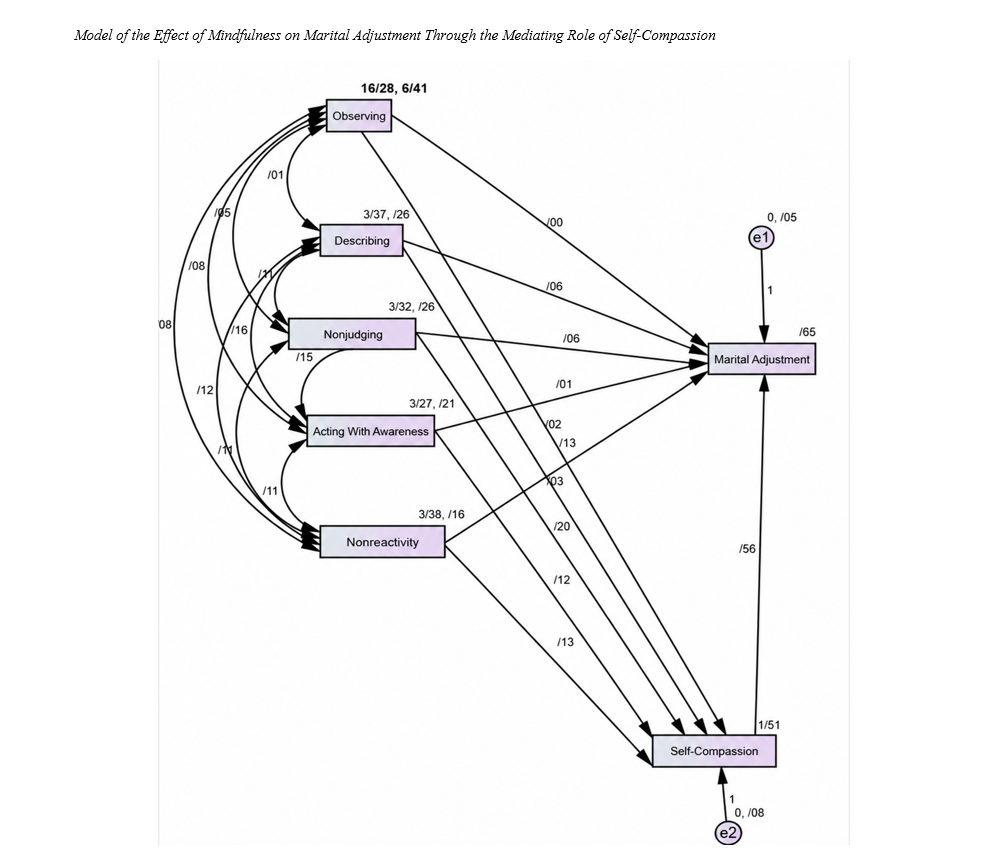
This study aimed to model the relationships among psychological capital, mindfulness, self-compassion, and marital adjustment in women and men residing in Tehran. The statistical population consisted of married individuals who attended neighborhood community centers in Tehran during 2024–2026. Based on the formula proposed by Tabachnick and Fidell (2005) and considering the number of study components, the required sample size was estimated to be 276 participants, who were selected through multistage random sampling. Data were collected using the Psychological Capital Questionnaire developed by Luthans et al. (2007), the Five Facet Mindfulness Questionnaire (FFMQ), Neff’s Self-Compassion Scale (2003), and Spanier’s Dyadic Adjustment Scale (1976). Path analysis was conducted in AMOS to estimate the direct and indirect effects of the variables. Overall, 44% of the variance in marital adjustment and 71% of the variance in self-compassion were explained by the variables included in the model, whereas approximately 56% of the variance in marital adjustment was attributable to variables outside the model. The results indicated that nonjudging, nonreactivity, and describing had direct effects on marital adjustment. In addition, nonreactivity and nonjudging had significant indirect effects on marital adjustment through the mediating variable of self-compassion. Acting with awareness had no significant effect, whereas describing exerted only a direct effect. Based on the findings, it can be concluded that the marital adjustment of women and men is not merely a secondary phenomenon resulting from positive life experiences, personal characteristics, or similar factors; rather, it should be examined from a comprehensive and interactional perspective.
Downloads
References
Ahmadvand, Z., Heydari-Nasab, L., & Shairi, M. R. (2012). Explaining psychological well-being based on mindfulness components. Health Psychology Quarterly, 2(2), 60-69.
Barry, K., Sanders, A., & Lee, R. (2023). Marital adjustment and mental health: A review of psychological outcomes. Journal of Family Psychology, 45(2), 102-117.
Brown, K. W., Creswell, J. D., & Ryan, R. M. (2015). The Evolution of Mindfulness Research. Guilford Press.
Dehghani-Doulatabadi, S., Plathadka, H., & Ismail, S. M. (2025). The moderating effect of interpersonal mindfulness between marital conflict and marital intimacy among Iranian married individuals. Brain and Behavior, 15(3), e70392. https://doi.org/10.1002/brb3.70392
Fincham, F. D., & Beach, S. R. H. (2022). Relationship science and couple therapy: Progress and possibilities. Current opinion in psychology, 43, 42-47. https://doi.org/10.1016/j.copsyc.2021.06.002
Hamidpour, R., Fazaili, T., & Heydari, H. (2024). The relationship between mindfulness and marital satisfaction in couples: The mediating role of theory of mind. Cultural-Educational Quarterly of Women and Family, 19(67), 103-128.
Lee, K., Zhang, C., & Chen, J. (2022). Mindfulness and romantic relationship quality: The role of emotion regulation and empathy. Journal of Social and Interpersonal Relationships, 39(2), 123-137.
Mollazadeh, J., Mansour, M., Ejei, J., & Kiamanesh, A. (2002). The effectiveness of a family psychological education program on expressed emotion in families of patients with severe psychiatric disorders. Family Research Quarterly, 5(1), 5-16.
Neff, K. D., & Beretvas, S. N. (2013). The role of self-compassion in romantic relationships. Self and identity, 12(1), 78-98. https://doi.org/10.1080/15298868.2011.639548
Neff, K. D., & Germer, K. (2023). Self-compassion-based interventions: A structured review of clinical studies. Journal of Compassion-Based Therapy, 2(1), 45-58.
Rajabi, G., Kazemi, F., & Shiralinia, K. (2022). Evaluation of a model of the relationship between mindfulness and marital satisfaction mediated by marital empathy. Journal of Applied Psychological Research, 13(1), 183-198. https://doi.org/10.22059/japr.2022.320767.643793
Stasik-O'Brien, S., Roberts, N., & Meyer, B. (2022). The role of mental health in the continuity of marital adjustment: Findings from a longitudinal study of couples. Journal of Family Health, 41(1), 75-88.
Travis, R., McGrath, L., & Nguyen, M. (2021). Effectiveness of a mindfulness-based intervention on marital satisfaction in couples. Journal of Clinical Psychology, 29(3), 245-259.
Zessin, M., Dickhäuser, O., & Garb, R. (2020). The relationship between self-compassion and interpersonal relationships: A meta-analytic review. Journal of Social Psychology, 58(3), 211-226.
Zhao, F., Zheng, K., & Wu, Z. (2023). Self-compassion, mental health, and marital conflict: A mediation model. Journal of Health Psychology, 38(4), 301-314.