Comparison of the Effectiveness of Self-Compassion Training and Mentalization-Based Training on Emotional Expressiveness and Emotional Self-Efficacy in Students with Anxiety
Keywords:
self-compassion, mentalization, emotional expressiveness, emotional self-efficacy, anxietyAbstract
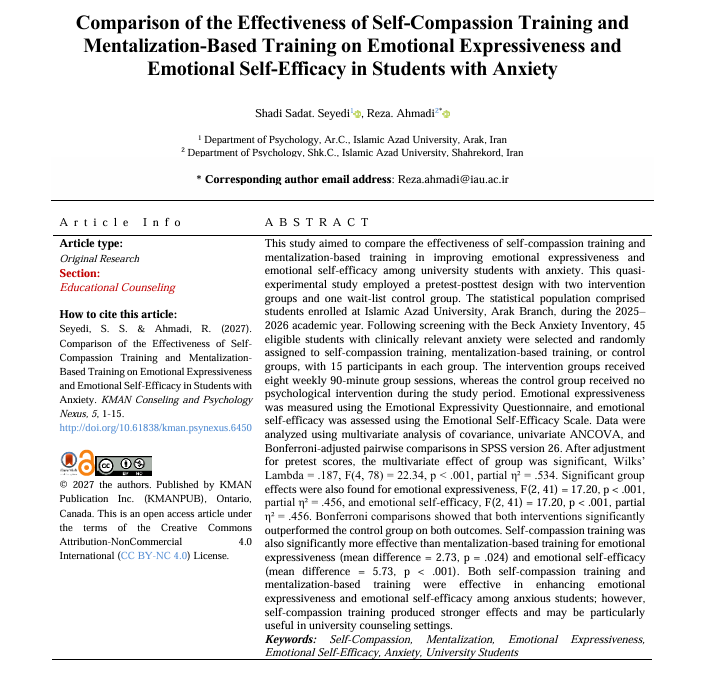
This study aimed to compare the effectiveness of self-compassion training and mentalization-based training in improving emotional expressiveness and emotional self-efficacy among university students with anxiety. This quasi-experimental study employed a pretest-posttest design with two intervention groups and one wait-list control group. The statistical population comprised students enrolled at Islamic Azad University, Arak Branch, during the 2025–2026 academic year. Following screening with the Beck Anxiety Inventory, 45 eligible students with clinically relevant anxiety were selected and randomly assigned to self-compassion training, mentalization-based training, or control groups, with 15 participants in each group. The intervention groups received eight weekly 90-minute group sessions, whereas the control group received no psychological intervention during the study period. Emotional expressiveness was measured using the Emotional Expressivity Questionnaire, and emotional self-efficacy was assessed using the Emotional Self-Efficacy Scale. Data were analyzed using multivariate analysis of covariance, univariate ANCOVA, and Bonferroni-adjusted pairwise comparisons in SPSS version 26. After adjustment for pretest scores, the multivariate effect of group was significant, Wilks’ Lambda = .187, F(4, 78) = 22.34, p < .001, partial η² = .534. Significant group effects were also found for emotional expressiveness, F(2, 41) = 17.20, p < .001, partial η² = .456, and emotional self-efficacy, F(2, 41) = 17.20, p < .001, partial η² = .456. Bonferroni comparisons showed that both interventions significantly outperformed the control group on both outcomes. Self-compassion training was also significantly more effective than mentalization-based training for emotional expressiveness (mean difference = 2.73, p = .024) and emotional self-efficacy (mean difference = 5.73, p < .001). Both self-compassion training and mentalization-based training were effective in enhancing emotional expressiveness and emotional self-efficacy among anxious students; however, self-compassion training produced stronger effects and may be particularly useful in university counseling settings.
Downloads
References
Bates, G. W., Elphinstone, B., & Whitehead, R. (2021). Self-compassion and emotional regulation as predictors of social anxiety. Psychology and Psychotherapy: Theory, Research and Practice, 94(3), 426-442. https://doi.org/10.1111/papt.12318
Bevington, D., Fuggle, P., Cracknell, L., & Fonagy, P. (2017). Adaptive mentalization-based integrative treatment: A guide for teams to develop systems of care. Oxford University Press. https://doi.org/10.1093/med-psych/9780198718673.001.0001
Cai, R. Y., Edwards, C., Love, A. M. A., Brown, L., & Gibbs, V. (2024). Self-compassion improves emotion regulation and mental health outcomes: A pilot study of an online self-compassion program for autistic adults. Autism, 28(10), 2572-2585. https://doi.org/10.1177/13623613241235061
Chevalier, V., Simard, V., & Achim, J. (2023). Meta-analyses of the associations of mentalization and proxy variables with anxiety and internalizing problems. Journal of anxiety disorders, 95, 102694. https://doi.org/10.1016/j.janxdis.2023.102694
Cowand, A., Amarsaikhan, U., Ricks, R. F., & Sephton, S. E. (2024). Self-compassion is associated with improved well-being and healthier cortisol profiles in undergraduate students. Mindfulness, 15, 1831-1845. https://doi.org/10.1007/s12671-024-02383-w
Egan, S. J., Rees, C. S., Delalande, J., Greene, D., Fitzallen, G., & Brown, S. (2022). A review of self-compassion as an active ingredient in the prevention and treatment of anxiety and depression in young people. Administration and Policy in Mental Health and Mental Health Services Research, 49(3), 385-403. https://doi.org/10.1007/s10488-021-01170-2
Fonagy, P., Luyten, P., & Allison, E. (2020). The mentalizing approach to psychopathology: State of the art and future directions. Annual Review of Clinical Psychology, 16, 297-325. https://doi.org/10.1146/annurev-clinpsy-071919-015355
Himmerich, S. J., & Orcutt, H. K. (2021). Examining a brief self-compassion intervention for emotion regulation in individuals with exposure to trauma. Psychological Trauma: Theory, Research, Practice, and Policy, 13(8), 907-910. https://doi.org/10.1037/tra0001110
Inwood, E., & Ferrari, M. (2022). Mechanisms of change in the relationship between self-compassion, emotion regulation, and mental health: A systematic review. Applied Psychology: Health and Well-Being.
Luyten, P., Campbell, C., & Fonagy, P. (2024). The role of mentalizing in psychological interventions in adults: Systematic review and recommendations for future research. Clinical psychology review, 101, 102115. https://doi.org/10.1016/j.cpr.2024.102380
Mey, L. K., Morello, K., & Wenzel, M. (2025). Emotion regulation partly mediates the link between self-compassion and well-being in daily life: Differences between overall, positive, and negative self-compassion. Mindfulness, 16, 3226-3244. https://doi.org/10.1007/s12671-025-02672-y
Ranjouri, S., Meyer, D., & Bates, G. W. (2025). Self-compassion components and emotional regulation strategies as predictors of psychological distress and well-being. Behavioral Sciences, 15(11), 1576. https://doi.org/10.3390/bs15111576
Sapach, M. J. N. T., & Carleton, R. N. (2023). Self-compassion training for individuals with social anxiety disorder: A preliminary randomized controlled trial. Cognitive behaviour therapy, 52(1), 18-37. https://doi.org/10.1080/16506073.2022.2130820
Sun, G., & Lyu, B. (2022). Relationship between emotional intelligence and self-efficacy among college students: The mediating role of coping styles. Discover Psychology, 2, 55. https://doi.org/10.1007/s44202-022-00055-1
Zhang, W., Chen, X., Zhu, Y., & Shi, X. (2025). Within-person relationships among self-compassion, emotion regulation difficulties, and anxiety symptoms: Testing an emotion regulation model of self-compassion. Journal of youth and adolescence, 54(5), 1163-1177. https://doi.org/10.1007/s10964-024-02122-3
Downloads
Additional Files
Publication Timeline
- Submitted
- Revised
- Accepted