The Effect of Dogmatic Thinking on Emotional Creativity: The Mediating Role of Self-Compassion in University Students
Keywords:
dogmatic thinking, emotional creativity, self-compassionAbstract
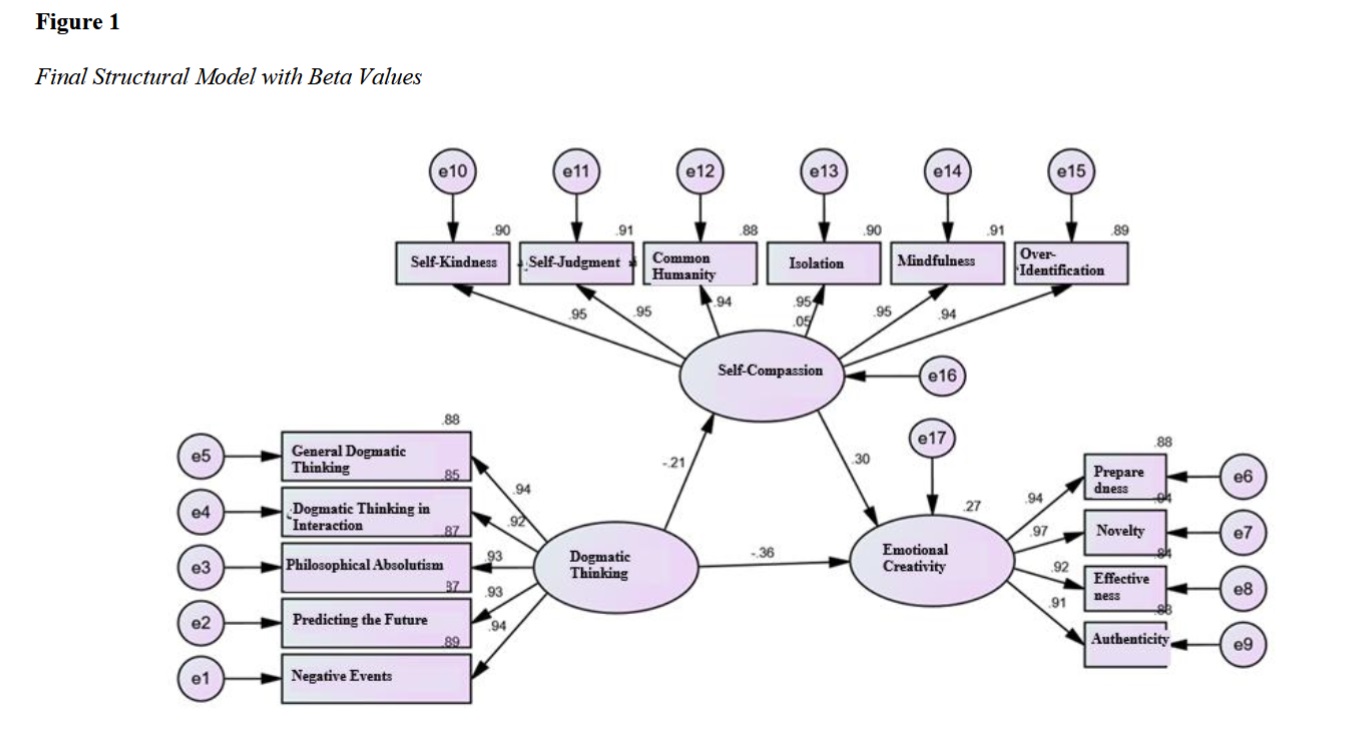
The aim of the present study was to examine the effect of dogmatic thinking on emotional creativity, considering the mediating role of self-compassion, among students at the Islamic Azad University, Neka Branch. This study was applied in terms of purpose. In terms of data collection, it was field-based, and regarding data gathering and analysis, it was descriptive and correlational, using a structural equation modeling approach. The statistical population included all students of the Islamic Azad University, Neka Branch, in the 2024–2025 academic year (N = 1,935). To determine the sample size, the Krejcie and Morgan table was used, and 321 students were selected through stratified random sampling based on academic level. The data collection instruments comprised three standard questionnaires: the Dogmatic Thinking Questionnaire by Younesi and Mirafzal (2008), the Emotional Creativity Questionnaire by Averill and Thomas-Knowles (1991), and the Self-Compassion Scale by Neff (2003). Data were analyzed in two parts: descriptive statistics (frequency, percentage, and charts) and inferential statistics (the Kolmogorov–Smirnov test and structural equation modeling) using SPSS and AMOS software. The results indicated that dogmatic thinking affects emotional creativity and self-compassion in students. In addition, self-compassion affects emotional creativity in students. Furthermore, the findings showed that self-compassion mediates the relationship between dogmatic thinking and emotional creativity in students.
Downloads
References
Altarawneh, A. F., & Alkhateeb, M. A. (2024). Common Misconceptions About Absolute Value and Related Thinking Strategies. Journal of Curriculum Studies Research, 6(2), 215-233. https://doi.org/10.46303/jcsr.2024.19
Anderson, T. R., & Miller, S. J. (2024). The role of Absolutist thinking in self-compassion: Implications for mental well-being. Journal of Positive Psychology, 19(1), 45-62.
Anic, A., & Dahlenburg, S. C. (2025). The Relationship Between Divergent Thinking, Emotional Regulation in the Arts, and Cognitive Reappraisal. Psychology of Aesthetics Creativity and the Arts. https://doi.org/10.1037/aca0000797
Averill, J. R., & Thomas-Knowles, C. (1991). Emotional creativity. In T. Strongman (Ed.), International Review of Studies on Emotion (pp. 269-299). Wiley.
Boeiry, I., Talebzadeh Shushtari, M., & Dasht Bozorgi, Z. (2024). Designing and testing a causal model of self-directed learning based on emotional creativity, critical thinking, and academic vitality with achievement motivation as a mediator. Journal of Psychological Sciences, 23(137), 1107-1128.
Casaló, L. V., Flavián, C., & Ibáñez-Sánchez, S. (2021). Be creative, my friend! Engaging users on Instagram by promoting positive emotions. Journal of Business Research, 130, 416-425. https://doi.org/10.1016/j.jbusres.2020.02.014
Chan, K. K. S., Lee, J. C. K., Yu, E. K. W., Chan, A. W., Leung, A. N. M., Cheung, R. Y., & Tse, C. Y. (2022). The impact of compassion from others and self-compassion on psychological distress, flourishing, and meaning in life among university students. Mindfulness, 13(6), 1490-1498. https://doi.org/10.1007/s12671-022-01891-x
Di Fabio, A., & Saklofske, D. H. (2021). The relationship of compassion and self-compassion with personality and emotional intelligence. Personality and individual differences, 169, 110109. https://doi.org/10.1016/j.paid.2020.110109
Hurabarat, Z. S., Riady, T., Amral, S., Sumiharti, S., Susanti, H., Saputra, T., & Taufan, A. (2023). Teaching practice program in college of education-creativity, emotional intelligence and locus of control. Jurnal Kependidikan, 9(1), 244-257. https://doi.org/10.33394/jk.v9i1.6416
Johnson, R. T., & Mitchell, K. L. (2023). The impact of Absolutist thinking on emotional creativity: A cognitive-emotional perspective. Journal of Creative Cognition, 15(2), 112-130.
Kotera, Y., Taylor, E., Fido, D., Williams, D., & Tsuda-McCaie, F. (2023). Motivation of UK graduate students in education: Self-compassion moderates pathway from extrinsic motivation to intrinsic motivation. Current Psychology, 42(12), 163-176. https://doi.org/10.1007/s12144-021-02301-6
Li, Y., & Wu, D. (2025). Creativity and Well-Being Among College Students: The Mediating Role of Meaning in Life. The Journal of psychology, 159(1), 1-16.
López, A., & Schroevers, M. J. (2018). Compassion for others and self-compassion: Levels, correlates, and relationship with psychological well-being. Mindfulness, 9(1), 325-331. https://doi.org/10.1007/s12671-017-0777-z
Matos, M., Duarte, C., & Pinto-Gouveia, J. (2021). Emotional creativity, self-compassion, and psychological well-being: A study of their interplay in coping with stress. Journal of Positive Psychology, 16(3), 250-262.
Mutiani, M., Supriatna, N., Wiyanarti, E., Alfisyah, A., & Abbas, E. W. (2021). Kuhnian's Paradigmatic Analysis Method As a Solution of Abstract Thinking Difficulties in Social Studies. Al-Ishlah: Jurnal Pendidikan, 13(3), 1653-1662. https://doi.org/10.35445/alishlah.v13i3.1046
Neff, K. D. (2003). Self-compassion: An alternative conceptualization of a healthy attitude toward oneself. Self and identity, 2, 85-101. https://doi.org/10.1080/15298860309032
Neff, K. D., & Tóth, I. (2022). Examining the mediating role of self-compassion in the relationship between emotional creativity and mental health outcomes. Mindfulness, 13(5), 987-998.
O'Donnell, K. J., & Michalak, J. (2020). Self-compassion moderates the relationship between Deterministic thinking and mental health outcomes. Mindfulness, 11(6), 1398-1408.
Onishchuk, I., Ikonnikova, M., Antonenko, T., Kharchenko, I., Shestakova, S., Kuzmenko, N., & Maksymchuk, B. (2020). Characteristics of foreign language education in foreign countries and ways of applying foreign experience in pedagogical universities of Ukraine. Revista Romaneasca pentru Educatie Multidimensionala, 12(3), 44-65. https://doi.org/10.18662/rrem/12.3/308
Pan, A. J., Lai, C. F., & Kuo, H. C. (2023). Investigating the impact of a possibility-thinking integrated project-based learning history course on high school students' creativity, learning motivation, and history knowledge. Thinking Skills and Creativity, 47, 101214. https://doi.org/10.1016/j.tsc.2022.101214
Pyszkowska, A., & Rönnlund, M. (2021). Psychological flexibility and self-compassion as predictors of well-being: Mediating role of a Deterministic thinking. Frontiers in psychology, 12. https://doi.org/10.3389/fpsyg.2021.671746
Robinson, P., & Taylor, C. (2023). The role of self-compassion in enhancing emotional creativity among university students. Journal of College Counseling, 26(2), 123-134.
Runco, M. A., & Pritzker, S. R. (2020). Encyclopedia of Creativity. Academic Press. https://doi.org/10.1016/B978-0-12-809324-5.23807-8
Sahu, P. (2020). Closure of universities due to coronavirus disease 2019 (COVID-19): Impact on education and mental health of students and academic staff. Cureus, 12(4). https://doi.org/10.7759/cureus.7541
Smith, J., & Rodriguez, M. (2021). Overcoming rigid thought patterns: The relationship between Absolutist thinking and self-compassion. Mindfulness and Personality Research, 8(3), 212-228.
Thompson, B., & Evans, L. (2020). Rethinking certainty: How flexible thinking fosters self-compassion and emotional resilience. Journal of Humanistic Psychology, 25(2), 98-115.
Tran, M. A. Q., Vo-Thanh, T., Soliman, M., Khoury, B., & Chau, N. N. T. (2022). Self-compassion, mindfulness, stress, and self-esteem among Vietnamese university students: Psychological well-being and positive emotion as mediators. Mindfulness, 13(10), 574-586. https://doi.org/10.1007/s12671-022-01980-x
Ukolova, L. I., Gribkova, O. V., Stolyarova, A. N., Shchetinina, N. N., Osipova, N. V., Akhmedova, J. U., & Emelyanenkova, A. V. (2020). The category of creativity in the formation of professional motivation of the teaching staff in the academic milieu of a higher education institution. Revista Turismo Estudos e Práticas(3), 1-11.
Younesi, J., & Mirafzal, A. (2007). Development of deterministic thinking questionnaire. Proceedings of the 10th European Congress of Psychology, Prague, Czech Republic.
Zahedi Moghaddam, R., & Doulikhani, L. (2025). Developing creative thinking, problem-solving, and teamwork skills through artificial intelligence projects. The Second National Conference on Humanities with a New Approach and the First International Research Conference of Modern Teachers, Astara.
Zalevskii, G. V. (2021). Fixed forms of behavior as excessively rigid behavior in normal and pathological individual and group systems. Psychology in Russia, 14(1), 3. https://doi.org/10.11621/pir.2021.0101
Downloads
Additional Files
Publication Timeline
- Submitted
- Revised
- Accepted