Comparison of the Effectiveness of Emotional Intelligence Training and Spiritual Intelligence Training on Executive Functions in Students with Learning Disorders
DOI:
https://doi.org/10.61838/kman.isn.psynexus.5077Keywords:
Emotional Intelligence, Spiritual Intelligence, Executive Functions, Learning DisabilityAbstract
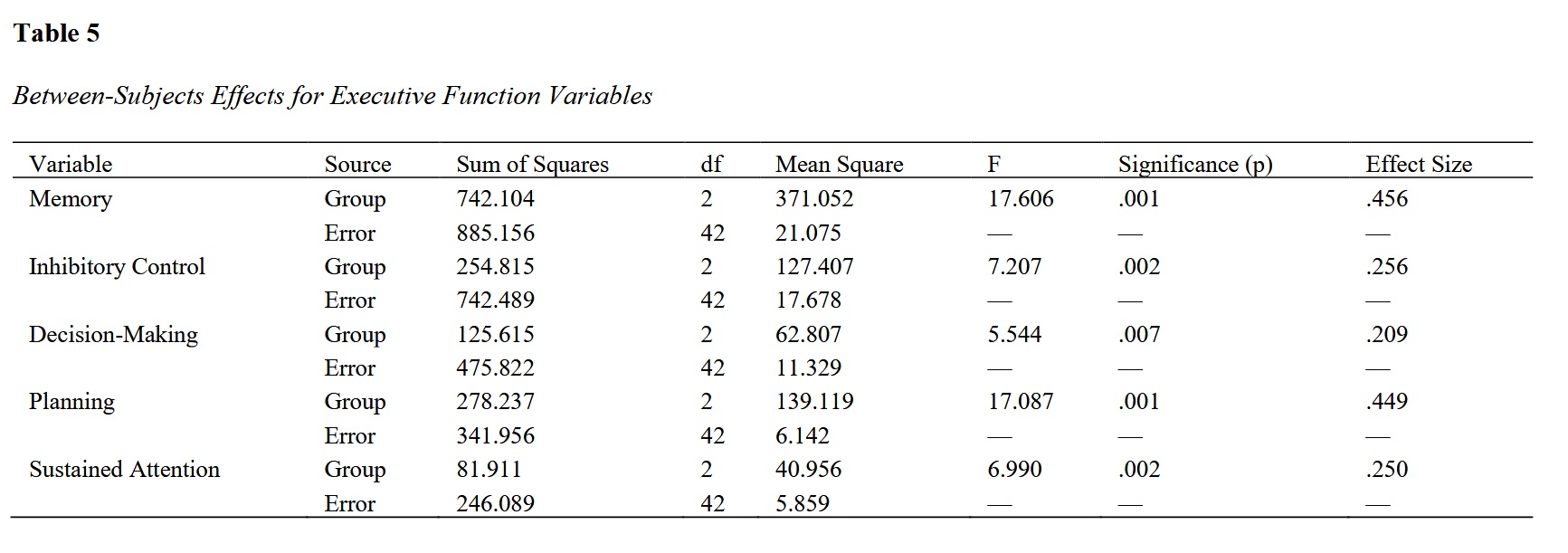
The present study was conducted with the aim of comparing the effectiveness of emotional intelligence training and spiritual intelligence training on executive functions in students with learning disorders. The present research was a quasi-experimental study with a pretest–posttest and follow-up design including a control group. The statistical population consisted of all students with learning disorders in Pishva, Varamin, who had referred to specialized learning disorder centers in Pishva, Varamin, in 2025; the research sample included 45 participants who were selected using convenience sampling and randomly assigned to two experimental groups and one control group, each consisting of 15 participants. The Nejati Cognitive Abilities Questionnaire (Nejati, 2013) was used for data collection. Multivariate analysis of variance (MANOVA) with repeated measures was used to analyze the data using SPSS software. The results indicated that there was a statistically significant difference between the effectiveness of emotional intelligence training and spiritual intelligence training on memory and sustained attention in students with learning disorders (p < .05). Emotional intelligence training resulted in significant improvements in memory, inhibitory control, decision-making, planning, and sustained attention scores (p < .05). Spiritual intelligence training resulted in significant improvements in memory and planning scores (p < .05). However, spiritual intelligence training did not have a statistically significant effect on inhibitory control, decision-making, or sustained attention scores (p > .05). Therefore, emotional intelligence training and spiritual intelligence training can be considered effective methods for improving executive functions in students with learning disorders.
Downloads
References
Abbaspour, Z., & Tavakhosh, A. M. (2024). The Effectiveness of Spiritual Intelligence Training on Mental Health in Older Men with COVID-19. Aging Psychology, 10(2), 143-129. https://doi.org/10.22126/jap.2024.10102.1750
Abdolreza pour, P., & Ghanbari, N. (2020). The effect of emotional intelligence and spiritual intelligence training on improving English language learners' performance in four skills. Journal of Educational Psychology Studies, 17(40), 76-97. https://www.sid.ir/paper/1037741/
Brady, A., Smith, J., & Lee, K. (2024). Neurocognitive underpinnings of specific learning disabilities: A review. Journal of Learning Disabilities, 57(3), 129-145. https://doi.org/10.1016/j.jld.2023.07.002
Brown, T., Miller, H., & Davis, R. (2024). Executive functions and their impact on adolescent social development. Developmental Psychology Journal, 42(1), 78-92. https://doi.org/10.2345/dpj.2024.42078
Cicotto, G. (2025). Spiritual Intelligence: A New Form of Intelligence for a Sustainable and Humane Future. Encyclopedia 2025, 5(3), 107. https://doi.org/10.3390/encyclopedia5030107
Clougher, D., Forte, M., Mezquid, G., & Balanzá-Martínez, V. (2024). Emotional intelligence and neurocognition profiles in first-episode psychosis: A two-year follow-up study. European Neuropsychopharmacology, 85, 66-77. https://doi.org/10.1016/j.euroneuro.2024.05.006
D'Angelo, R., Smith, J., & Lee, M. (2024). Cognitive assessment tools for specific learning disabilities: A critical review. Psychology in the Schools, 61(2), 178-192. https://doi.org/10.1002/pits.22823
Davis, L., Taylor, S., & Wright, M. (2024). The importance of executive functions in adolescent mental health. Journal of Clinical Child and Adolescent Psychology, 52(3), 188-200. https://doi.org/10.8901/jccap.2024.52367
Evans, D., & Brown, P. (2023). Ambiguity tolerance as a predictor of adolescent decision-making. Youth Behavior Journal, 44(1), 98-110. https://doi.org/10.6789/ybj.2023.44001
Fernández-Abascal, E. G., & Martín-Díaz, M. D. (2024). Emotional intelligence training and cognitive regulation in students with learning difficulties. Frontiers in psychology, 15(4), 2021-2033. https://doi.org/10.3389/fpsyg.2024.1456231
Fischer, C. (2019). Cognitive factors associated with emotional intelligence. International Psychogeriatrics, 31(9), 1229-1231. https://doi.org/10.1017/S1041610219000917
Fuchs, L. S., Fuchs, D., & Vaughn, S. (2024). Interventions for specific learning disabilities: Evidence-based approaches. Educational Psychologist, 59(4), 250-265. https://doi.org/10.1080/00461520.2024.1919331
Garcia, L., Zhang, X., & Lee, J. (2023). Executive functions and the role of parenting during adolescence. Journal of Child and Family Studies, 32(3), 243-255. https://doi.org/10.2346/jcfs.2023.32345
Gibson, K. A., Johnson, C. L., & Marks, S. (2023). Specific learning disabilities in early childhood: A growing concern. Early Childhood Education Journal, 51(5), 615-628. https://doi.org/10.1007/s10643-023-01536-z
Johnson, H., Lee, M., & White, T. (2025). The combined effects of emotional and spiritual intelligence training on executive functions in adolescent girls. Journal of Educational Research, 72(2), 245-260. https://doi.org/10.1080/00220671.2024.1806742
Johnson, L., & Wang, K. (2024). The role of executive functions in academic achievement during adolescence. Journal of Educational Psychology, 56(2), 121-134. https://doi.org/10.5678/jep.2024.56122
Jung, M., & Park, H. (2023). The development of executive functions across adolescence: A neurocognitive approach. Neuropsychology Review, 33(4), 405-420. https://doi.org/10.1234/npr.2023.33405
Kim, S., Lee, K., & Zhang, W. (2023). Genetic and environmental factors in executive function performance among adolescents. Cognitive Development Journal, 18(2), 145-159. https://doi.org/10.5672/cdj.2023.18245
Lee, J., & Park, M. (2023). Environmental influences on executive function development in adolescents. Youth Development Review, 28(4), 305-317. https://doi.org/10.9087/ydr.2023.28405
Mayer, J. D., Salovey, P., & Caruso, D. R. (2023). The Mayer-Salovey-Caruso Emotional Intelligence Test (MSCEIT). Emotional Intelligence Review, 31(4), 295-311. https://cms.jvrafricagroup.co.za/assets/documents/products/samples/msceit/sample-_-msceit-_-personal-summary-report.pdf
Miller, S., & Taylor, M. (2024). Cognitive flexibility and executive functions in adolescence. Adolescent Cognitive Development, 16(1), 105-119. https://doi.org/10.8765/acd.2024.16105
Moharrami, N., & Sardari, B. (2020). The effectiveness of emotional regulation skills training on executive functions in students with procrastination symptoms. Scientific Journal of Education and Evaluation, 13(49), 37-63. https://www.sid.ir/fa/VEWSSID/J_pdf/22613994902.pdf
Salehi Shablizi, M., Haji Yakhchali, A., Shahini Yilagh, M., & Maktabi, G. (2024). The effect and comparison of emotional intelligence and academic motivation training on academic engagement and academic performance of male students at Farhangian University of Khuzestan Province. Quarterly Journal of Experimental and Cognitive Psychology, 1(2), 24-34. http://193.36.85.187:9110/index.php/ecp/article/view/134
Salovey, P., & Mayer, J. D. (2023). Emotional intelligence. Imagination, Cognition, and Personality, 9(3), 185-211. https://doi.org/10.2190/DUGG-P24E-52WK-6CDG
Smith, A., Johnson, R., & Williams, P. (2023a). Adolescents' coping mechanisms and ambiguity tolerance. Journal of Adolescent Development, 55(3), 243-258. https://doi.org/10.1234/jad.2023.12345
Smith, A., Johnson, R., & Williams, P. (2023b). Executive functions in adolescence: A developmental perspective. Journal of Adolescent Psychology, 34(3), 233-247. https://doi.org/10.1234/jap.2023.23345
Wright, D., Evans, P., & Brown, K. (2024). Emotion regulation and executive function in adolescence: A longitudinal study. Journal of Emotional and Behavioral Disorders, 21(2), 98-110. https://doi.org/10.1111/jebd.2024.21210
Zohar, D., & Marshall, I. (2023). Spiritual intelligence: The ultimate intelligence. Journal of Contemporary Education, 23(1), 15-29. https://www.alisonmorgan.co.uk/Books/Zohar%202000.pdf
Downloads
Additional Files
Publication Timeline
- Submitted
- Revised
- Accepted