Determining the Difference in the Effectiveness of Cognitive Behavioral Therapy and Schema Therapy on Emotional Inhibition in Adolescents with High-Risk Behaviors
Keywords:
Emotional inhibition, cognitive behavioral therapy, schema therapy, high-risk behaviors, adolescentsAbstract
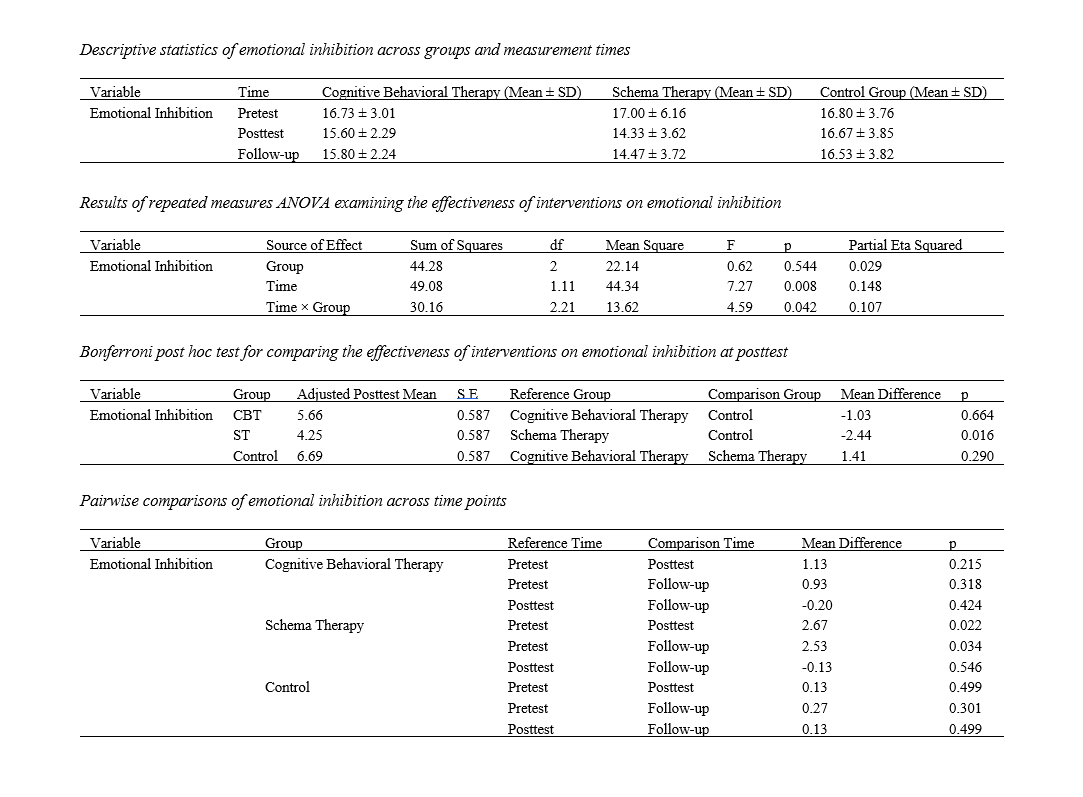
The present study aimed to determine the difference in the effectiveness of cognitive behavioral therapy and schema therapy on emotional inhibition in adolescents with high-risk behaviors. This applied study employed a quasi-experimental design with a pretest–posttest format including a control group and a two-month follow-up period. The statistical population consisted of adolescents with high-risk behaviors referred to counseling centers affiliated with the Department of Education in Karaj in 2025. Using purposive sampling, 45 participants who met the inclusion criteria were selected and randomly assigned into three groups: cognitive behavioral therapy (n = 15), schema therapy (n = 15), and control (n = 15). The experimental groups received eight sessions of structured interventions based on standardized therapeutic protocols, while the control group remained on a waiting list. Data were collected using the Emotional Inhibition Scale (EIS). Data analysis was conducted using SPSS-26 software at both descriptive and inferential levels, including repeated measures analysis of variance (ANOVA) and Bonferroni post hoc tests after verifying statistical assumptions. The results indicated that the main effect of group on emotional inhibition was not statistically significant (F = 0.62, p = 0.544), whereas the main effect of time was significant (F = 7.27, p = 0.008), indicating changes across measurement stages. Additionally, the interaction effect between time and group was significant (F = 4.59, p = 0.042), suggesting differential changes across groups over time. Bonferroni post hoc comparisons revealed that schema therapy significantly reduced emotional inhibition compared to the control group at posttest (p = 0.016), while cognitive behavioral therapy did not show a significant difference compared to the control group (p = 0.664). Within-group comparisons demonstrated significant improvements in the schema therapy group from pretest to posttest (p = 0.022) and follow-up (p = 0.034), whereas no significant changes were observed in the cognitive behavioral therapy and control groups (p > 0.05). The findings suggest that schema therapy is more effective than cognitive behavioral therapy in reducing emotional inhibition among adolescents with high-risk behaviors, with effects that are sustained over time, highlighting the importance of targeting deep cognitive-emotional structures in therapeutic interventions.
Downloads
References
Baramake, Z., Fadavi, M. S., & Yousefi, Z. (2024). Development of a Successful Intelligence Training Package Aimed at Reducing High-Risk Behaviors Especially for Teenagers. Journal of Psychological Dynamics in Mood Disorders (PDMD), 2(4), 101-114. https://doi.org/10.22034/pdmd.2024.444922.1054
Chalilorahman, E., & Yousefi, Z. (2019). Multiple Relationships of Maladjustment Schemas, Personality, and Family Relations with Alexithymia in Primary School Children [Research]. Quarterly Journal of Child Mental Health, 6(1), 124-137. https://doi.org/10.29252/jcmh.6.1.11
Hadiyan, N., Mottaghi, S., & Rezapour Mirsaleh, Y. (2023). Investigating the mediating role of maladaptive schemas and emotional expression in the relationship between childhood trauma and sexual intimacy in women from low-income families. Applied Family Therapy Journal (AFTJ), 4(5), 610-632. https://doi.org/10.61838/kman.aftj.4.5.35
Joharifard, M., Zahracar, K., Farokhi, N. a., & Mardani rad, M. (2021). The causal model of tendency to high-risk behaviors in adolescents based on metacognitive beliefs and identity styles with role mediating of negative repetitive thoughts and resilience. Counseling Culture and Psycotherapy, 12(47), 161-194. https://doi.org/10.22054/qccpc.2021.57166.2589
Khajevand, S., Bahrainian, A., Nasri, M., & Shahabizadeh, F. (2023). Investigating the effectiveness of metacognitive interpersonal therapy on the cognitive regulation of emotion and emotional inhibition in adolescents with high-risk behaviors. Journal of Cognitive Psychology, 11(4), 91-105. https://jcp.khu.ac.ir/article-1-3797-fa.pdf
Khodapanah, M., Sohrabi, F., Ahadi, H., & Taghi loo, S. (2018). The Structural Model of Brain- Behavioral Systems, Impulsivity ,Alexithymia and Cognitive Emotion Regulation with Eating Behavior. Iran-J-Health-Educ-Health-Promot, 6(3), 251-265. https://doi.org/10.30699/acadpub.ijhehp.6.3.251
Le Vigouroux, S., Bernat, K., & Charbonnier, E. (2023). Risk Factors and Consequences of Parental Burnout: Role of Early Maladaptive Schemas and Emotion-Focused Coping. Trends in Psychology. https://doi.org/10.1007/s43076-023-00288-6
Mayer, J., Smith, R., & Johnson, K. (2023). Impact of cognitive behavioral therapy on cognitive distortions in individuals with high-risk behaviors. Journal of Behavior Therapy, 45(3), 312-327.
Mirzaalian Dastjerdi, F. (2022). Predicting high-risk behaviors based on childhood maltreatment with the mediation of early maladaptive schemas in high school students. Journal of a New Approach to Children's Education, 4(3), 76-83. https://journal.iocv.ir/article_149551.html?lang=en
Mirzaei Fayyaz Abadi, S., Moulavi, E., & Taheri, N. (2019). The relationship between emotional regulation and cognitive inhibition in the tendency towards risky behaviors among adolescent girls in Mashhad. Journal of Social Psychology, 7(52), 123-136. https://www.noormags.ir/view/en/articlepage/1759391/
Mohammadi Hosseini Asl, F., Saken Azari, R., Abdoltajedini, P., & Aghdasi, A. N. (2022). The Role of Attachment Styles, Cognitive Emotion Regulation and Subjective Vitality in Predicting High-Risk Behaviors of Female Adolescents. Quarterly Journal of Child Mental Health, 9(3), 121-135. https://doi.org/10.52547/jcmh.9.3.11
Moshkabadi, E. G., Heydari, S., & Fakhri, M. (2024). Comparison of the Effectiveness of Cognitive Behavioral Training and Acceptance and Commitment Training on High-Risk Behaviors in Self-Injurious Adolescents. Jayps, 5(5), 126-135. https://doi.org/10.61838/kman.jayps.5.5.15
Nicol, A., Mak, A. S., Murray, K., & Kavanagh, P. S. (2021). Early maladaptive schemas in young people who self-injure. Journal of Clinical Psychology, 77(7), 1745-1762. https://doi.org/10.1002/jclp.23172
Pirani, Z. (2015). The Role of Behavioral activation/inhibition Systems and emotional, cognitive and behavioral engagement in prediction of educational exhaustion. Journal of School Psychology, 4(3), 7-22. https://doi.org/10.22098/jsp.2015.353
Pourroosta, A., Hamid, N., Bashlideh, K., & Hashemi, S. I. (2024). Comparison of the Effectiveness of Positive Psychology-Based Therapy and Cognitive-Behavioral Therapy on Internet Addiction and High-Risk Behaviors of Students. New Psychological Research, 19(73), 22-34. https://www.ensani.ir/fa/article/577237/
Pourshahabadi, F., & Einipour, J. (2020). The Effectiveness of Schema Therapy on Differentiation of Self and Emotional Control among Couples with Marital Maladjustment. International Journal of Applied Behavioral Sciences, 7(2), 18-29. https://doi.org/10.22037/ijabs.v7i2.28249
Rada, C., Gheonea, D., Ţieranu, C. G., & Popa, D. E. (2022). Diagnosis and Psychotherapeutic Needs by Early Maladaptive Schemas in Patients With Inflammatory Bowel Disease [Original Research]. Frontiers in psychology, 12. https://doi.org/10.3389/fpsyg.2021.807107
Reyhani, S., & Ahovan, M. (2024). The effectiveness of emotional schema therapy on regulating emotions and reducing high-risk behaviors in female adolescents. Journal of Research in Behavioural Sciences, 22(1), 137-149. https://doi.org/10.29252/rbs.22.1.137
Sabet, A. H., Nejad, S. N., & Khalatbari, J. (2016). Comparison of the Effect of Schema Therapy and Cognitive Group Therapy on Depression in Women Engaging in High-Risk Sexual Behaviors Who Were Referred to Hamadan Health Center. Avicenna Journal of Neuro Psych Physiology, 3(1). https://doi.org/10.17795/ajnpp-39755
Samsami, M., & Mohammadkhani, S. (2022). Cognitive emotion regulation strategies in students with high-risk behaviors: The mediating role of metacognitive beliefs. 9th International Conference on Knowledge and Technology of Educational Sciences, Social Studies and Psychology of Iran, Tehran.
Sefidrood, M., & Hobbi, M. B. (2023). The Role of Attachment Styles and Cognitive Emotion Regulation in Predicting the Tendency to High-Risk Behaviors in Adolescents. International Journal of Applied Behavioral Sciences, 10(1), 1-8. https://doi.org/10.22037/ijabs.v9i4.34259
Sharei, A., Kasaeei Esfahani, A., & Salmani, A. (2025). The Effect of Mindfulness Therapy on Emotion Regulation, Cognitive Self-Awareness, and Tendency to High-Risk Behaviors in Orphaned and Poorly Monitored Adolescents: A Quasi-Experimental Study. Journal of Rafsanjan University of Medical Sciences, 23(9), 812-827. https://doi.org/10.61186/jrums.23.9.812
Zarea, S., Ahi, Q., Vaziri, S. A. H., & Shahabizadeh, F. (2020). Sexual Schemas and High-Risk Sexual Behaviors in Female Students the Mediating Role of Cognitive Emotion Regulation. International Archives of Health Sciences, 7(4), 203-209. https://doi.org/10.4103/iahs.iahs_84_20
Downloads
Additional Files
Publication Timeline
- Submitted
- Revised
- Accepted