Comparison of the Effectiveness of Gestalt-Based Play Therapy and Parent-Centered Play Therapy on Academic Self-Efficacy among Female Students in the Second Cycle of Elementary School
Keywords:
Gestalt-based play therapy, parent-centered play therapy, academic self-efficacyAbstract
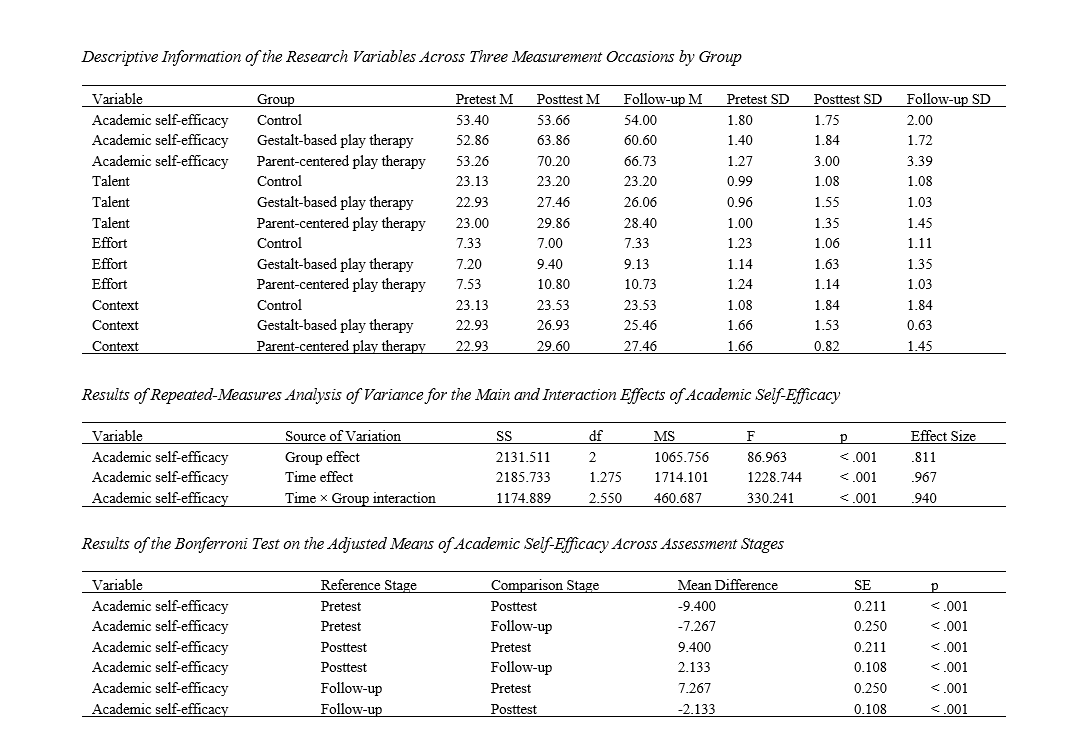
The present study aimed to compare the effectiveness of Gestalt-based play therapy and parent-centered play therapy on academic self-efficacy among female students in the second cycle of elementary school. The research method was quasi-experimental, using a pretest–posttest design with a control group and a two-month follow-up. The statistical population included female students in the second cycle of elementary school, aged 9 to 11 years, who were studying in public elementary schools in District 8 of Tehran during the 2024–2025 academic year. A total of 45 students were selected for two experimental groups and one control group, with 15 participants in each group, using convenience sampling, and responded to the Academic Self-Efficacy Questionnaire developed by Morgan and Jinks (1998). The results of repeated-measures analysis of variance and the Bonferroni post hoc test showed that Gestalt-based play therapy and parent-centered play therapy effectively improved academic self-efficacy among female students in the second cycle of elementary school (p ≤ .001). Gestalt-based play therapy showed a greater effect on increasing academic self-efficacy. Based on the findings, both approaches play valuable roles in supporting children’s psychological and academic development and have distinct strengths that can provide interventions tailored to specific therapeutic goals.
Downloads
References
Abood, M. H., Alharbi, B. H., Mhaidat, F., & Gazo, A. M. (2020). The relationship between personality traits, academic self-efficacy and academic adaptation among university students in Jordan. International Journal of Higher Education, 9(3), 120-128. https://doi.org/10.5430/ijhe.v9n3p120
Bahl, R., Gupta, S., Tanwar, K., Khan, Z., Hakak, I. A., & Amin, F. (2024). Locus of control, academic procrastination and academic performance amongst university students: Moderating role of parental involvement. Journal of Applied Research in Higher Education. https://doi.org/10.1108/JARHE-04-2024-0181
Cannavò, M., & Davì, S. (2025). Gestalt therapy and somatic symptom disorder: Clinical reflections on embodiment, contact, and relational field. The Journal of Humanistic Counseling. https://doi.org/10.1002/johc.70025
Cohen, A. (2024). Gestalt Therapy and Treatment of Trauma. In Experiential Therapies for Treating Trauma. https://doi.org/10.4324/9781003455851-3
Fatimah, S., Murwani, F. D., Farida, I. A., & Hitipeuw, I. (2024). Academic self-efficacy and its effect on academic engagement: Meta-analysis. International Journal of Instruction, 17(1), 271-294. https://doi.org/10.29333/iji.2024.17115a
Gebauer, M. M., McElvany, N., Bos, W., Koller, O., & Schober, C. (2020). Determinants of academic self-efficacy in different socialization contexts: Investigating the relationship between students' academic self-efficacy and its sources in different contexts. Social Psychology of Education, 23(2), 339-358. https://doi.org/10.1007/s11218-019-09535-0
Green, Z. A. (2022). Generalized self-efficacy shields on the negative effect of academic anxiety on academic self-efficacy during COVID-19 over time: A mixed-method study. Journal of School and Educational Psychology, 2(1), 44-59. https://doi.org/10.47602/josep.v2i1.17
Gunaydin, Y., & Zincir, H. (2024). The effect of child-parent relationship therapy-based play support on parental stress and acceptance, and child behaviours in children who witness domestic violence: Randomized controlled study. Australian and New Zealand Journal of Family Therapy, 45(3), 336-348. https://doi.org/10.1002/anzf.1579
Gutierrez, M., & Tomas, J. M. (2019). The role of perceived autonomy support in predicting university students' academic success mediated by academic self-efficacy and school engagement. Educational Psychology, 39(6), 729-748. https://doi.org/10.1080/01443410.2019.1566519
Hosseini, M., & Ashori, M. (2024). Effect of Child–parent Relationship Therapy on Emotion Regulation and Stress in Mothers of Deaf Children. International Journal of Play Therapy, 33(3), 117-128. https://doi.org/10.1037/pla0000219
Khine, M. S., & Nielsen, T. (2022). Current status of research on academic self-efficacy in education. In Academic Self-efficacy in Education: Nature, Assessment, and Research (pp. 3-8). https://doi.org/10.1007/978-981-16-8240-7_1
Li, L., Gao, H., & Xu, Y. (2020). The mediating and buffering effect of academic self-efficacy on the relationship between smartphone addiction and academic procrastination. Computers & Education, 159, 104001. https://doi.org/10.1016/j.compedu.2020.104001
Li, X., Xu, Y., Li, G., Ning, L., Xie, X., Shao, C., & Yang, X. (2024). The relationship between academic procrastination and anxiety symptoms among medical students during the COVID-19 pandemic: Exploring the moderated mediation effects of resilience and social support. BMC psychiatry, 24(1), 850. https://doi.org/10.1186/s12888-024-06202-3
Peterle, C. F., Fonseca, C. L., Freitas, B. H. B. M. D., Gaiva, M. A. M., Diogo, P. M. J., & Bortolini, J. (2022). Emotional and behavioral problems in adolescents in the context of COVID-19: A mixed method study. Revista latino-americana de enfermagem, 30(spe), e3744. https://doi.org/10.1590/1518-8345.6273.3744
Qu, G., Liu, H., Han, T., Zhang, H., Ma, S., Sun, L., & Sun, Y. (2024). Association between adverse childhood experiences and sleep quality, emotional and behavioral problems and academic achievement of children and adolescents. European Child & Adolescent Psychiatry, 33(2), 527-538. https://doi.org/10.1007/s00787-023-02185-w
Rahayu, W., Candra, H., & Sujadi, E. (2024). Academic procrastination among college students: Do learning awareness and self-management play a role? Edunesia: Jurnal Ilmiah Pendidikan, 5(3), 1430-1448. https://doi.org/10.51276/edu.v5i3.965
Shamsabadi, F., Mirzaian, B., & Abbasi, G. (2024). Comparison of the Effectiveness of Attachment-Based Play Therapy and Cognitive-Behavioral Therapy on Emotional Regulation and Quality of Life in Children with Separation Anxiety Disorder. KMAN Counseling & Psychology Nexus, 2(2), 220-229. https://journals.kmanpub.com/index.php/psychnexus/article/view/3488
Tavakoli, S., Abbasi, F., Heydari, B., & Akhondzadeh, M. (2024). Comparing the Effectiveness of Cognitive Behavioral Play Therapy and Gestalt Play Therapy on Vandalistic Behaviors, Impulsivity, and Cognitive Flexibility in Aggressive Male Elementary Students. Journal of Assessment and Research in Applied Counseling (JARAC), 6(3), 28-36. https://doi.org/10.61838/kman.jarac.6.3.4
Wonders, L. L., & Affee, M. L. (2024). Play Therapy Treatment Planning with Children and Families: A Guide for Mental Health Professionals. Taylor & Francis. https://doi.org/10.4324/9781003334231
Downloads
Additional Files
Publication Timeline
- Submitted
- Revised
- Accepted