The Effectiveness of Schema Therapy on Fear of Negative Evaluation and Cognitive Flexibility in Adolescents
Keywords:
Schema therapy, fear of negative evaluation, cognitive flexibility, adolescentsAbstract
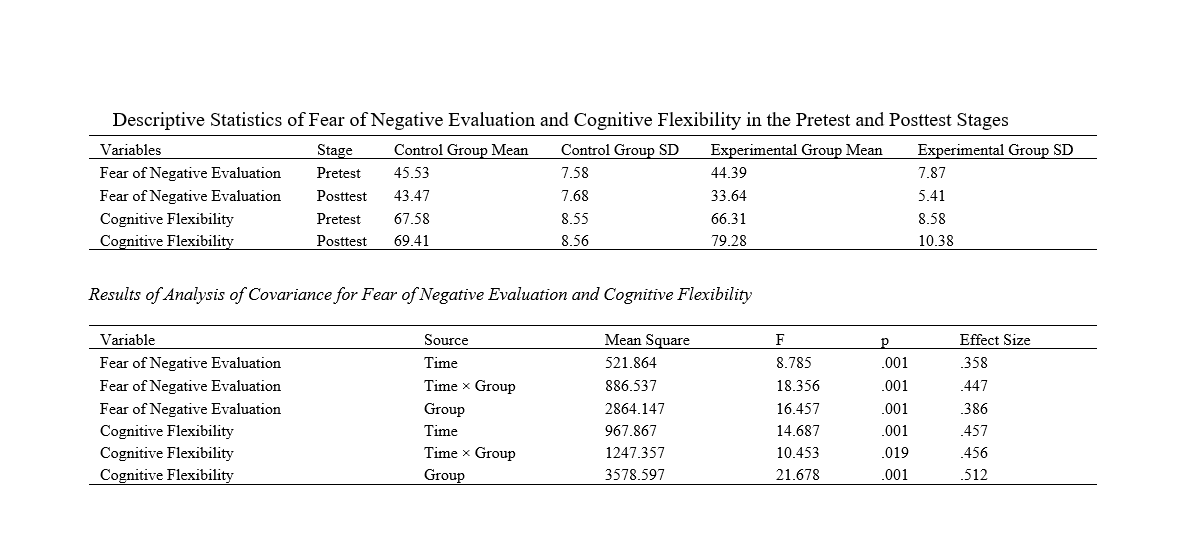
The present study aimed to investigate the effectiveness of schema therapy on fear of negative evaluation and cognitive flexibility in adolescents. The research method was quasi-experimental with a pretest–posttest design and a control group. The statistical population of this study consisted of adolescents who referred to counseling centers in the city of Tehran in 2026. Using convenience sampling, 30 participants were selected as the sample and were randomly assigned into two groups: 15 participants in the experimental group and 15 participants in the control group. Data were collected using the Fear of Negative Evaluation Questionnaire and the Cognitive Flexibility Questionnaire. Subsequently, the participants in the experimental group received schema therapy intervention for 10 sessions of 90 minutes each, while the control group received no intervention. After completion of the sessions, both groups were reassessed using the posttest. The findings indicated that there was a significant difference between the mean scores of fear of negative evaluation and cognitive flexibility in adolescents between the pretest and posttest stages in the experimental and control groups. Therefore, schema therapy was found to have a significant effect on fear of negative evaluation and cognitive flexibility in adolescents.
Downloads
References
Ahanian Moghaddam, P., Atashpour, S. H., & Golparvar, M. (2025). Comparing the Effectiveness of Combined Schema Therapy and Mindfulness With Schema Therapy and CBT on Psychological Flexibility. Practice in Clinical Psychology. https://jpcp.uswr.ac.ir/article-1-950-en.html
Badihi Zeraati, F., Hasani, J., & Ghasemi, M. (2020). Investigating the relationship between behavioral brain system activity and illness anxiety with the mediating role of cognitive flexibility. Journal of Sabzevar University of Medical Sciences, 29(1), 36-50.
Bagheri, F., Sharifi Pourchokami, Z., Tajbakhsh, K., Hamidemoghadam, A., & Haji Alipani, V. (2021). The relationship of social networks, cognitive flexibility, and anxiety sensitivity in predicting coronaphobia among students. Psychological Achievements of Shahid Chamran University of Ahvaz, 29(1), 209-228.
Bayanloo, A., & Jafari Harandi, R. (2021). The role of fear of negative evaluation by others in predicting dimensions of students' creativity. Knowledge and research in applied psychology, 25(3), 120-128.
Beheshtian, E., Toozandehjani, H., & Saffarian Toosi, M. (2019). Comparing the effectiveness of single-process cognitive behavioral therapy and behavioral activation on fear of negative evaluation in individuals with generalized anxiety disorder. Applied Psychological Research Quarterly, 10(4), 101-110.
Bekaian, M., Bolghanabadi, M., Asghari Nekah, S. M., & Bagherzadeh Golmakani, Z. (2021). Comparing the effectiveness of psychodrama and group cognitive behavioral therapy on fear of negative evaluation, self-focused attention, and self-criticism in students with social anxiety. Journal of Psychology, 25(4), 571-581.
Chalabianloo, G., & Parvaz, R. (2022). The role of temperament dimensions, rumination, cognitive flexibility, and trait anxiety in predicting depressed mood. Psychological studies, 18(1), 11-24.
Deh Nabi, A., & Radsepehr, H. (2017). The effectiveness of cognitive behavioral group therapy on body image concern and improvement of cognitive flexibility among women. Journal of Sabzevar University of Medical Sciences, 8(3), 146-155.
Doustkam, M., Pourheidari, S., Karimi Sadr, F., & Hosseini, S. A. (2021). The effectiveness of single-process cognitive behavioral therapy on facial interpretation bias and fear of negative evaluation in students with paranoid traits. Psychological Achievements of Shahid Chamran University of Ahvaz, 28(1), 91-110.
Efe, Y. S., & Erden, E. (2018). A comparison of aggression and self-injury among type 1 diabetic and healthy adolescents: A sample from Turkey. Archives of Psychiatric Nursing, 32(2), 174-179.
Fattahi, A. A., & Dehghani, A. (2018). The effectiveness of schema therapy on emotional regulation, self-efficacy, and craving in men. Addiction Research, 12(48), 185-202.
Kellogg, S. H., & Young, J. E. (2018). Schema therapy for borderline personality disorder. Journal of Clinical Psychology, 62(4), 445-458.
Khamarniya, G., Zarei, S., Farahabadi, M., Amirsasan, Y., Mirmasoumi, M. S., & Arkani, E. (2024). The effectiveness of schema therapy on self-worth and cognitive flexibility in women with bulimia nervosa. Rehabilitation Research in Nursing, 11(2), 88-98. https://ijrn.ir/article-1-883-en.pdf
Lucero, M., Satz, S., Miceli, R., Swartz, H. A., & Manelis. (2022). The effects of mood disorders and childhood trauma on fear of positive and negative evaluation. Acta Psychologica, 227, 103603.
Neufeld, C. B., Palma, P. C., Santos, K. A., Brust-Renk, G., Curtiss, J., & Hofmann, S. G. (2020). A randomized clinical trial of group and individual cognitive-behavioral therapy approaches for social anxiety disorder. International Journal of Clinical and Health Psychology, 20, 29-37.
Panahifar, S., Yousefi, N., & Amani, A. (2018). The effectiveness of schema-focused couple therapy on modifying early maladaptive schemas and increasing adjustment among couples seeking divorce. Fifth International Conference on Psychology, Educational Sciences, and Lifestyle, Tehran.
Regina, G., Carvajal-Velez, L., Emmanuel, A., Azzopardi, P., Baltag, V., & Dastgiri, S. (2023). The importance of mental health measurement to improve global adolescent health. Journal of Adolescent Health, 72, S3-S6.
Samadi Taher Gourabi, M., & Shakerinia, I. (2021). The effectiveness of neurofeedback on working memory and cognitive flexibility in patients with mild depression. Journal of Guilan University of Medical Sciences, 30(4), 290-302.
Schaap, G. M., Chakhssi, F., & Westerhof, G. J. (2021). Inpatient schema therapy for nonresponsive patients with personality pathology: Changes in symptomatic distress, schemas, schema modes, coping styles, experienced parenting styles, and mental well-being. Psychotherapy, 53(4), 402-412.
Sebastião, R., & Neto, D. D. (2024). Stress and mental health: The role of emotional schemas and psychological flexibility in the context of COVID-19. Journal of Contextual Behavioral Science, 100736. https://doi.org/10.1016/j.jcbs.2024.100736
Sempertegui, G. A., Karreman, A., Arntz, A., & Bekker, M. H. (2018). Schema therapy for borderline personality disorder: A comprehensive review of its empirical foundations, effectiveness and implementation possibilities. Clinical psychology review, 33(3), 426-447.
Sistani Pour, N., Asghari Ebrahim Abad, M. J., & Ghanbari Hashem Abadi, B. (2024). The effectiveness of group emotional schema therapy on balancing dark personality traits, increasing flourishing, and cognitive flexibility in female heads of households. Clinical Psychology Studies, 14(53), 1-18. https://jcps.atu.ac.ir/article_17013.html
Tomiyama, H., Nakao, T., Murayama, K., Nemoto, K., Ikari, K., Yamada, S., Kuwano, M., Hasuzawa, S., Togao, O., Hiwatashi, A., & Kanba, S. (2019). Dysfunction between dorsal caudate and salience network associated with impaired cognitive flexibility in obsessive-compulsive disorder: A resting-state fMRI study. NeuroImage: Clinical, 24, 102004.
Vakili, K. (2022). Effect of membership in social networks and mental rumination on cognitive flexibility of university students. Human Information Interaction, 9(1), 34-47.
Valizadeh, S., Makvandi, B., Bakhtiyarpour, S., & Hafezi, F. (2020). The effectiveness of cognitive behavioral therapy on cognitive flexibility among prisoners. Journal of psychiatric nursing, 8(4), 1-9.
Van Wijk-Herbrink, M. F. (2018). Schema therapy in adolescents with externalizing behavior problems: Bridging theory and practice Amsterdam University].
Young, J. E., Klosko, J. S., & Weishaar, M. E. (2022). Schema therapy: A practical guide for clinical specialists (H. Hamidpour & Z. Andooz, Trans.; Vol. 1). Arjmand Publications.
Young, R., Len-Rios, M., & Young, H. (2017). Romantic motivations for social media use, social comparison, and online aggression among adolescents. Computers in human Behavior, 75, 385-395.
Zhang, S., Liu, Q., Jia, M., Zhang, Q., & Zhang, L. (2025). The Predictive Roles of Self-Compassion, Perceived Social Support, and Psychological Flexibility in Early Maladaptive Schemas Among College Students: An Exploration Based on Latent Profile Analysis. Frontiers in psychology, 16. https://doi.org/10.3389/fpsyg.2025.1619308
Downloads
Additional Files
Publication Timeline
- Submitted
- Revised
- Accepted