Design and Validation of a Trauma-Informed Curriculum Model for Enhancing Resilience and Mental Health among Students in Post-Crisis Conditions
Keywords:
Trauma-informed curriculum, resilience, mental health, post-crisis education, psychosocial support, school climate, emotional safety, studentsAbstract
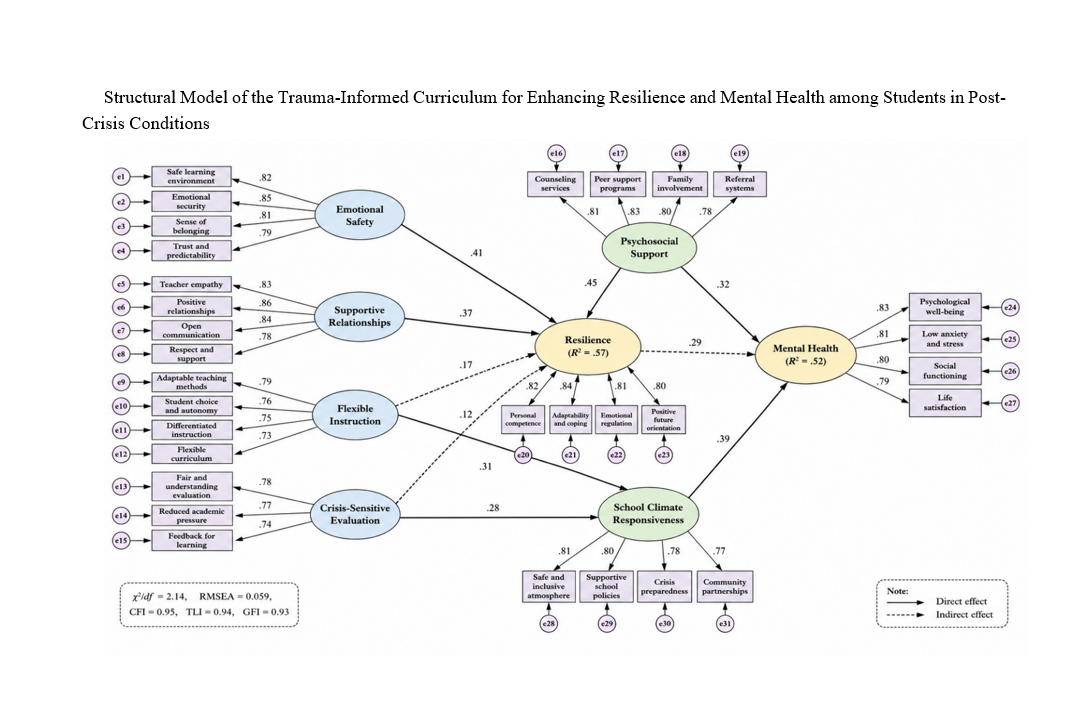
The present study aimed to design and validate a trauma-informed curriculum model for enhancing resilience and mental health among students in post-crisis educational conditions. The study was conducted using a mixed-methods exploratory sequential design in Tehran during the 2025–2026 academic year. In the qualitative phase, semi-structured interviews were conducted with 18 experts in curriculum planning, educational psychology, counseling, and crisis intervention selected through purposeful sampling until theoretical saturation was achieved. The qualitative data were analyzed using thematic analysis to identify the dimensions and components of the trauma-informed curriculum model. In the quantitative phase, the proposed model was validated among 312 educational professionals, including teachers, counselors, school administrators, and curriculum specialists selected through multistage cluster sampling. Data collection instruments included the Connor–Davidson Resilience Scale, the General Health Questionnaire, and a researcher-developed Trauma-Informed Curriculum Questionnaire derived from the qualitative findings. Descriptive statistics, exploratory factor analysis, confirmatory factor analysis, and structural equation modeling were conducted using IBM SPSS Statistics and AMOS software. The findings demonstrated that the proposed trauma-informed curriculum model possessed acceptable construct validity and strong structural fit indices (χ²/df = 2.14, RMSEA = 0.059, CFI = 0.95, GFI = 0.93). Exploratory factor analysis extracted seven dimensions including emotional safety, supportive teacher–student relationships, flexible instructional practices, crisis-sensitive evaluation, psychosocial support systems, resilience-building educational activities, and school climate responsiveness, explaining 68.47% of the total variance. Structural equation modeling revealed that psychosocial support (β = 0.45), emotional safety (β = 0.41), and supportive relationships (β = 0.37) significantly predicted student resilience. In addition, school climate responsiveness (β = 0.39), flexible instruction (β = 0.31), and crisis-sensitive evaluation (β = 0.28) significantly predicted mental health outcomes. The overall model explained 57% of the variance in resilience and 52% of the variance in mental health among students in post-crisis conditions. The findings indicate that trauma-informed curriculum design can function as an effective educational and psychosocial framework for strengthening resilience and promoting mental health among students exposed to crises and traumatic experiences. The integration of emotionally supportive environments, psychosocial services, flexible pedagogical practices, and responsive school climates into curriculum structures may significantly improve students’ psychological adaptation and educational functioning during post-crisis recovery. The study highlights the necessity of incorporating trauma-informed principles into educational policy, curriculum development, teacher training, and school support systems to enhance the long-term well-being of students in increasingly crisis-prone societies.
Downloads
References
Atkinson, L. J., & Fowler, T. A. (2023). Roles of Schools and Educators in Supporting Resilience in Young Children After Disasters. Cjem, 3(2). https://doi.org/10.25071/3jdffs41
Ayık, Y., Kaya, H., Sarışahin, S., Öztürk, B., & Kayıhan, H. (2025). Examination of the Mental Health Status of University Students Directly or Indirectly Affected by the Earthquake. British Journal of Occupational Therapy, 88(10), 647-662. https://doi.org/10.1177/03080226251347192
Baek, S. (2025). Resilience as a Predictor of Indirect Trauma Among Korean Adolescents: A Cross-Sectional Correlational Study. Healthcare, 13(19), 2491. https://doi.org/10.3390/healthcare13192491
Basistha, B. (2025). Climate Change and Mental Health in India: A Narrative Review of Vulnerabilities, Impacts, and Resilience Pathways. Frontiers in Public Health, 13. https://doi.org/10.3389/fpubh.2025.1686876
Beckstein, A., Chollier, M., Kaur, S., & Ghimire, A. R. (2022). Mental Wellbeing and Boosting Resilience to Mitigate the Adverse Consequences of the COVID-19 Pandemic: A Critical Narrative Review. Sage Open, 12(2). https://doi.org/10.1177/21582440221100455
Bikar, S. S., Rathakrishnan, B., Kamaluddin, M. R., Nasir, N. C. M., & Nasir, M. A. M. (2021). Social Sustainability of Post-Disaster: How Teachers Enable Primary School Students to Be Resilient in Times of Ranau Earthquake. Sustainability, 13(13), 7308. https://doi.org/10.3390/su13137308
Capurso, M., Stasio, S. D., & Ragni, B. (2022). Universal Crisis Psychoeducational Interventions in Schools: A Scoping Review. School Psychology International, 43(4), 339-380. https://doi.org/10.1177/01430343221104986
Cogorno, L., Smithbauer, S., Beck, C., & Zaporozhets, O. (2023). The Contributing Factors for Psychology Students Continuing Higher Education Amid War. Continuing Professional Education Theory and Practice, 18-31. https://doi.org/10.28925/1609-8595.2023.4.2
Dass-Brailsford, P., Patel, V., & Brailsford, K. W. (2025). A Systematic Review of Child/Adolescent Programs and Interventions Post-Hurricane Katrina: 2005–2025. Traumatology an International Journal. https://doi.org/10.1037/trm0000611
Ellis, É. M. (2025). Trauma‐Informed Climate Education in Couple and Family Therapy Training and Supervision. Australian and New Zealand Journal of Family Therapy, 46(4). https://doi.org/10.1002/anzf.70043
Fan, J., Huang, Y., Yang, F., Cheng, Y., & Yu, J. (2024). Psychological Health Status of Chinese University Students: Based on Psychological Resilience Dynamic System Model. Frontiers in Public Health, 12. https://doi.org/10.3389/fpubh.2024.1382217
Ford‐Paz, R. E., Santiago, C. D., Bustos, Y., Uriarte, J., Distel, L. M. L., Ros, A. M., Coyne, C. A., Rivera, C., Guo, S., Rusch, D., Jean, N. S., Hilado, A., Zarzour, H., Gómez, R. R., & Cicchetti, C. (2023). Acceptability and Initial Promise of Trainings for Community Stakeholders Serving Refugee and Immigrant Families. Psychological Services, 20(1), 188-201. https://doi.org/10.1037/ser0000457
Fu, Q., & Zhang, X. (2024). Promoting Community Resilience Through Disaster Education: Review of Community-Based Interventions With a Focus on Teacher Resilience and Well-Being. PLoS One, 19(1), e0296393. https://doi.org/10.1371/journal.pone.0296393
Fuchs, R., Glaude, M., Hansel, T. C., Osofsky, J. D., & Osofsky, H. J. (2021). Adolescent Risk Substance Use Behavior, Posttraumatic Stress, Depression, and Resilience: Innovative Considerations for Disaster Recovery. Substance Abuse, 42(3), 358-365. https://doi.org/10.1080/08897077.2020.1784357
Gibbs, L., Marinković, K., Nursey, J., Tong, L., Tekin, E., Ulubaşoğlu, M., Callard, N., Cowlishaw, S., & Cobham, V. E. (2021). Child and Adolescent Psychosocial Support Programs Following Natural Disasters—a Scoping Review of Emerging Evidence. Current psychiatry reports, 23(12). https://doi.org/10.1007/s11920-021-01293-1
Gkatsa, T. (2023). A Systematic Review of Psychosocial Resilience Interventions for Children and Adolescents in the COVID-19 Pandemic Period. Journal of School and Educational Psychology, 3(1), 34-48. https://doi.org/10.47602/josep.v3i1.35
GÖK, M. Ş., Aydın, A., Baga, Y., & Çiftçi, B. (2024). The Relationship Between the Psychological Resilience and General Health Levels of Earthquake Survivor Nursing Students in Kahramanmaras Earthquakes, the Disaster of the Century. Journal of Community Psychology, 52(3), 498-511. https://doi.org/10.1002/jcop.23110
Lalani, N., Drolet, J., McDonald‐Harker, C., Brown, M., Brett-MacLean, P., Agyapong, V. I. O., Greenshaw, A. J., & Silverstone, P. H. (2021). Nurturing Spiritual Resilience to Promote Post-Disaster Community Recovery: The 2016 Alberta Wildfire in Canada. Frontiers in Public Health, 9. https://doi.org/10.3389/fpubh.2021.682558
Li, G., Shi, W., Gao, X., Shi, X., Feng, X., Liang, D., Li, C., Phillips, M. R., & Hall, B. J. (2024). Mental Health and Psychosocial Interventions to Limit the Adverse Psychological Effects of Disasters and Emergencies in China: A Scoping Review. The Lancet Regional Health - Western Pacific, 45, 100580. https://doi.org/10.1016/j.lanwpc.2022.100580
Mansha, S., & Khanam, A. (2023). An Exploration of Trauma Handling Techniques Perceived by School Psychologists to Train Preservice Teachers. Review of Education Administration and Law, 6(2), 481-500. https://doi.org/10.47067/real.v6i2.347
McCarty, S., Pacqué, K., Gatto, A. J., Hill, K., & Charak, R. (2022). Youth-Led Resilience Promotion During Disaster Recovery: A Proposed Framework, Innovative Program, and Lessons Learned. Psychological Trauma Theory Research Practice and Policy, 14(S1), S32-S40. https://doi.org/10.1037/tra0001142
Montgomery, C. A. (2025). Preparing Social Workers to Respond to Emergencies and Human- Made Disasters: Introducing Essential Elements of Disaster Mental Health in MSW Education. https://doi.org/10.21203/rs.3.rs-7624064/v1
Orengo‐Aguayo, R., Stewart, R. W., Tania del Mar Rodríguez, S., & Gonzalez, K. (2024). Creating Trauma and Disaster Informed Schools and Systems of Care for Underserved Youth Through Mental Health Awareness Training in Puerto Rico. https://doi.org/10.21203/rs.3.rs-4001178/v1
Parrott, E., Bernardino, A., Lomeli-Rodriguez, M., Burgess, R., Rahman, A., Direzkia, Y., & Joffé, H. (2023). Community Resilience After Disasters: Exploring Teacher, Caregiver and Student Conceptualisations in Indonesia. Sustainability, 16(1), 73. https://doi.org/10.3390/su16010073
Schuermann, H. (2023). Trauma-Informed Strategies for Rural Schools. Theory & Practice in Rural Education, 13(2), 29-50. https://doi.org/10.3776/tpre.2023.v13n2p29-50
Shabahang, R., Arena, A., Navis, I., Kuhls, D. A., Newton, C., & Burke, R. V. (2025). Factors Associated With Resilience in Children During a Disaster: A Scoping Review. Disaster Medicine and Public Health Preparedness, 19. https://doi.org/10.1017/dmp.2024.341
Shervington, D., Richardson, L., & Green, J. (2021). Educators as Essential Workers in the Era of COVID-19: Applying Lessons From Disaster Recovery. 1(1). https://doi.org/10.33696/mentalhealth.1.004
Strauven, S., Dennison, M., O’Donnell, M., Cowlishaw, S., Gibson, K., Pedder, D. J., Baur, J., Nursey, J., & Cobham, V. E. (2024). A Pilot Study of a Brief and Scalable Psychosocial Intervention for Children and Adolescents Following Disasters. British Journal of Clinical Psychology, 64(1), 6-35. https://doi.org/10.1111/bjc.12484
Tyas, A. P. M., Mardhika, A., Qona’ah, A., Susanto, J., & Ilkafah, I. (2023). Empowerment of Elementary School Teachers on Psychosocial Structured Activities (PSSA). Abdimas Jurnal Pengabdian Masyarakat Universitas Merdeka Malang, 8(1), 154-164. https://doi.org/10.26905/abdimas.v1i1.8862
Wahab, S., Yong, L. L., Chieng, W. K., Yamil, M., Sawal, N. A., Abdullah, N. Q., Rahmawati, C., Wiredarma, S. M. W., Ismail, R., Othman, A. H., & Damanhuri, H. A. (2021). Post-Traumatic Stress Symptoms in Adolescents Exposed to the Earthquake in Lombok, Indonesia: Prevalence and Association With Maladaptive Trauma-Related Cognition and Resilience. Frontiers in Psychiatry, 12. https://doi.org/10.3389/fpsyt.2021.680393
Walton, A. A., Marr, J., Cahillane, M. J., & Bush, K. F. (2021). Building Community Resilience to Disasters: A Review of Interventions to Improve and Measure Public Health Outcomes in the Northeastern United States. Sustainability, 13(21), 11699. https://doi.org/10.3390/su132111699
Wang, J. (2024). Impact of Natural Disasters on Student Enrollment in Higher Education Programs: A Systematic Review. Heliyon, 10(6), e27705. https://doi.org/10.1016/j.heliyon.2024.e27705
Xu, Y., Ni, Y., Yang, J., Wu, J., Lin, Y., Li, J., Zeng, W., Zeng, Y., Huang, D., Wu, X., Shao, J., Li, Q., & Zhu, Z. (2024). The Relationship Between the Psychological Resilience and Post-Traumatic Growth of College Students During the COVID-19 Pandemic: A Model of Conditioned Processes Mediated by Negative Emotions and Moderated by Deliberate Rumination. BMC psychology, 12(1). https://doi.org/10.1186/s40359-024-01853-z
Марковиќ, М., & Серафимовска, Е. (2023). Mental Health Resilience in the Journalism Curriculum. Journalism & Mass Communication Educator, 78(2), 233-250. https://doi.org/10.1177/10776958231153260
Downloads
Additional Files
Publication Timeline
- Submitted
- Revised
- Accepted