The Effectiveness of Schema Therapy on Body Image, Suicidal Ideation, and Psychological Distress in Individuals Seeking Cosmetic Surgery: A Quasi-Experimental Study
Keywords:
body image, psychological distress, cosmetic surgery, schema therapy, suicidal ideation.Abstract
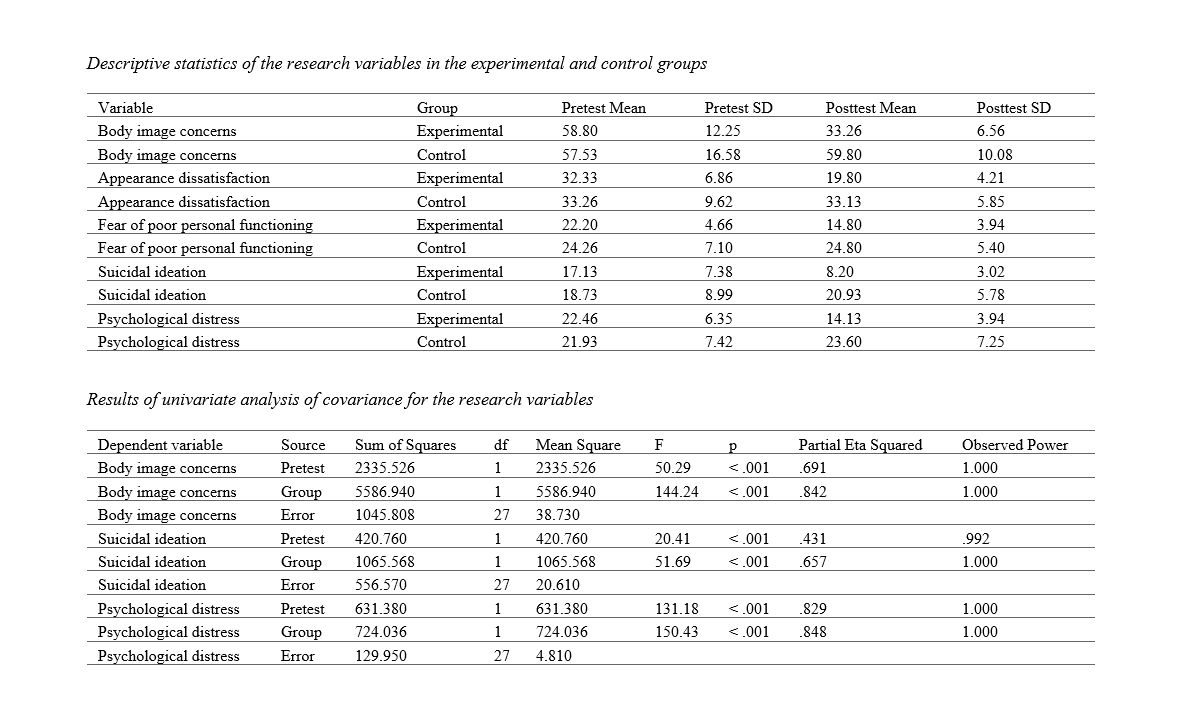
This study aimed to determine the effectiveness of schema therapy on body image, suicidal ideation, and psychological distress among individuals applying for cosmetic surgery. This quasi-experimental study used a pretest–posttest design with a control group. The statistical population included individuals applying for cosmetic surgery who referred to Afra Counseling Center in Isfahan, Iran, in 2024. Thirty eligible participants were selected through convenience sampling and randomly assigned to an experimental group and a control group, with 15 participants in each group. The experimental group received schema therapy in twelve 90-minute sessions, while the control group received no intervention during the study period. Data were collected using the Body Image Concern Inventory, the Beck Scale for Suicide Ideation, and the Psychological Distress Questionnaire. Data were analyzed using multivariate and univariate analysis of covariance. The results of multivariate analysis of covariance showed a significant overall effect of group on the combined dependent variables after controlling for pretest scores, Pillai’s trace = .902, F(3, 23) = 70.92, p < .001, η² = .902. The results of univariate analysis of covariance indicated significant differences between the experimental and control groups in body image concerns, F(1, 27) = 144.24, p < .001, η² = .842; suicidal ideation, F(1, 27) = 51.69, p < .001, η² = .657; and psychological distress, F(1, 27) = 150.43, p < .001, η² = .848. These findings demonstrated that schema therapy significantly reduced body image concerns, suicidal ideation, and psychological distress in the experimental group compared with the control group. Schema therapy appears to be an effective psychological intervention for improving body image and reducing suicidal ideation and psychological distress among individuals applying for cosmetic surgery. These findings support the use of schema-based interventions as part of psychological assessment and counseling programs for cosmetic surgery applicants.
Downloads
References
Babaei, Z., Mansoubifar, M., Sabet, M., Borjali, M., & Mashayekh, M. (2021). Comparing the effectiveness of cognitive-behavioral therapy and mindfulness on distress tolerance and suicidal thoughts in adolescents with suicidal ideation. Journal of Clinical Psychology, 13(4), 41-52.
Bach, B., Lockwood, G., & Young, J. E. (2024). A new look at schema therapy: Theory, clinical applications, and evidence. Journal of Contemporary Psychotherapy, 54(1) 1-12. https://doi.org/10.1007/s10879-023-09561-4
Bayat, M., Basharpoor, S., Aghajani, S., & Mikaeili, N. (2025). Comparison of the Effectiveness of Emotional Schema Therapy and Acceptance and Commitment Therapy on Distress Tolerance and Emotion Regulation Difficulties in Individuals with Major Depressive Disorder. Journal of Psychological Science, 24(150), 59-81.
Chu, C., Buchman-Schmitt, J. M., & Joiner, T. E. (2023). The interpersonal theory of suicide: Recent developments and future directions. Current opinion in psychology, 45, 101287. https://doi.org/10.1016/j.copsyc.2022.101287
Dakanalis, A., Carra, G., & Clerici, M. (2023). Psychological distress and body image dissatisfaction: A systematic review. Journal of affective disorders, 320, 252-260. https://doi.org/10.1016/j.jad.2022.09.123
Griffiths, S., Murray, S. B., & Touyz, S. (2023). Body image and mental health. The Lancet Psychiatry, 10(3), 189-200. https://doi.org/10.1016/S2215-0366(22)00410-5
Honigman, R., Phillips, K. A., & Castle, D. J. (2024). A review of psychosocial outcomes for patients seeking cosmetic surgery. Clinical psychology review, 105, 102331. https://doi.org/10.1016/j.cpr.2023.102331
Karami Mohajeri, Z., Karbalaei Harafteh, F., Khalatbari, J., & Fardin, M. (2026). The Effectiveness of Integrating Schema Therapy and Acceptance and Commitment Therapy on Subjective Well-Being and Body Image Concern in Women with Breast Cancer. Journal of Psychological Science, 24(145), 197-220.
Littleton, H. L., Axsom, D., & Pury, C. L. S. (2005). Development of the Body Image Concern Inventory. Behaviour Research and Therapy, 43(2), 229-241. https://doi.org/10.1016/j.brat.2003.12.006
Masley, S. A., Gillanders, D. T., & Simpson, S. G. (2023). A systematic review of schema therapy outcomes. Clinical psychology review, 99, 102120. https://doi.org/10.1016/j.cpr.2022.102120
Moradi, H., Elahyari, A., & Farahani, H. (2024). A structural model of the relationship between sexual satisfaction and body-image concern in women and men: The mediating role of self-esteem and the moderating role of gender among students. Clinical and Personality Psychology, 2(2), 169-178.
Rafaeli, E., Bernstein, D. P., & Young, J. E. (2024). Schema Therapy: Distinctive Features (2nd ed.). Routledge. https://doi.org/10.4324/9781003024537
Rajaeizadeh, M. S., & Khayatan, F. (2025). Effectiveness of Schema Therapy on Distress Tolerance, Resilience, Emotion Regulation, and Parenting Styles in Mothers of Children with Attention-Deficit/Hyperactivity Disorder. Rooyesh-e-Ravanshenasi, 14(2), 123-134.
Ribeiro, J. D., Franklin, J. C., & Fox, K. R. (2023). Self-esteem and suicidal ideation: A meta-analytic review. Clinical psychology review, 101, 102237. https://doi.org/10.1016/j.cpr.2022.102237
Sarwer, D. B., Spitzer, J. C., & Crerand, C. E. (2023). Psychological aspects of cosmetic surgery. Aesthetic Surgery Journal, 43(2), 145-156. https://doi.org/10.1093/asj/sjac247
Young, J. E., Klosko, J. S., & Weishaar, M. E. (2023). Schema Therapy: A Practitioner's Guide (Updated ed.). Guilford Press.
Zerang, M., Ahangari, S. K., Saberi, F., Iraninezhad, Z. S. J., & Abbasimofrad, P. (2025). Effectiveness of Schema Therapy on Psychological Distress and Life Engagement in Couples Experiencing Marital Conflict. Ijbmc, 12(1), 244-249. https://doi.org/10.61838/ijbmc.v12i1.975
Zhou, Q., Liang, Y., & Liu, X. (2025). Profiles and Transitions of Non-Suicidal Self-Injury With Addictive Features in Adolescents: Predictive Role of Maladaptive Cognitive Schemas. Journal of Behavioral Addictions, 14(3), 1468-1480. https://doi.org/10.1556/2006.2025.00065
Downloads
Additional Files
Publication Timeline
- Submitted
- Revised
- Accepted