Developing a Structural Model of the Effect of a Cognitive Science- and Physical Activity-Based Curriculum on Self-Regulated Learning, Cognitive Flexibility, and Mental Health in Students
Keywords:
Cognitive science-based curriculum, physical activity, self-regulated learning, cognitive flexibility, mental health, structural equation modeling, studentsAbstract
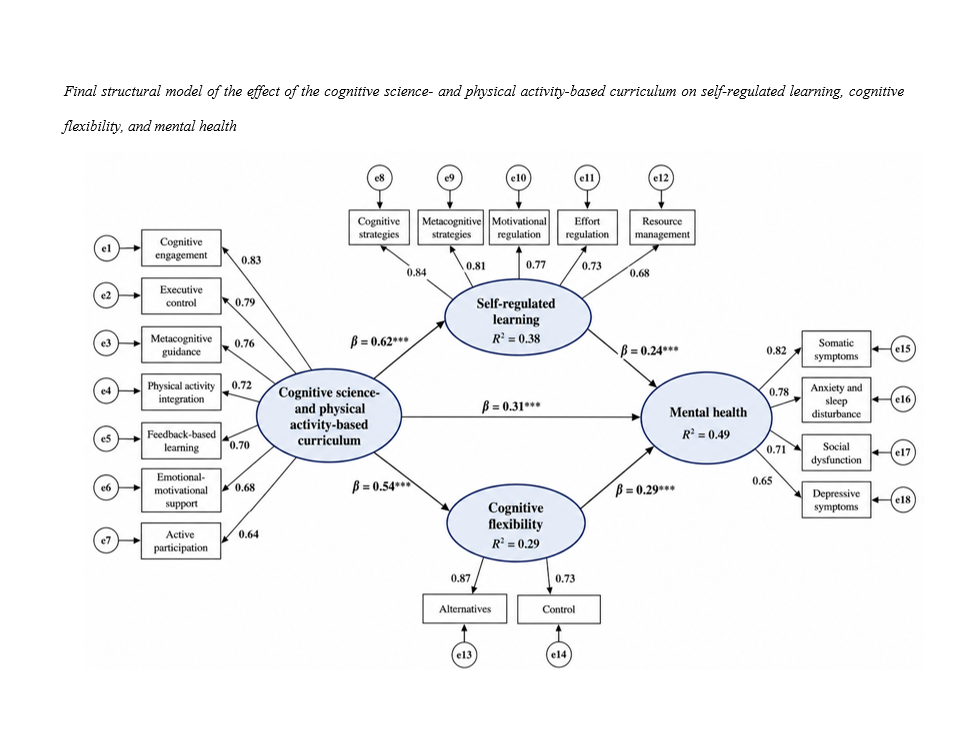
The present study aimed to develop and test a structural model explaining the effect of a cognitive science- and physical activity-based curriculum on self-regulated learning, cognitive flexibility, and mental health among secondary school students in Tehran. This quantitative study was conducted using a descriptive-correlational design based on structural equation modeling. The statistical population included secondary school students in Tehran during the academic year 2025–2026, from whom 384 students were selected through multistage cluster sampling. Data were collected using a demographic information form, a researcher-made questionnaire for assessing the cognitive science- and physical activity-based curriculum, the Self-Regulated Learning Questionnaire, the Cognitive Flexibility Inventory, and the General Health Questionnaire. The validity of the measurement model was examined through confirmatory factor analysis, and reliability was assessed using Cronbach’s alpha and composite reliability. Data were analyzed using SPSS and AMOS software. Descriptive indices, normality indices, correlation coefficients, confirmatory factor analysis, model fit indices, standardized path coefficients, and indirect effects were examined. The structural model showed acceptable fit with the data, with χ²/df = 1.92, CFI = 0.951, TLI = 0.943, GFI = 0.918, AGFI = 0.900, RMSEA = 0.049, and SRMR = 0.044. The cognitive science- and physical activity-based curriculum had significant direct effects on self-regulated learning (β = 0.62, p < 0.001), cognitive flexibility (β = 0.54, p < 0.001), and mental health (β = 0.31, p < 0.001). Self-regulated learning significantly predicted mental health (β = 0.24, p < 0.001), and cognitive flexibility also had a significant effect on mental health (β = 0.29, p < 0.001). The curriculum also had significant indirect effects on mental health through self-regulated learning and cognitive flexibility. The model explained 38% of the variance in self-regulated learning, 29% of the variance in cognitive flexibility, and 49% of the variance in mental health. The findings indicated that a curriculum based on cognitive science and physical activity can improve students’ self-regulated learning, strengthen cognitive flexibility, and promote mental health.
Downloads
References
Ang, W. H. D., Lau, S. T., Cheng, L. J., Chew, H. S. J., Tan, J. H., Shorey, S., & Lau, Y. (2022). Effectiveness of Resilience Interventions for Higher Education Students: A Meta-Analysis and Metaregression. Journal of Educational Psychology, 114(7), 1670-1694. https://doi.org/10.1037/edu0000719
Argus‐Calvo, B., Clegg, D. J., Francis, M. D., Carrola, P. A., & Leiner, M. (2024). A Holistic Approach to Sustain and Support Lifelong Practices of Wellness Among Healthcare Professionals: Generating Preliminary Solid Steps Towards a Culture of Wellness. BMC Medical Education, 24(1). https://doi.org/10.1186/s12909-024-06353-7
Aslam, S., & Bin, S. Y. (2025). Active Futures: Combating Youth Sedentary Lifestyles in Pakistan Through Smart Use of Fragmented Time. Frontiers in Sports and Active Living, 7. https://doi.org/10.3389/fspor.2025.1518884
B., A. S. (2024). Unlocking Potential: Contribution of Sports in Improving Mental Health in Children. International Journal for Multidisciplinary Research, 6(4). https://doi.org/10.36948/ijfmr.2024.v06i04.23609
Bagum, M., Riaz, Z., & Fareed, A. (2024). Effectiveness of Physical Activities in Students’ Mental Health at Elementary Level. Journal of Education and Social Studies, 5(1), 193-202. https://doi.org/10.52223/jess.2024.5119
Baker, C. N., Oshrin, S., Petrovic, L., Swanberg, S., & Nastasi, B. K. (2024). Transitioning to Telehealth During COVID-19: Challenges and Opportunities for Trauma-Focused School Psychology. Training and Education in Professional Psychology, 18(4), 413-420. https://doi.org/10.1037/tep0000477
Barker, R. K., Tuominen, L. P., Larson, M. R., Lee-Nichols, M. E., Eslinger, G., Patterson, K. L., & Stocker, S. L. (2021). Enhancing Mindfulness and Well-Being in Higher Education. International Journal of Community Well-Being, 4(4), 625-646. https://doi.org/10.1007/s42413-021-00118-6
Cóndor, J., Enríquez, B. G. A., Dávila, D. L. O., Reyes, D. E. G., Vergara, J. A. M., & Urbina, G. J. V. (2024). Adaptation, Stress Management, Mood and Its Relationship With Academic Performance in Peruvian Students Beginning Their University Studies. https://doi.org/10.21203/rs.3.rs-5443718/v1
Folger, A., Nekkanti, A., Williamson, G., Guidinger, C., & Kelly, N. R. (2023). Rural Sixth-Grade Teachers’ and Students’ Perceptions of a Mindfulness-Based Mental Health Curriculum. Frontiers in psychology, 14. https://doi.org/10.3389/fpsyg.2023.1277614
Greenleaf, A. T., & Reese, R. F. (2024). Nurturing Minds With Nature: Incorporating Ecodaemonia Theory Into Comprehensive School Counseling Programs. Professional School Counseling, 28(1). https://doi.org/10.1177/2156759x241259977
Habyarimana, J. d. D., Tugirumukiza, E., & Zhou, K. (2022). Physical Education and Sports: A Backbone of the Entire Community in the Twenty-First Century. International journal of environmental research and public health, 19(12), 7296. https://doi.org/10.3390/ijerph19127296
Hikmat, R., Yosep, I., & Mardhiyah, A. (2025). A Scoping Review of Nursing Interventions of Improving Resilience Among University Students During Online Learning. BMC Nursing, 24(1). https://doi.org/10.1186/s12912-025-03581-0
Indriaswuri, R., Gading, I. K., Suranata, K., & Suarni, N. K. (2023). Mindfulness and Academic Performance: A Literature Review. Migration Letters, 20(9), 341-358. https://doi.org/10.59670/ml.v20i9.6087
Latino, F., Tafuri, D., & Tafuri, F. (2025). Academic Self-Pressure and Physiological Responses in Adolescents: A Pilot Experimental Study on the Moderating Role of an Escape Room-Based Physical Activity Intervention on Cognitive and Academic Outcomes. International journal of environmental research and public health, 22(6), 948. https://doi.org/10.3390/ijerph22060948
Latino, F., Tafuri, F., Maisuradze, M., & Tafuri, M. G. (2025). Enhancing Academic Performance, Cognitive Functions, and Mental Well-Being Through Active Breaks: Evidence From a Pilot Study With University Student Sample. International journal of environmental research and public health, 22(11), 1605. https://doi.org/10.3390/ijerph22111605
Li, Z., Li, J., Kong, J., Wang, R., & Jiang, F. (2024). Adolescent Mental Health Interventions: A Narrative Review of the Positive Effects of Physical Activity and Implementation Strategies. Frontiers in psychology, 15. https://doi.org/10.3389/fpsyg.2024.1433698
Marschin, V., & Herbert, C. (2021). A Short, Multimodal Activity Break Incorporated Into the Learning Context During the Covid-19 Pandemic: Effects of Physical Activity and Positive Expressive Writing on University Students' Mental Health—Results and Recommendations From a Pilot Study. Frontiers in psychology, 12. https://doi.org/10.3389/fpsyg.2021.645492
Martín-Rodríguez, A., Gostian-Ropotin, L. A., Beltrán-Velasco, A. I., Belando‐Pedreño, N., Simón, J. A., López-Mora, C., Navarro-Jiménez, E., Tornero-Aguilera, J. F., & Clemente‐Suárez, V. J. (2024). Sporting Mind: The Interplay of Physical Activity and Psychological Health. Sports, 12(1), 37. https://doi.org/10.3390/sports12010037
McCallum, M., Ho, A. S., Mitchell, E. S., May, C. N., Behr, H., Ritschel, L. A., Mochrie, K. D., & Michaelides, A. (2022). Feasibility, Acceptability, and Preliminary Outcomes of a Cognitive Behavioral Therapy–Based Mobile Mental Well-Being Program (Noom Mood): Single-Arm Prospective Cohort Study. Jmir Formative Research, 6(4), e36794. https://doi.org/10.2196/36794
Monsillion, J., Zebdi, R., & Romo, L. (2023). School Mindfulness-Based Interventions for Youth, and Considerations for Anxiety, Depression, and a Positive School Climate—A Systematic Literature Review. Children, 10(5), 861. https://doi.org/10.3390/children10050861
Mun, D.-J. (2021). Analysis of Physical Factors According to School Facility Opening of Elementary School Students. Journal of Clinical Movement Science in Human, 25(1), 31-36. https://doi.org/10.17817/2021.02.16.1111632
P., P., L., P., & KUmari, B. s. S. (2024). Enhancing Student Wellbeing in Alignment With NEP 2020. International Journal for Multidisciplinary Research, 6(4). https://doi.org/10.36948/ijfmr.2024.v06i04.25336
Papadopoulos, N., Mantilla, A., Bussey, K., Emonson, C., Olive, L., McGillivray, J., Pesce, C., Lewis, S., & Rinehart, N. (2022). Understanding the Benefits of Brief Classroom‐Based Physical Activity Interventions on Primary School‐Aged Children's Enjoyment and Subjective Wellbeing: A Systematic Review. Journal of School Health, 92(9), 916-932. https://doi.org/10.1111/josh.13196
Papageorgiou, A., Andreou, P., Savva, Z., Kossenas, K., Quattrocchi, A., Charalambous, H., Demetriou, C. A., Philippou, E., Kolokotroni, O., Michail, K. A., Nicolaou, C., & Constantinou, C. (2025). Effectiveness of School-Based Psycho-Educational Interventions in Preventing Sub-Clinical Anxiety and Stress in Adolescents. Clinical Child Psychology and Psychiatry, 31(3), 1205-1233. https://doi.org/10.1177/13591045251396388
Razza, R. A., Zhang, Y., & Edelstein, A. (2025). Mindfulness-Based Cognitive and Emotional Wellness Supports for Adolescents: Adaptations and Lessons Learned During the COVID-19 Pandemic. School Psychology International, 46(4), 421-454. https://doi.org/10.1177/01430343251361133
Rezapour, T., Assari, S., Kirlić, N., Vassileva, J., & Ekhtiari, H. (2020). Enhancing Cognitive Resilience in Adolescence and Young Adults: A Neuroscience-Informed Approach. https://doi.org/10.31234/osf.io/enrv9
Roberts, J. S., Ferber, R., Funk, C., Harrington, A. W., Maixner, S. M., Porte, J. L., Schissler, P., Votta, C., Deldin, P. J., & Connell, C. M. (2022). Mood Lifters for Seniors: Development and Evaluation of an Online, Peer-Led Mental Health Program for Older Adults. Gerontology and geriatric medicine, 8. https://doi.org/10.1177/23337214221117431
Ruíz, P., Rosa, L., & Puig-Lagunes, Á. A. (2025). Effectiveness of a Yoga-Based Intervention on Academic Burnout Syndrome in Medical Students: A Pilot Study. Journal of education and health promotion, 14(1). https://doi.org/10.4103/jehp.jehp_755_24
Sapulette, B. J., Prabhasuari, I. A. M., Zakiyah, H., Fatmawati, K. A., Soselisa, A. H., & Warsini, S. (2025). Outcomes of Mindfulness Therapy for Adolescents With Mental Health Issues: A Scoping Review. Journal of Indian Association for Child and Adolescent Mental Health. https://doi.org/10.1177/09731342251360104
Setia, S., Krägeloh, C., Bandyopadhyay, G., & Subramaniam, K. (2021). Inculcating Dispositional Optimism for Prevention of Mental and Substance Use Disorders Throughout and After the Coronavirus Disease-19 Pandemic. Alternative and Complementary Therapies, 27(2), 68-78. https://doi.org/10.1089/act.2021.29322.sse
Sevi̇ndi̇k, S. T., & Mansuroğlu, S. (2025). The Transformation Brought by Stress Management Training Based on Bar-On’s Mixed Model of Emotional Intelligence in Nursing Students: A Qualitative Study. BMC Nursing, 24(1). https://doi.org/10.1186/s12912-025-03913-0
Shapiro, S. L., Carlson, L. E., & Sawyer, B. A. (2024). Mindfulness-Based Psychotherapy. 53-73. https://doi.org/10.1037/0000418-005
Sharma, L. R., & Upreti, U. P. (2023). Reconnoitering Advantages and Challenges of Integrating Physical Education Into the Curriculum. International Journal of Multidisciplinary Comprehensive Research, 2(4), 81-88. https://doi.org/10.54660/ijmcr.2023.2.4.81-88
Subramanyam, A. A., Somaiya, M., & Sousa, A. D. (2024). Mental Health and Well-Being in Children and Adolescents. Indian Journal of Psychiatry, 66(Suppl 2), S304-S319. https://doi.org/10.4103/indianjpsychiatry.indianjpsychiatry_624_23
Vitagliano, L. A., Wester, K. L., Jones, C. T., Wyrick, D. L., & Vermeesch, A. (2023). Group Nature-Based Mindfulness Interventions: Nature-Based Mindfulness Training for College Students With Anxiety. International journal of environmental research and public health, 20(2), 1451. https://doi.org/10.3390/ijerph20021451
Downloads
Additional Files
Publication Timeline
- Submitted
- Revised
- Accepted