Causal Modeling of Specific Learning Difficulties Based on Self-Control with the Mediating Role of Disobedience among Sixth-Grade Students in Urmia
Keywords:
specific learning difficulties, self-control, disobedienceAbstract
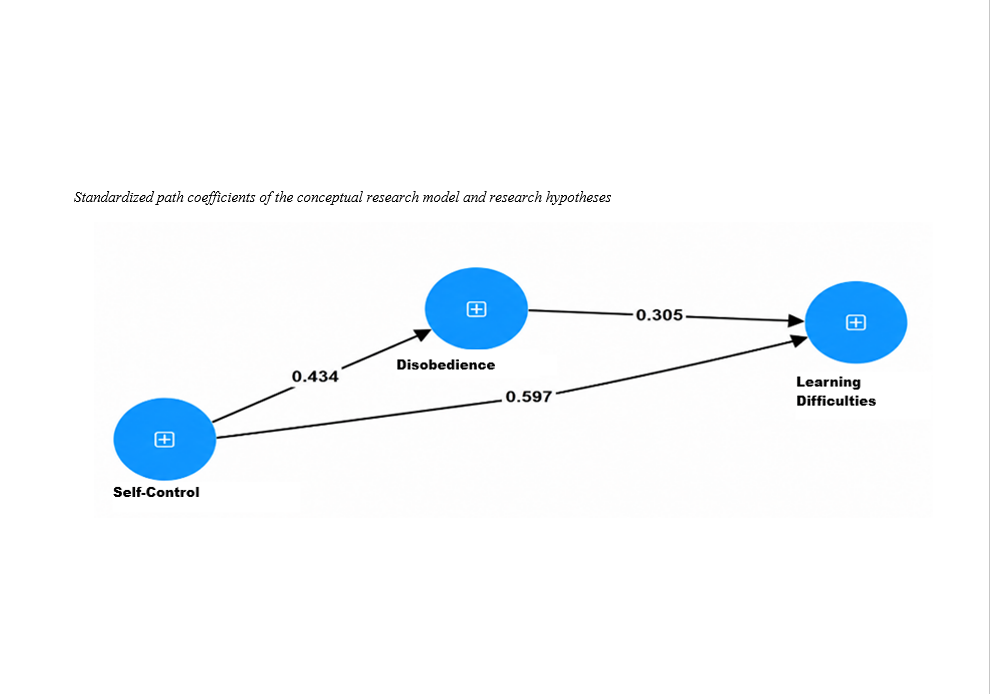
The present study aimed to model the causal relationships of specific learning difficulties based on self-control with the mediating role of disobedience among sixth-grade students in Urmia. In terms of its objective, this research was applied, and in terms of its nature and methodology, it employed a descriptive-correlational design based on structural equation modeling. The statistical population consisted of all sixth-grade elementary school students in Urmia during the 2024–2025 academic year. A sample of 250 students was selected through purposive sampling. The research data were collected using the Colorado Learning Difficulties Questionnaire developed by Willcutt et al. (CLDQ), the 13-item Brief Self-Control Scale developed by Tangney et al., and the Golmakani Children’s Disobedience Questionnaire, Parent and Teacher Forms. The research hypotheses were tested through bootstrapping using SmartPLS, and supplementary analyses were performed using SPSS version 26. The results indicated that self-control had a direct effect on specific learning difficulties among sixth-grade students in Urmia. The findings also demonstrated that disobedience mediated the relationship between self-control and learning difficulties. Overall, the proposed causal model of specific learning difficulties based on self-control with the mediating role of disobedience among sixth-grade students in Urmia demonstrated an acceptable fit.
Downloads
References
Abolghasemi, A., Barzegar, S., & Rostamoghli, Z. (2014). The Effectiveness of Self-Regulated Learning Training on Self-Efficacy and Life Satisfaction in Students with Mathematics Disorder. Learning Disabilities, 4(2), 6-21.
Alizadeh, M. R. (2020). The Effectiveness of Affection-Based Parenting Training on Parenting Styles, Parent–Child Relationships, and Psychological Flexibility among Mothers of Children with Learning Disabilities [Master's thesis, Islamic Azad University, Ardabil Branch].
Clinton, M. E., Conway, N., Sturges, J., & Hewett, R. (2022). Self-Control during Daily Work Activities and Work-to-Nonwork Conflict. Journal of Vocational Behavior, 132, 23-40.
Ezzati, M., & Ghasem, G. (2021). A Comparison of Self-Control and Bully–Victim Behavior between Students with Specific Learning Disabilities and Typically Developing Students. Learning Disabilities, 10(3), 356-368.
Gholamzadeh Nikjou, H., Alivandi Vafa, M., Tabatabaei, S. M., & Moheb, N. (2022). The Effectiveness of Transcranial Direct Current Stimulation on Impulsivity and Aggression in Students with Specific Learning Disabilities. Rehabilitation Medicine, 11(5), 728-741.
Guerra, G. C., Positano, M. T., Sperati, A., Passaquindici, I., Logrieco, M. G., & Lionetti, F. (2025). Supporting Parents of Children With Learning Disorders: A Systematic Review of Intervention Strategies. Frontiers in psychology, 16(1), 15-36. https://doi.org/10.3389/fpsyg.2025.1536894
Hamedgolparvar, M. (2023). A Predictive Model of Written Learning Problems Based on Executive Functions, Oppositionality, and Parent–Child Communication among Primary School Children in Tabriz [Master's thesis, Islamic Azad University, Shabestar Branch].
Jalil-Abkenar, S. S., & Ashouri, M. (2013). Practical Guidelines for Teaching Students with Learning Disabilities: Reading, Writing, and Spelling Disorders. Exceptional Education, 13(116), 5-14.
Lievore, R., Cardillo, R., & Mammarella, I. C. (2025). Anxiety in Youth With and Without Specific Learning Disorders: Exploring the Relationships With Inhibitory Control, Perfectionism, and Self-Conscious Emotions. Frontiers in Behavioral Neuroscience, 19. https://doi.org/10.3389/fnbeh.2025.1536192
Macassa, G., McGrath, C., Tomaselli, G., & Buttigieg, S. C. (2021). Corporate Social Responsibility and Internal Stakeholders' Health and Well-Being in Europe: A Systematic Descriptive Review. Health Promotion International, 36(3), 866-883.
Mattheis, N. (2020). Unruly Kids? Conceptualizing and Defending Youth Disobedience. European Journal of Political Theory, 21(3).
Mehri, Z. (2024). The Effectiveness of Mindfulness-Based Parenting Training on the Mental Health of Mothers of Children with Oppositional Defiant Disorder. Quarterly Journal of New Ideas in Psychology, 20(24) 1-12.
Nejati, V., Ghafouri, F., Hejazi, M., & Behroozmand, R. (2026). The Effectiveness of Attention Training in Specific Learning Disorders:A Systematic Review and Transfer Analysis. https://doi.org/10.21203/rs.3.rs-7853101/v1
Rezaei, S. (2016). The Effect of a Six-Week Perceptual–Motor Training Program on Fine and Gross Motor Performance and Handwriting Skills in Children with Written Expression Disorder [Master's thesis, Razi University]. Kermanshah.
Rusciolelli, C., & Sobotka, S. A. (2025). Screening for Specific Learning Disorders: The Role of the Pediatric Primary Care Provider. Pediatric Annals, 54(4), e144-e149. https://doi.org/10.3928/19382359-20250206-05
Salamati, M. (2020). The Relationship between the Quality of Educational Services, Mental Health, and Academic Achievement among Fifth- and Sixth-Grade Primary School Students in District 1 of Tehran. Quarterly Journal of New Ideas in Psychology, 6(10), 1-9.
Wilens, T. E., Oberdhan, D., Jin, N., Skubiak, T., Childress, A., Stralen, J. v., & Ward, C. L. (2026). Efficacy of Centanafadine for Executive Functioning and Learning Problems in Children and Adolescents With Attention-Deficit/Hyperactivity Disorder. Journal of Child and Adolescent Psychopharmacology, 36(5), 266-277. https://doi.org/10.1177/10445463261441745
Yousefi, N., Naeimi, G., Ghaednia Jahromi, A., Mohammadi, H., & Farmani Shahreza, S. (2013). A Comparison of Attention-Deficit/Hyperactivity Disorder, Oppositional Behavior, and Conduct Problems in Primary School Students with Learning Disabilities and Typically Developing Students. Journal of Learning Disabilities, 3(1), 129-147.
Zolrahim, R., Pouri-Mohammadmorad, E., Gharabakhshi, K., Rezaahraei, A., Alipour, J., & Feyzollahi, M. (2024). The Effectiveness of Compassion Therapy on the Ability to Control Negative Thinking, Emotional Self-Control, and Reduction of Self-Criticism in Mothers of Children with Intellectual Disabilities Second International Conference on Sociology, Social Sciences, and Education, Bushehr.
Downloads
Additional Files
Publication Timeline
- Submitted
- Revised
- Accepted