Development of a Mental Imagery Training Package for the Career Development of Unemployed Youth
Keywords:
unemployment, mental imagery, career developmentAbstract
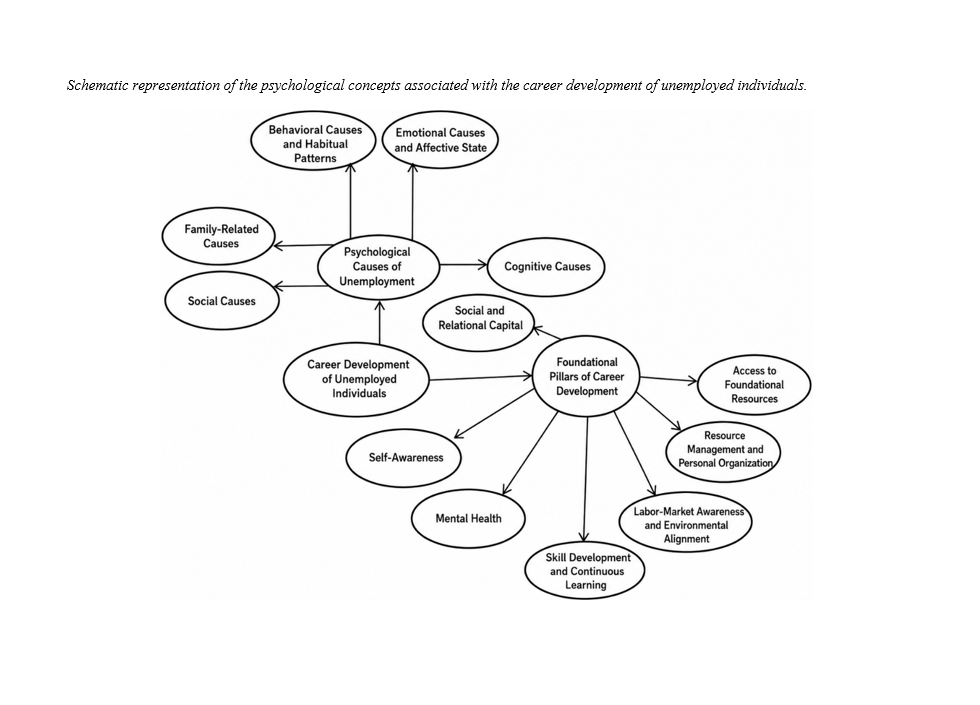
This study aimed to develop a mental imagery training package for the career development of unemployed youth. The research method was conventional content analysis based on the approach proposed by Hsieh and Shannon (2005). The research corpus comprised all texts related to mental imagery and the career development of unemployed individuals that met the inclusion and exclusion criteria. The research instrument consisted of a line-by-line examination of the texts, and the data were analyzed using the five-stage method developed by Hsieh and Shannon (2005). The results of the psychological content analysis of unemployment revealed three concepts: (1) causes of unemployment, (2) foundational pillars of career development, and (3) components of career development for unemployed individuals. The content analysis of mental imagery also revealed three concepts: (1) psychopathology, (2) goals of positive mental imagery, and (3) strategies. Following the content analysis of the texts, the process of adapting the mental imagery method to unemployment was conducted according to the approach proposed by Yousefi and Golparvar (2023). This stage resulted in the development of eight 90-minute training sessions incorporating positive mental imagery content for career development. Mental imagery for securing employment, increasing self-efficacy, and enhancing employability capacity was addressed by modifying four categories of imagery: intrusive mental images, employment-related images that trigger maladaptive emotions, paralyzing images that inhibit practical career-related action, and disconnected images in the domain of employability and career-development skill enhancement. Corrective strategies capable of improving career development were also examined based on the concepts extracted from the texts. Cognitive restructuring, physiological-emotional regulation, cognitive-behavioral strategies, and experiential-perceptual strategies were selected as frameworks for skill modification. Content-validity assessment by experts using the content validity ratio indicated that the package possessed satisfactory content validity (CVR = .98). Based on these findings, the package may proceed to the stage of examining its implementation validity.
Downloads
References
Abdollahi, S., Choubforoushzadeh, A., Arianpour, H., & Sahraian, K. (2024). The Effectiveness of Cochran Career Narrative Therapy on Psychological Distress and Career Hope among Secondary-School Students. Career and Organizational Counseling, 16(3), 95-118. https://doi.org/10.48308/jcoc.2025.238970.1466
Askari, M., Naami, A., & Hashemi, S. E. (2025). The Effectiveness of Career Excellence Training on Work Motivation and Work Engagement. Career and Organizational Counseling, 17(4), 11-36.
Blustein, D. L. (2013). The Psychology of Working: A New Perspective. In The Oxford Handbook of the Psychology of Working (pp. 3). Oxford University Press.
Boyce, C. J., Wood, A. M., Daly, M., & Sedikides, C. (2015). Personality Change Following Unemployment. Journal of Applied Psychology, 100(4), 991.
Cadaret, M. C., & Hartung, P. J. (2020). Efficacy of a Group Career Construction Intervention with Urban Youth of Colour. British Journal of Guidance & Counselling, 49, 187-199. https://doi.org/10.1080/03069885.2020.1782347
Cardoso, P., Duarte, M. E., Pacheco, L., & Janeiro, I. N. (2022). Life-Design Group-Based Intervention Fostering Vocational Identity, Career Adaptability, and Career Decision-Making Self-Efficacy. Cypriot Journal of Educational Sciences, 17, 1453-1467. https://doi.org/10.18844/cjes.v17iSI.1.6674
Carvalho, C. L. D., Marôco, J., Taveira, M. D. C., & Silva, A. D. (2025). Employability Resources of Unemployed Adults: Longitudinal Effects of a Group Career Intervention. Frontiers in psychology, 16, 1470611.
de Carvalho, C. L., Taveira, M. D. C., & Silva, A. D. (2024). Integrative Review of Career Interventions with Unemployed People: Nature, Outcomes, and Recommendations. Journal of employment counseling, 61(1), 18-45.
de Carvalho, C. L., Taveira, M. D. C., & Silva, A. D. (2025). Face-to-Face and Online Group Career Intervention for Unemployed Individuals: A Process Study. Journal of employment counseling, 62(2), 78-102.
Grol, M., Vanlessen, N., & De Raedt, R. (2017). Feeling Happy When Feeling Down: The Effectiveness of Positive Mental Imagery in Dysphoria. Journal of Behavior Therapy and Experimental Psychiatry, 57, 156-162.
Holmes, E. A., & Mathews, A. (2010). Mental Imagery in Emotion and Emotional Disorders. Clinical psychology review, 30(3), 349-362.
Hsieh, H. F., & Shannon, S. E. (2005). Three Approaches to Qualitative Content Analysis. Qualitative Health Research, 15(9), 1277-1288.
Khabaz Shirazi, A., Golparvar, M., & Yousefi, Z. (2021). Comparing the Effectiveness of Social-Cognitive Career Counseling and Acceptance and Commitment-Based Counseling on Vitality and Self-Efficacy among Female Students. Career and Organizational Counseling, 13(4), 71-92. https://doi.org/10.48308/jcoc.2022.102056
Kossen, C., & McIlveen, P. (2018). Unemployment from the Perspective of the Psychology of Working. Journal of Career Development, 45(5), 474-488.
Mahini, T. F., & Aghi Aghdasi, M. T. (2025). Examining the Impact of Positive Psychology and Mental Imagery Techniques on the Mental Health of Injured Athletes.
Maisarah, S., & Chen, M. L. (2025). Evaluating the Effectiveness of Positive Career Counseling on Career Decision-Making and Future Orientation. Journal of Adolescent and Youth Psychological Studies, 6(2), 146-154.
Malekian, M., & Abedi, M. (2024). The Effectiveness of a Meaning-Centered Career Intervention on Subjective Career Success and Career Resilience among Employees. Industrial and Organizational Psychology Studies, 11(2), 1-16. https://doi.org/10.22055/jiops.2024.47001.1408
Maree, J. G., Gerryts, E. W., Fletcher, L., & Olivier, J. (2019). Using Career Counselling with Group Life-Design Principles to Improve the Employability of Disadvantaged Young Adults. Journal of Psychology in Africa, 29(2), 110-120.
Misra, A. K., Singh, A. K., & Singh, P. K. (2022). Modeling the Role of Skill Development to Control Unemployment. Differential Equations and Dynamical Systems, 30(2), 397-409.
Mousavi Dastjerdi, M., Abedi, M., Samiei, F., & Nilforooshan, P. (2026). Comparing Job-Crafting-Based Career Counseling and Social-Cognitive Career Counseling on Teachers' Work Engagement. Journal of Applied Psychological Research, 17(1), 181-200. https://doi.org/10.22059/japr.2026.355963.644633
Nanay, B. (2023). Mental Imagery: Philosophy, Psychology, Neuroscience. Oxford University Press.
Noble, H., & Smith, J. (2015). Issues of Validity and Reliability in Qualitative Research. Evidence-Based Nursing, 18(2), 34-35.
Odou, N., & Vella-Brodrick, D. A. (2013). The Efficacy of Positive Psychology Interventions to Increase Well-Being and the Role of Mental Imagery Ability. Social Indicators Research, 110(1), 111-129.
Paulet, T., & Weiner, L. (2025). Imagery-Based Cognitive Therapy to Reduce Emotional Dysregulation and Mood Instability in Bipolar Disorder: A Case-Series Study. Behavioural and Cognitive Psychotherapy, 53(1), 1-16.
Pictet, A., Coughtrey, A. E., Mathews, A., & Holmes, E. A. (2011). Fishing for Happiness: The Effects of Generating Positive Imagery on Mood and Behaviour. Behaviour Research and Therapy, 49(12), 885-891.
Pigou, A. C. (2013). Theory of Unemployment. Routledge.
Pultz, S., & Hansen, M. P. (2026). What Am I Worth? An Exploration of Unemployed People's Experiences. In Handbook on Unemployment and Society (pp. 81).
Rafiola, R. H., Hulukati, W., Idris, I., & Hamidah, A. U. (2023). Increasing Career Decision-Making Self-Efficacy through Solution-Focused Career Counseling. Bisma: The Journal of Counseling, 7(2), 223-229.
Ramos, E., & Cunha, C. (2026). Emotion Regulation Intervention in Unemployed Adults: Results from a Controlled Pilot Study. Applied Psychology: Health and Well-Being, 18(1), e70106.
Raut, S. K., Alon, I., Rana, S., & Kathuria, S. (2024). Knowledge Management and Career Readiness: A Review and Synthesis. Journal of Knowledge Management, 28(7), 1821-1866.
Rouhafza, O., & Aghili, S. M. (2026). Comparing the Effectiveness of Flourishing Training and Transactional Analysis on Career Optimism and University-to-Work Transition Readiness. Social Psychology Research, 16(61), 91-108. https://doi.org/10.22034/spr.2026.525963.2140
Sahito, F. Z., Sahito, Z. H., Alishba, U., & Phulpoto, J. (2025). The Effectiveness of Career Guidance and Counseling Services in Secondary Schools. Voyage Journal of Educational Studies, 5(1), 15-31.
Von Scheve, C., Esche, F., & Schupp, J. (2017). The Emotional Timeline of Unemployment: Anticipation, Reaction, and Adaptation. Journal of Happiness Studies, 18(4), 1231-1254.
Yiğit, B., Uygun, E. G., & Erus, S. M. (2026). Do Online Career Counseling Interventions Work? A Meta-Analysis of Career-Related Psychological Outcomes. Journal of Career Assessment, 10690727261433253.
Zimmer, W. K., & Matthews, S. D. (2022). A Virtual Coaching Model of Professional Development to Increase Teachers' Digital Learning Competencies. Teaching and Teacher Education, 109, 103544.
Downloads
Additional Files
Publication Timeline
- Submitted
- Revised
- Accepted