A Comparison of the Effectiveness of Positive Youth Development Program Training and Social-Cognitive Problem-Solving Skills Training on Attitudes Toward Problem Solving Among Female Students
Keywords:
Positive Youth Development Program, social-cognitive problem-solving skills, attitude toward problem solving, female students.Abstract
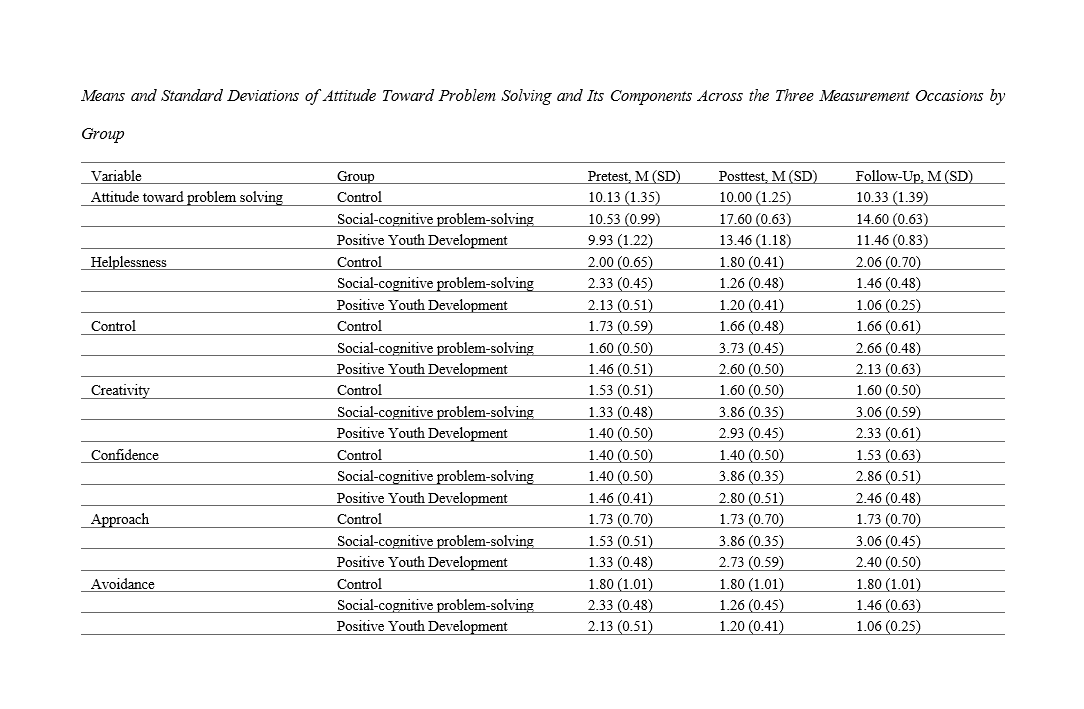
Attitude toward problem solving is one of the most fundamental competencies adolescents require when confronting academic and social challenges. A negative problem-solving orientation is associated with the ineffective application of problem-solving skills and the adoption of an avoidant problem-solving style. This study aimed to compare the effectiveness of Positive Youth Development Program training and social-cognitive problem-solving skills training in improving attitudes toward problem solving among female students. The study was applied in purpose and employed a quasi-experimental pretest–posttest–follow-up design with a control group. The statistical population consisted of all female upper-secondary school students in Qaem Shahr during the 2022–2023 academic year. Using purposive sampling and based on pretest scores, 45 students were selected and randomly assigned to two experimental groups and one control group, with 15 participants in each group. The first experimental group received Positive Youth Development Program training, whereas the second experimental group received social-cognitive problem-solving skills training. Each intervention consisted of 12 two-hour sessions. Data were collected using the Cassidy and Long Problem-Solving Attitude Questionnaire and analyzed using repeated-measures analysis of variance and the Bonferroni post hoc test. The main effects of group and time, as well as the Time × Group interaction effect, were significant for attitudes toward problem solving (p < .001). Compared with the control group, both experimental interventions significantly improved attitudes toward problem solving (p < .05). A significant difference was also observed between the two experimental groups, such that social-cognitive problem-solving skills training produced a 2.622-point greater improvement in attitudes toward problem solving than the Positive Youth Development Program. Both programs were effective in improving attitudes toward problem solving among female students; however, social-cognitive problem-solving skills training demonstrated greater effectiveness because of its emphasis on cognitive restructuring and goal-directed strategies. Therefore, it may be employed as an effective intervention in academic counseling.
Downloads
References
A'Raafi, M. I., Maghfiroh, H., Zubaidah, S., & Munzil, M. (2024). The contribution of collaboration and problem-solving skills to cognitive learning outcomes through Remap-TPS. In International Conference on Mathematics and Science Education (ICoMSE 2023) (pp. 173-182). Atlantis Press. https://doi.org/10.2991/978-2-38476-275-0_15
Akbari, A., & Hosseini, F. (2025). The effects of training female students in emotion regulation techniques on their social problem-solving skills and social anxiety: A randomized controlled trial. Child and adolescent psychiatry and mental health, 19(1), 3. https://doi.org/10.1186/s13034-025-00860-1
Alazemi, A. F. T., Heydarnejad, T., Ismail, S. M., & Gheisari, A. (2023). A model of academic buoyancy, L2 grit, academic emotion regulation, and personal best: Evidence from an EFL context. Heliyon, 9(2). https://doi.org/10.1016/j.heliyon.2023.e13149
Alizadeh, M., Heidari, F., Mirzazadeh, A., Peighambardoust, S., Beheshtizadeh, F., Taghavi, A., & Hassanzadeh, G. (2022). Comparing the flow experience of medical students in cognitive, behavioral, and social educational games: A quasi-experimental study. Journal of Medical Education Development, 15(47), 36-42. https://doi.org/10.52547/edcj.15.47.36
Almulla, M., & Al-Rahmi, W. (2023). Integrated social cognitive theory with learning input factors: The effects of problem-solving skills and critical thinking skills on learning performance sustainability. Sustainability, 15(5), 3978. https://doi.org/10.3390/su15053978
Amany, D. A. L., Puteri, A. A. I., & Karim, S. (2023). Analysis of the relationship between student interest and written communication in solving realistic mathematics problems. Delta-Phi: Jurnal Pendidikan Matematika, 1(1), 15-19. https://doi.org/10.61650/dpjpm.v1i1.36
Aras, E., & Peker, A. (2024). Adolescents' attitudes and intentions to seek psychological help according to the theory of planned behavior. Current Approaches in Psychiatry, 16(4), 617-627. https://doi.org/10.18863/pgy.1371163
Chen, J., Li, S., & Nie, Y. (2024). Parent-adolescent conflict and problematic internet use among Chinese adolescents: The mediating role of depression and the moderating role of school climate. BMC psychology, 12(1). https://doi.org/10.1186/s40359-024-01781-y
Clark, O., Rivelli, A., Mroczkowski, A., Espino, S., Kelly, E., Vogel, L., & Zebracki, K. (2023). Problem solving and collaborative involvement among adolescents with spinal cord injury and their caregivers. Frontiers in Rehabilitation Sciences, 4. https://doi.org/10.3389/fresc.2023.1100707
Flora, M., Barros, L., & Malheiro, I. (2025). Experience with a self-management education program for adolescents with type 1 diabetes: A qualitative study. Nursing Reports, 15(1), 22. https://doi.org/10.3390/nursrep15010022
Fotouhi, F., Barzegar Bafrouei, K., & Hasani, H. (2023). The roles of positive youth development and self-compassion in aggression tendencies among female upper-secondary students in Yazd. Journal Of Shahid Sadoughi University Of Medical Sciences, 31(6), 6746-6763.
Golshiri, P., Mostofi, A., & Rouzbahani, S. (2023). The effect of problem-solving and assertiveness training on self-esteem and mental health of female adolescents: A randomized clinical trial. BMC psychology, 11(1). https://doi.org/10.1186/s40359-023-01154-x
Haghish, E., Obaidi, M., Strømme, T., Bjørgo, T., & Grønnerød, C. (2023). Mental health, well-being, and adolescent extremism: A machine learning study on risk and protective factors. Research on Child and Adolescent Psychopathology, 51(11), 1699-1714. https://doi.org/10.1007/s10802-023-01105-5
Hu, Y., & Jiang, X. (2022). Hope as an engine mediating the relation between parental attachment and social problem-solving skills in adolescents. School Psychology International, 43(3), 237-252. https://doi.org/10.1177/01430343221091991
Joshi, S., Verma, P., Rajagopalan, H., Siddiqui, M., & Lachyan, A. (2023). Variability in health impact: Examining lifestyle and dietary habits across different stages of adolescence: A comprehensive literature review. European Journal of Nutrition & Food Safety, 15(11), 41-47. https://doi.org/10.9734/ejnfs/2023/v15i111354
Junsomang, S., Thampradit, S., Sripatnet, C., Ainyeam, A., Arsa, R., Jumneansuk, A., & Pudpong, T. (2025). Addressing emotional aggression in Thai adolescents: Evaluating the P-positive program using an EQ metric. International Journal of Adolescent Medicine and Health, 37(1), 59-65. https://doi.org/10.1515/ijamh-2025-0005
Karimi, F. (2022). An empirical examination of the effect of social problem-solving skills training on psychological empowerment among secondary-school teachers and its stability over time. Cultural Psychology, 6(1), 199-234.
Kent, L., Nelson, B., & Northoff, G. (2023). Can disorders of subjective time inform the differential diagnosis of psychiatric disorders? A transdiagnostic taxonomy of time. Early Intervention in Psychiatry, 17(3), 231-243. https://doi.org/10.1111/eip.13333
Kern, R. S., Reddy, L. F., Horan, W. P., Glynn, S. M., Stigers, P. J., Sugar, C. A., & Green, M. F. (2022). Social cognition and social problem-solving skills training to improve job functioning and tenure in veterans with psychiatric disability. Psychiatric Rehabilitation Journal. https://doi.org/10.1037/prj0000518
Kilci, A., Yalçıner, S., & Bekir, S. (2025). Mental competence in esports: The mediating role of cognitive flexibility in the relationship between negative problem orientation and social problem solving. Research Square. https://doi.org/10.21203/rs.3.rs-5868921/v1
Li, S., Zhang, Y., Wang, X., & Yuan, R. (2024). Association between life satisfaction, problem behaviours, and psychological distress in orphaned adolescents: Exploring gender and orphanhood-type discrepancies. Child & Family Social Work, 29(3), 808-817. https://doi.org/10.1111/cfs.13138
McLoughlin, S., & Kristjánsson, K. (2024). Virtues as protective factors for adolescent mental health. Journal of Research on Adolescence, 35(1). https://doi.org/10.1111/jora.13004
Mendes, A., Canavarro, M., & Ferreira, C. (2022). The roles of self-compassion and psychological flexibility in the psychological well-being of adolescent girls. Current Psychology, 42(15), 12604-12613. https://doi.org/10.1007/s12144-021-02438-4
Meyer, J., Rozas, A., Muñoz, I., Burmeister, C., Macchiavello, C., Lendzion, L., & García-Huidobro, D. (2023). Development of the ¡Vamos por Más! parenting program to prevent substance use among Chilean adolescents. Health Promotion International, 38(2). https://doi.org/10.1093/heapro/daad004
Nurjamin, A., Salazar-Espinoza, D. E., Saenko, N., & Bina, E. (2023). Learner-oriented assessment matters: Testing the effects of academic buoyancy, reflective thinking, and learner enjoyment in self-assessment and test-taking anxiety management among EFL learners. Language testing in Asia, 13(1), 30. https://doi.org/10.1186/s40468-023-00247-z
Omidi, S., Kakabaraee, K., & Amiripour, A. (2023). Effectiveness of social problem-solving skills training on depression in patients with systolic heart failure in Kermanshah. Journal of Kermanshah University of Medical Sciences, 27(2). https://doi.org/10.5812/jkums-136995
Padunggun, Y., Boonyapalanant, E., & Koseeyaporn, P. (2024). Development of a training course to promote non-cognitive skills using problem-solving learning for automation control. 2024 9th International STEM Education Conference (iSTEM-Ed),
Pahlavanneshan, S., Pakdaman, S., Ghanbari, S., Shahidi, S., & Shokri, O. (2022). Development and validation of a positive youth development model for Iranian adolescents. Quarterly Journal of Applied Psychology.
Peron, S., & Neufeld, C. (2022). Health promotion for adolescents: Specific characteristics of group programs. Psicologia: Teoria e Prática, 24(2). https://doi.org/10.5935/1980-6906/ePTPCP13479.en
Pieńkowska, H. (2024). Goals, principles, and methods for diagnosing the school and family environment and students' special educational needs. In (pp. 300-305). https://doi.org/10.54937/2024.9788056111024.300-305
Roorda, G., de Vries, S., & Smale-Jacobse, A. E. (2024). Using lesson study to help mathematics teachers enhance students' problem-solving skills through teaching via problem solving. Frontiers in Education, 9, 1331674. https://doi.org/10.3389/feduc.2024.1331674
Shojaei, A., Haji Yakhchali, A., Maktabi, G., & Shahni Yeylagh, M. (2023). The mediating role of positive youth development in the relationship among social competence, academic well-being, and academic vitality in upper-secondary students in Behbahan. Rooyesh-e-Ravanshenasi Journal, 12(10), 21-32.
Sihite, M. S. R., Pangaribuan, L. R., Armanto, D., & Syahputra, E. (2024). Development of a reciprocal learning model assisted by hypnoteaching (SuReL) to develop social attitudes, self-confidence, and mathematical problem-solving ability. Educational Administration: Theory and Practice, 30(2). https://doi.org/10.52152/kuey.v30i2.762
Soheili Salek, Z., Farrokhi, N., & Poushneh, K. (2022). The effectiveness of positive youth development training on adolescents' psychological capital and anxiety. Quarterly Journal of Modern Psychological Research, 17(67), 157-165.
Son, D., Updegraff, K. A., & Umaña-Taylor, A. J. (2024). Parent-child conflict in Mexican-origin families: Charting development from adolescence to young adulthood. Journal of Research on Adolescence. https://doi.org/10.1111/jora.12925
Tejada-Gallardo, C., Blasco-Belled, A., & Mora, C. (2021). Feeling positive toward time: How time-attitude profiles are related to mental health in adolescents. Journal of adolescence, 89(1), 84-94. https://doi.org/10.1016/j.adolescence.2021.04.002
Topsakal, İ., Yalçın, S., & Çakır, Z. (2022). The effect of problem-based STEM education on students' critical-thinking tendencies and perceptions of problem-solving skills. Science Education International, 33(2), 136-145. https://doi.org/10.33828/sei.v33.i2.1
Uzun, G. Ö. (2022). The storm period in psychological and educational development: An overview of adolescence. Revista on Line De Política E Gestão Educacional, 4113-4128. https://doi.org/10.22633/rpge.v25iesp.7.16171
Wang, H., Gai, X., & Li, S. (2023). A person-centered analysis of meaning in life, purpose orientations, and attitudes toward life among Chinese youth. Behavioral Sciences, 13(9), 748. https://doi.org/10.3390/bs13090748
Wang, Y. P. (2021). Effects of online problem-solving instruction and identification attitudes toward instructional strategies on students' creativity. Frontiers in psychology, 12, 771128. https://doi.org/10.3389/fpsyg.2021.771128
Xiong, J., Hai, M., Su, Z., & Li, Y. (2021). Mediating effects of social problem solving and coping efficacy on the relationship between cumulative risk and mental health in Chinese adolescents. Current Psychology, 42(11), 8759-8770. https://doi.org/10.1007/s12144-021-02167-8
Zhao, J. (2024). Research on the promotion mechanism of sports participation in children and adolescents based on social cognitive theory. Research in Health Science, 9(2), 26. https://doi.org/10.22158/rhs.v9n2p26
Downloads
Additional Files
Publication Timeline
- Submitted
- Revised
- Accepted