The Effectiveness of the Flipped Learning Model on Cognitive Engagement and Critical Thinking in Upper Elementary School Students with Attention-Deficit/Hyperactivity Disorder
Keywords:
attention-deficit/hyperactivity disorder, critical thinking, cognitive engagement, flipped learningAbstract
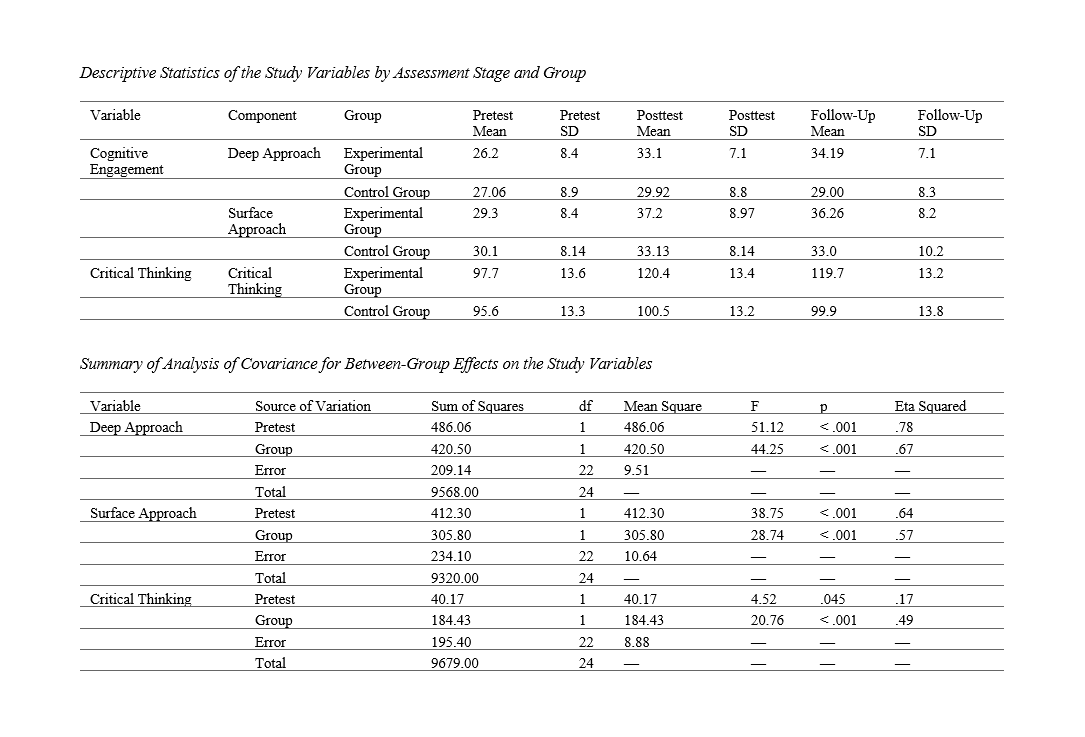
The present study aimed to determine the effectiveness of the flipped learning model on cognitive engagement and critical thinking among upper elementary school students with attention-deficit/hyperactivity disorder (ADHD). This study employed a quasi-experimental pretest–posttest design with a control group and a follow-up assessment. The statistical population consisted of sixth-grade female students diagnosed with attention-deficit/hyperactivity disorder who were referred to the Counseling Center of the Alborz Province Department of Education during the first six months of 1404 SH. Of these students, 24 were selected through purposive sampling and randomly assigned to experimental and control groups. The research instruments included the Cognitive Processing Questionnaire developed by Kember et al. (2004) and the Critical Thinking Questionnaire developed by Ricketts (2003). The experimental group received eight sessions of flipped learning instruction, whereas the control group received conventional classroom instruction. The data were analyzed using analysis of covariance and the Bonferroni post hoc test. The results indicated that flipped learning had a significant positive effect on cognitive engagement and critical thinking (p<.001). Accordingly, flipped learning can be recommended as an effective and sustainable instructional approach for enhancing cognitive engagement and strengthening critical thinking among elementary school students with attention-deficit/hyperactivity disorder.
Downloads
References
Ahmadvand Kahrizi, A., Ahmadi, P., & Akhavan Tafti, M. (2025). The Effect of Flipped Learning on Students' Critical Thinking in the Thinking and Research Course. Quarterly Journal of Education, 41(3), 221-238.
Allahgholipour, F., & Fathollahi, A. (2025). Examining Flipped Learning in Mathematics and Its Effects on Self-Directed Learning and Academic Achievement: A Study of Sixth-Grade Female Students in District 12 of Tehran. Educational Research, 17(51), 1-25.
American Psychiatric, A. (2024). The American Psychiatric Association Practice Guideline for the Treatment of Patients with Borderline Personality Disorder. American Psychiatric Pub. https://doi.org/10.1176/appi.books.9780890428009
Antara, I. K. J., Santyasa, I. W., Tegeh, I. M., Parwati, N. N., & Suartama, I. K. (2026). Effect of the Problem-Based Learning Flipped Classroom Model on Junior High School Students' Digital Literacy and Critical Thinking Skills. JKTP: Jurnal Kajian Teknologi Pendidikan, 9(2), 254-266. https://doi.org/10.17977/um038v9i22026p254-266
Burns, G. L., Becker, S. P., Montaño, J. J., Sáez, B., & Servera, M. (2025). Cognitive Disengagement Syndrome Is Clinically Distinct from ADHD Presentations within Childhood and Adolescence. Journal of Attention Disorders, 29(11), 963-976. https://doi.org/10.1177/10870547251344719
Díaz-Moreno, E., Heredia-Jimenez, J., & Escabias, M. (2025). Beyond DSM Subtypes: Neuropsychological Evidence against Functional Distinctions in Childhood ADHD. Applied Neuropsychology: Child, 12(2), 1-7. https://doi.org/10.1080/21622965.2025.2556429
Dugré, J. R., & Potvin, S. (2022). Developmental Multi-Trajectory of Irritability, Anxiety, and Hyperactivity as Psychological Markers of Heterogeneity in Childhood Aggression. Psychological medicine, 52(2), 241-250. https://doi.org/10.1017/S0033291720001877
Esnavandi, M., Moradi, R., & Bagheri, M. (2025). Flipped Classroom and Microlearning in the Digital Age: A Comparative Study of Cognitive, Emotional, and Behavioral Engagement among Elementary School Students. Educational Technology, 19(4), 977-990.
Hashempour, M. H., Gharibi, H., & Rahmani, S. (2025). The Effectiveness of De Bono's Six Thinking Hats Program on Moral Judgment and Critical Thinking among Children Aged 12–15 Years. Journal of Research and Innovation in Education and Development, 5(1), 1-14. https://doi.org/10.61838/jsied.175
Hatemzadeh, E., & Rezaei, F. (2025). The Effectiveness of Percussion Exercises on Theory of Mind and Types of Attention in Attention-Deficit Disorder. Clinical Psychology: Innovations in Research and Practice, 17(4), 19-36.
Hsia, L. H., Lin, Y. N., & Hwang, G. J. (2021). A Creative Problem Solving-Based Flipped Learning Strategy for Promoting Students' Performing Creativity, Skills and Tendencies of Creative Thinking and Collaboration. British Journal of Educational Technology, 52(4), 1771-1787. https://doi.org/10.1111/bjet.13073
Li, S., & Lajoie, S. P. (2022). Cognitive Engagement in Self-Regulated Learning. European Journal of Psychology of Education, 37(3), 833-852. https://doi.org/10.1007/s10212-021-00565-x
Ma, X., Zhu, S., Li, C., Xu, J., Liu, M., Lin, Y., & Li, Y. (2026). Impact of Forward and Reverse Engineering Pedagogy on Primary Students' Cognitive Engagement and Self-Regulated Learning in Human-GenAI Collaborative Programming. https://doi.org/10.21203/rs.3.rs-9492175/v1
Maisano, H., Chesebrough, C., Zhang, F., Daly, B., Beeman, M., & Kounios, J. (2026). ADHD Symptom Magnitude Predicts Creative Problem-Solving Performance and Insight versus Analysis Solving Modes. Personality and individual differences, 254(1), 113-130. https://doi.org/10.1016/j.paid.2026.113660
Michael, C., Mitchell, M. E., Cascone, A. D., Fogleman, N. D., Rosch, K. S., Cutts, S. A., & Cohen, J. R. (2024). Reconfiguration of Functional Brain Network Organization and Dynamics with Changing Cognitive Demands in Children with Attention-Deficit/Hyperactivity Disorder. Biological Psychiatry: Cognitive Neuroscience and Neuroimaging, 11(2), 28-41.
Morin, B., Kecskemety, K. M., Harper, K. A., & Clingan, P. A. (2013). The Inverted Classroom in a First-Year Engineering Course 2013 ASEE Annual Conference & Exposition,
Mortezapour, M., Janaabadi, H., & Marzieh, A. (2024). The Role of Perceived Teacher Expectations in Predicting Cognitive Engagement and Academic Self-Efficacy among Students with Learning Disorders. Learning Disabilities, 13(3), 58-69.
Pakmehr, H., Mirdoraghi, F., Ghanaei, A., & Karami, M. (2013). Validation, Reliability Assessment, and Factor Analysis of the Ricketts Critical Thinking Disposition Scale among Secondary School Students. Quarterly Journal of Educational Measurement, 3(11), 33-54.
Paydar, M., Ebrahimi, O., Alipour, F., & Abdi, V. (2025). The Effect of Flipped Instruction on Students' Cognitive Engagement and Active Participation Proceedings of the First International Conference and National Festival of Happy Schools with Cultural, Artistic, Skills-Based, Educational, Religious, Training, and Management Approaches, Bushehr, Iran.
Sahebyar, H., & Mesrabadi, J. (2021). The Effectiveness of Flipped Learning on Educational Indicators: A Meta-Analysis. Educational Innovations, 20(3), 7-30.
Salemi, F., Saadat-Talab, A., & Mollazadeh, A. (2024). The Effectiveness of a Philosophy-for-Children Program on Critical Thinking, Academic Self-Efficacy, and Spiritual Development among Female Students Aged 10–13 Years. Educational Research, 15(49), 1-24.
Shafiei, H., & Iranizadeh, H. (2025). The Effectiveness of Flipped Learning Instruction on Critical Thinking and Academic Engagement among Students in Experimental Science. Educational Psychology Studies, 22(58), 133-154.
Shahi, A., Amiri, M., & Ebrahimi, L. (2024). The Effectiveness of Self-Regulation Strategy Training on Attention Deficits, Social Adjustment, and Self-Efficacy among Children with Attention-Deficit/Hyperactivity Disorder. Journal of Rehabilitation Medicine, 13(1), 106-119. https://doi.org/10.32598/SJRM.13.1.7
Shiralinejad, F., Ghasemi, M., & Emamipour, S. (2022). Comparing the Effectiveness of Traditional Instruction and Blended Instruction Based on Cognitive Load Theory among Female Secondary School Students in District 1 of Kerman. Psychological Studies of Adolescents and Youth, 3(2), 197-212. https://doi.org/10.61838/kman.jayps.3.2.15
Shivandi Chalicheh, K. (2015). Modeling Mathematics Academic Achievement Based on Task Value, Cognitive Engagement, Achievement Emotion, and Academic Self-Regulation Allameh Tabataba'i University].
Somaa, F. (2024). The Flipped Classroom Approach: A Review of Cognitive Styles and Academic Performances. Cureus, 16(7), 114-123. https://doi.org/10.7759/cureus.63729
Yousefizadeh, S., & Aghaei Moghadam, F. (2023). The Effectiveness of Critical Thinking Skills Training on Academic Creativity and Satisfaction with Education among High School Students in Tehran. Journal of Research and Innovation in Education and Development, 3(4), 10-19. https://doi.org/10.61838/jsied.3.4.2
Yüksel, M. (2026). Global Trends in Flipped Learning Research: A Bibliometric and Thematic Analysis. Journal of Learning and Teaching in Digital Age, 11(2), 28-41. https://doi.org/10.53850/joltida.1788161
Zahedian, M., & Nami, K. (2024). The Effectiveness of Flipped Instruction on Self-Directed Learning and Self-Efficacy among Students at Farhangian University: A Case Study of Female Students at the Bandar Abbas Campus. Educational Innovations, 22(3), 125-148.
Zhao, D., & Zhang, J. (2024). The Effects of Working Memory Training on Attention Deficit, Adaptive and Non-Adaptive Cognitive Emotion Regulation of Chinese Children with Attention Deficit/Hyperactivity Disorder (ADHD). BMC psychology, 12(1), 59-72. https://doi.org/10.1186/s40359-024-01539-6
Downloads
Additional Files
Publication Timeline
- Submitted
- Revised
- Accepted