Comparing the Effectiveness of Acceptance and Commitment–Based Training and Cognitive-Behavioral Training on Students’ Hope for the Future
Keywords:
Acceptance and Commitment–Based Training, Cognitive-Behavioral Training, Hope for the Future, Students, AdolescentsAbstract
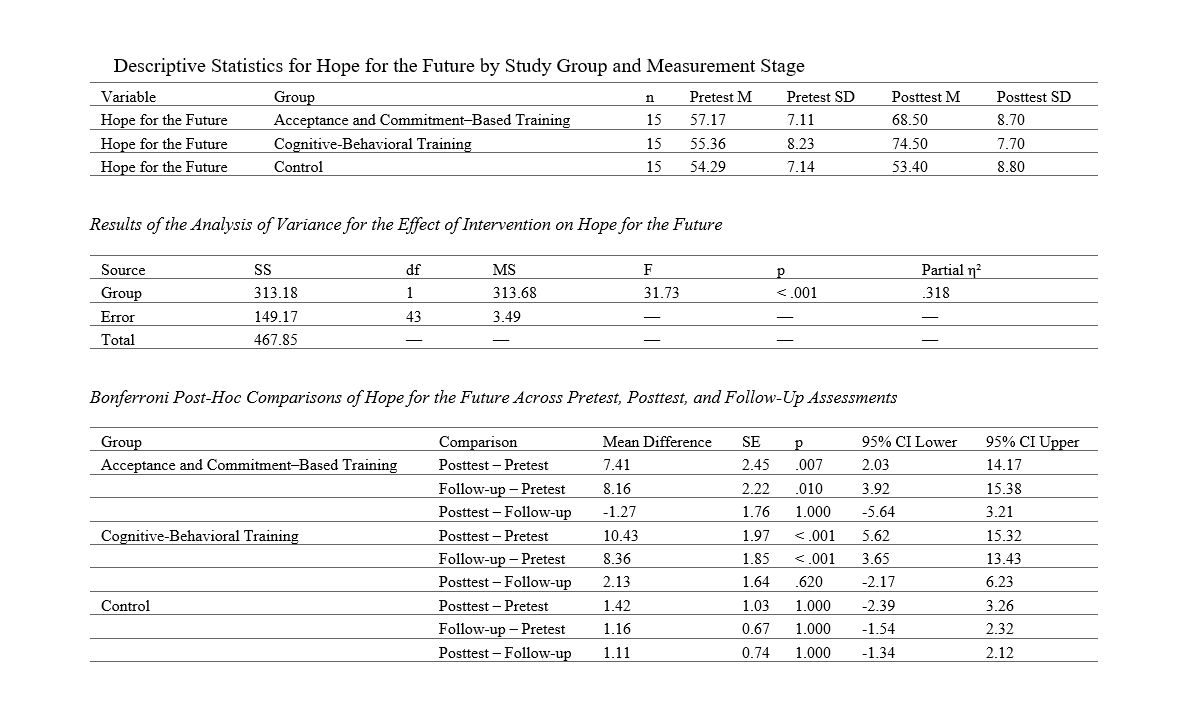
This study aimed to compare the effectiveness of Acceptance and Commitment–Based Training and Cognitive-Behavioral Training in improving hope for the future among female lower-secondary-school students. The study employed a quasi-experimental pretest-posttest design with a control group and a two-month follow-up. The statistical population consisted of female lower-secondary-school students in Mashhad, Iran, during the 2025–2026 academic year. Participants were selected through convenience sampling and assigned to three groups: Acceptance and Commitment–Based Training, Cognitive-Behavioral Training, and control, with 15 students in each group. The first experimental group received a ten-session acceptance and commitment-based intervention, while the second experimental group received a ten-session cognitive-behavioral intervention. The control group received no intervention. Data were collected at pretest, posttest, and two-month follow-up using the 19-item Adolescent Hope Questionnaire developed by Ginevra et al. (2017). Data were analyzed using repeated-measures analysis of variance and Bonferroni post-hoc comparisons at a significance level of .05. The analysis revealed a significant intervention effect on hope for the future, F = 31.73, p < .001, partial η² = .318. Bonferroni comparisons showed significant increases from pretest to posttest and from pretest to follow-up in the Acceptance and Commitment–Based Training group (p = .007 and p = .010, respectively) and in the Cognitive-Behavioral Training group (both p < .001). The differences between posttest and follow-up were not significant in either intervention group, indicating maintenance of treatment gains. No significant differences were observed across measurement occasions in the control group. Both Acceptance and Commitment–Based Training and Cognitive-Behavioral Training were effective in improving hope for the future among female lower-secondary-school students, and the improvements were maintained at the two-month follow-up.
Downloads
References
Alavi Lavasani, E., & Ahmadi Tahour Soltani, M. (2017). The correlation of childhood mistreatment with emotional divorce: The mediating role of attachment styles, early maladaptive schemas, and emotion regulation difficulties. Quarterly Journal of Health Promotion Management, 6(4), 49-58. https://doi.org/10.21859/jhpm-07027
Alibekian, A., & Afsharinia, K. (2020). Evaluating model of mediating role of marital boredom in the relationship between self-differentiation, conflict resolution styles, and marital expectations in predicting marital adjustment in married women and men in Kermanshah city. Psychological Methods and Models, 11(38), 225-246. https://www.magiran.com/p2148763
Alsawalqa, R. O. (2019). Marriage burnout: When the emotions exhausted quietly quantitative research. Iranian journal of psychiatry and behavioral sciences, 13(2). https://doi.org/10.5812/ijpbs.68833
Ayadi, N., Rasouli, M., & Nazari, A. M. (2017). Investigating the mediating role of self-esteem in the relationship between insecure attachment style and marital burnout in opiate addicts. Journal of Disability Studies, 7, 58-58. http://jdisabilstud.org/article-1-700-fa.html
Aziz, A., & Naqvi, I. (2025). Exploring the Dynamics of Marital Commitment, Communication Patterns, and Conflict Handling: Insights from Women in Child Marriages. The Family Journal, 10664807241308902. https://doi.org/10.1177/10664807241308902
Bahramian, A., Kazemi, S. A., Javidi, H. A., & Barzegar, M. (2025). Investigating the Relationship Between Conflict Resolution Styles, Irrational Beliefs, and Communication Patterns with Marital Conflicts. Scientific Quarterly of Psychological Methods and Models, 15(55), 1-20.
Banford Witting, A., & Busby, D. (2019). The long arm of trauma during childhood: Associations with resources in couple relationships. Journal of marital and family therapy, 45(3), 534-549. https://doi.org/10.1111/jmft.12354
Dugal, C., Bélanger, C., Brassard, A., & Godbout, N. (2020). A dyadic analysis of the associations between cumulative childhood trauma and psychological intimate partner violence: The mediating roles of negative urgency and communication patterns. Journal of marital and family therapy, 46(2), 337-351. https://doi.org/10.1111/jmft.12414
Farhangi, A. (2021). Early maladaptive schemas and irrational relationship beliefs: The mediating role of effective conflict resolution styles. Women's Research Journal, 1(35), 131-149. https://sid.ir/paper/1050831/fa
Fitzgerald, M., & Shuler, J. (2023). Coping together or separate: Attachment and dyadic coping as mediators linking childhood maltreatment to intimate relationship quality. Journal of Couple & Relationship Therapy, 22(4), 344-361. https://doi.org/10.1080/15332691.2022.2149650
Godbout, N., Morissette Harvey, F., Cyr, G., & Bélanger, C. (2020). Cumulative childhood trauma and couple satisfaction: Examining the mediating role of mindfulness. Mindfulness, 11, 1723-1733. https://doi.org/10.1007/s12671-020-01390-x
Hicks, T., Johnson, L., & Miller, R. (2026). Schema Modes and Relationship Conflict: Cognitive Emotional Predictors of Romantic Instability. Journal of marital and family therapy, 52(1), 88-103.
Jafari, A., Alami, A., Charoghchian, E., Delshad Noghabi, A., & Nejatian, M. (2021). The impact of effective communication skills training on the status of marital burnout among married women. BMC Women's Health, 21(1), 1-10. https://doi.org/10.1186/s12905-021-01372-8
Javdan, M., Bahrampour, T., & Dehghani, M. (2023). The role of family relationships and conflict resolution styles in marital burnout of couples seeking a divorce. Journal of Family Relations Studies, 3(8), 32-39. https://doi.org/10.22098/jfrs.2023.12006.1093
Joqratian, D., Bolghan Abadi, M., & Esfahani, M. S. (2026). The Mediating Role of Emotion Regulation in the Relationship between Differentiation of Self and Marital Conflicts. Journal of Child and Family Studies, 35, 291-301. https://doi.org/10.1007/s10826-025-03146-4
Kaleta, K., & Błońska, S. (2021). Martial burnout in mothers of children with autism spectrum disorder: The role of marital communication and sociodemographic factors. Kwartalnik Naukowy Fides et Ratio, 47(3), 442-461. https://doi.org/10.34766/fetr.v47i3.833
Kang, K., & Choi, W. (2022). The mediating effect of dysfunctional communication style on the relationship between negative childhood experiences and marital satisfaction. Study on Learner-Centered Subject Education, 22(18), 551-570. https://doi.org/10.22251/jlcci.2022.22.18.551
Kara, E., & Yüksel Şahin, F. (2022). The relationships between childhood traumatic experiences, marital self-efficacy and relational resilience: The mediating role of attachment types. The Journal of Academic Social Sciences, 10(124). https://doi.org/10.29228/ASOS.51800
Karanja, J. K., & Yator, O. (2021). Relationship Between Accommodation Conflict Resolution Style And Marital Satisfaction Among Couples In Nairobi City County, Kenya. IOSR Journal of Humanities and Social Science, 26(7), 51-59. https://ir-library.ku.ac.ke/handle/123456789/31069
Knapp, A. E., Knapp, D. J., Brown, C. C., & Larson, J. H. (2017). Conflict resolution styles as mediators of female child sexual abuse experience and heterosexual couple relationship satisfaction and stability in adulthood. Journal of Child Sexual Abuse, 26(1), 58-77. https://doi.org/10.1080/10538712.2016.1262931
Laakso, M., Fagerlund, A., & Lagerstrom, M. (2025). Increasing student well-being through a positive psychology intervention: Changes in salivary cortisol, depression, psychological well-being, and hope. Applied Psychology: Health and Well-Being, 17(1), e12616. https://doi.org/10.1111/aphw.12616
Lassri, D., Gewirtz-Meydan, A., & Zamir, O. (2023). The mediating role of self-compassion between childhood maltreatment and satisfaction with intimate relationships. Mindfulness, 14(4), 970-978. https://doi.org/10.1007/s12671-023-02107-6
Moteshafie, S., Jamshidimanesh, M., & Haghani, H. (2023). The relationship between sexual satisfaction and marital burnout in married nurses. Iranian Journal of Nursing, 35(140), 5-18. https://doi.org/10.32598/ijn.35.140.518
Parpaee, R., Amiri, H., & Arefi, M. (2020). The Causal model fitness for the Prediction of Marital Satisfaction based on Attachment Style and Personality trait by Mediating Couple’s Effective Communication in women. Journal of Modern Psychological Researches, 15(57), 117-130. https://dor.isc.ac/dor/20.1001.1.27173852.1399.15.57.8.6
Raeisi, R. (2025). The Effectiveness of Hope Training on the Academic Motivation, Academic Hardiness, and Academic Hope of Second-grade Elementary School Students in Chelgerd. The 7th National Conference of Professional Research in Psychology and Counseling with a Teacher's Perspective,
Rahseparmonfared, F., Arvand, Z., & Shariatzadeh Janidi, G. (2021). The effectiveness of solution-focused couple therapy on marital conflict and marital burnout of couples. Measurement and Research in Counseling and Psychology, 3(4 (10)), 53-67. https://doi.org/10.22038/jmrh.2022.65120.1899
Rezaei, S., & Rezaei, F. (2018). Predicting marital burnout based on conflict resolution styles and marital expectations. Applied Counseling, 8(2), 23-38. https://sid.ir/paper/400423/en
Shan, J., & Xu, T. (2025). The role of hope, academic thriving, and adaptive coping in fostering peace of mind among university students: A mixed-methods study. Frontiers in psychology, 16, 1510244. https://doi.org/10.3389/fpsyg.2025.1510244
Sheikhhadisiroei, R., Sayyadi, M., & Ghafouri, S. (2018). Early maladaptive schemas and irrational relationship beliefs: The mediating role of efficient conflict resolution styles. Educational Psychology, 3(35), 37-52. https://www.magiran.com/p2640439
St-Pierre Bouchard, J., Brassard, A., Lefebvre, A. A., Dugal, C., Lafontaine, M. F., Savard, C., & Godbout, N. (2023). Cumulative childhood trauma, communication patterns, and intimate partner violence perpetrated by men seeking help. Journal of interpersonal violence, 38(9-10), 6843-6864. https://doi.org/10.1177/08862605221138651
Stinson, M. A., Bermúdez, J. M., Gale, J., Lewis, D., Meyer, A. S., & Templeton, G. B. (2017). Marital satisfaction, conflict resolution styles, and religious attendance among Latino couples: Using the actor–partner interdependence model. The Family Journal, 25(3), 215-223. https://doi.org/10.1177/1066480717710645
Tasew, A. S., & Getahun, K. K. (2025). Marital conflict among couples: The case of Durbete town, Amhara Region, Ethiopia. Cogent Psychology, 8(1), 1903127.
Vaslehchi, T., Alizade Moghaddam, A., Ehsanfar, M., Hajiyousefi, E., & Abbasi, N. (2024). The efficacy of cognitive behavioral couple therapy on communication beliefs and marital burnout among couples on the verge of divorce. Journal of Assessment and Research in Applied Counseling, 6(1), 64-71. https://doi.org/10.61838/kman.jarac.6.1.7
Vazhappilly, J. J., & Reyes, M. E. (2018). Efficacy of emotion-focused couples communication program for enhancing couples’ communication and marital satisfaction among distressed partners. Journal of Contemporary Psychotherapy, 48, 79-88. https://doi.org/10.1007/s10879-017-9375-6
Vitek, K. N., & Yeater, E. A. (2021). The association between a history of sexual violence and romantic relationship functioning: A systematic review. Trauma, Violence, & Abuse, 22(5), 1221-1232. https://doi.org/10.1177/1524838020915615
Zamir, O. (2022). Childhood maltreatment and relationship quality: A review of type of abuse and mediating and protective factors. Trauma, Violence, & Abuse, 23(4), 1344-1357. https://doi.org/10.1177/1524838021998319
Zohrei, E., Dehghan Manshadi, M., Fallah, M. H., & Vaziri, S. (2025). Designing a model of marital conflict based on conflict with the family of origin and in-laws. Iranian Evolutionary Educational Psychology Journal, 7(4).
Downloads
Additional Files
Publication Timeline
- Submitted
- Revised
- Accepted