The Effects of Hope Training, Self-Compassion Training, and Their Combination on Academic Procrastination and Academic Hope among Students
Keywords:
training, hope, self-compassion, academic procrastination, academic hope, students, boysAbstract
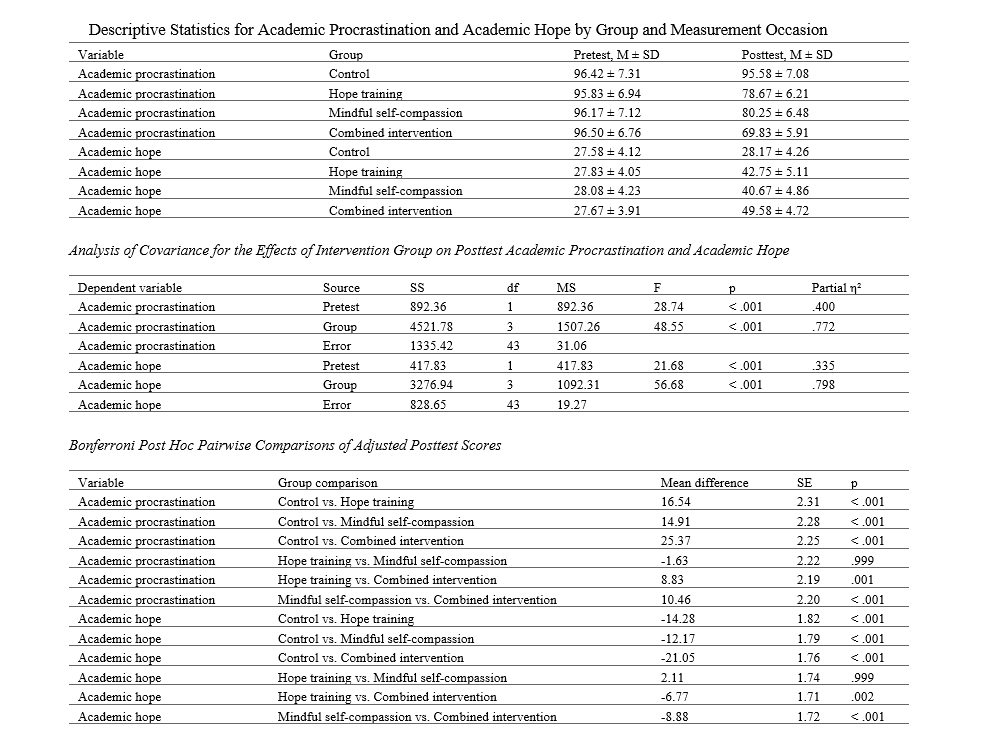
The aim of this study was to investigate the effectiveness of hope training and mindful self-compassion training on academic procrastination and academic hope among eighth-grade boys. This quasi-experimental study employed a pretest–posttest design with a control group and was conducted in 2025. Using cluster random sampling, 48 eighth-grade male students were selected from schools in western Tehran and assigned to four groups. Twelve students were assigned to the control group, 12 received hope training, 12 received mindful self-compassion training, and 12 received a combination of the two interventions. Data were collected using both field and library methods. The data collection instruments consisted of two standardized questionnaires: the Procrastination Assessment Scale–Students developed by Solomon and Rothblum (1984) and the Domain-Specific Hope Scale developed by Sympson (1999), including the academic hope subscale. A pretest was initially administered to all 48 participants. Following the therapeutic interventions administered to the experimental groups, a posttest was administered simultaneously to all participants. The findings indicated that hope training and mindful self-compassion training were effective in reducing academic procrastination and enhancing academic hope among eighth-grade boys. Accordingly, families and schools can contribute to improving boys’ academic conditions by fostering hope and self-compassion.
Downloads
References
Abri, S., Nouri, M., & Saemi, H. (2025). Investigating the Relationship Between Academic Hope and Academic Vitality with the Academic Achievement of First-grade High School Students in Aliabad Katul County. Journal of Psychological Studies and Educational Sciences, 8(92). https://en.civilica.com/doc/2292972/
Germer, C., & Neff, K. D. (2019). Mindful Self-Compassion (MSC). In (pp. 357-367). Routledge.
Harrison, S. (2022). What Does Self-Compassion Really Mean?
Lo, C.-C., Chen, I. C., Ho, W.-S., & Cheng, Y.-C. (2023). A Sequential Mediation Model of Perceived Social Support, Mindfulness, Perceived Hope, and Mental Health Literacy: An Empirical Study on Taiwanese University Students. Acta Psychologica. https://doi.org/10.1016/j.actpsy.2023.104016
Nada, C. I., Santos, S. A., Macedo, E., & Araújo, H. C. (2020). Can Mainstream and Alternative Education Learn from Each Other? An Analysis of Measures against School Dropout and Early School Leaving in Portugal. Educational Review, 72(3), 365-385.
Neff, K. D. (2023). Self-Compassion: Theory, Method, Research, and Intervention. Annual review of psychology, 193-218.
Norouzi, N. (2024). The Effect of Future Perspective Training on Academic Hope, Psychological Well-being, Goal Orientation, and Time Perspective in Eleventh-Grade Male Students Shahid Chamran University of Ahvaz].
Pravani, N., & Maroné, O. (2023). Self-Compassion as a Mechanism to Facilitate the Adjustment of First-Year Students to University Environments. International Journal of Applied Positive Psychology. https://doi.org/10.1007/s41042-023-00129-y
Raeisi, R. (2025). The Effectiveness of Hope Training on the Academic Motivation, Academic Hardiness, and Academic Hope of Second-grade Elementary School Students in Chelgerd. The 7th National Conference of Professional Research in Psychology and Counseling with a Teacher's Perspective,
Shan, J., & Xu, T. (2025). The role of hope, academic thriving, and adaptive coping in fostering peace of mind among university students: A mixed-methods study. Frontiers in psychology, 16, 1510244. https://doi.org/10.3389/fpsyg.2025.1510244
Shireen, N. T., & Luke, J. M. (2023). Self-Compassion and Hope among College Students Based on Gender. The International Journal of Indian Psychology, 11(4). https://doi.org/10.25215/1104.227
Slater, C. B. (2024). Snyder's Hope Theory: A Beacon for Teachers Contending with Secondary Stress, Compassion Fatigue and Burnout in Relation to Students' Experiences of Abuse. Child Protection and Practice, 1. https://doi.org/10.1016/j.chipro.2024.100007
Snyder, C. R. (2002). Hope Theory: Rainbows in the Mind. Psychological Inquiry, 13(4), 249-275. https://www.jstor.org/stable/1448867
Snyder, C. R., & Taylor, J. D. (2000). Hope as a Common Factor across Psychotherapy Approaches: A Lesson from the Dodo's Verdict. In.
Sutton, J., & Smith, W. (2021). How to Perform Hope Therapy: 4 Best Techniques.
Winarsunu, T., Utami, L. A., Fasikhah, S. S., & Anwar, Z. (2023). Hope Therapy: Can It Treat Hopelessness and Internal Locus of Control on Diabetes Mellitus Patients? PLoS One, 18(6), e0286418.
Wong, W. L. L., & Cheung, S. H. (2024). The Role of Hope in College Transition: Its Cross-Lagged Relationships with Psychosocial Resources and Emotional Well-Being in First-Year College Students. Journal of adolescence.
Ziegler, M., & Opdenakker, N. C. (2018). The Development of Academic Procrastination in First-Year Secondary Education Students: The Link with Metacognitive Self-Regulation, Self-Efficacy, and Effort Regulation. Learning and Individual Differences, 64, 71-82.
Downloads
Additional Files
Publication Timeline
- Submitted
- Revised
- Accepted